



Floorplan financing is one of the most important tools used by car dealerships to grow inventory without tying up large amounts of cash. Whether you're a new dealer, an auction buyer, or simply curious about how dealerships manage vehicle inventory, understanding floorplan finance can help you make smarter business decisions. This guide explains how floorplan financing works, its costs, benefits, risks, and how dealers use it to improve cash flow and support long-term growth.
What Is Floorplan Finance?
Most car dealerships do not pay cash for every vehicle sitting on their lot. A dealer may have dozens or even hundreds of vehicles available for sale, and purchasing all of them outright would require a huge amount of capital. This is where floorplan finance comes in.
Floorplan financing is one of the most common ways dealerships acquire inventory while preserving cash for daily operations. It allows dealers to stock more vehicles, respond to customer demand, and grow their business without tying up all of their available funds in inventory.
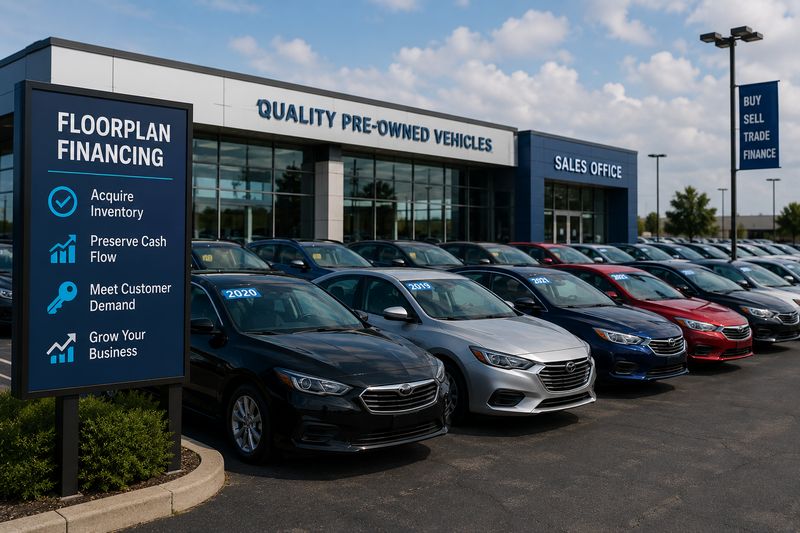
Understanding how floorplan finance works can also help auction buyers and retail consumers better understand how dealerships manage inventory, pricing, and cash flow.
Definition of Floorplan Financing
Floorplan financing is a type of inventory financing specifically designed for vehicle dealers. Instead of paying for every car with their own cash, dealers use a line of credit provided by a lender to purchase inventory.
The lender pays for the vehicle, and the dealer repays the lender after the vehicle is sold.
For example, imagine a small independent dealer finds ten used vehicles at an auction. Purchasing all ten vehicles might require $80,000 to $120,000 in cash. Rather than spending that money upfront, the dealer can use floorplan financing to acquire the vehicles and keep most of their cash available for other expenses.
Each vehicle essentially serves as collateral for the financing. Once the vehicle is sold, the dealer pays back the amount borrowed for that specific unit, along with any applicable interest and fees.
This system allows dealers to maintain inventory without constantly needing large amounts of cash.
Why Floorplan Finance Is Important for Auto Dealers
Without floorplan financing, many dealerships would struggle to maintain enough inventory to attract customers.
Customers want choices. If a dealership only has five vehicles available because cash is limited, buyers may simply shop elsewhere. Floorplan financing helps dealers keep a larger selection of vehicles on the lot.
For example, a dealer may have $100,000 available in cash. Without financing, that might be enough to purchase only eight to ten used vehicles. With floorplan financing, the same dealer may be able to stock 30, 40, or even 50 vehicles.
This larger inventory improves the chances of making sales because customers have more options to choose from.
Floorplan financing also helps dealers manage unexpected opportunities. If a dealer finds several desirable vehicles at a dealer auction or online auction, they can purchase them quickly without waiting to accumulate additional cash.
For growing dealerships, floorplan financing often becomes a critical tool for expansion.
How Floorplan Financing Differs From Traditional Business Loans
Although both provide access to capital, floorplan financing works differently from a traditional business loan.
A traditional business loan typically provides a lump sum of money that can be used for various purposes. The borrower then repays the loan over a fixed schedule regardless of how the funds are used.
Floorplan financing is tied directly to inventory purchases.
Instead of receiving one large loan, dealers receive a revolving credit facility that can be used repeatedly to purchase vehicles. As vehicles are sold and financing is repaid, credit becomes available again for future purchases.
For example, a dealer may have a $500,000 floorplan credit line. They use $300,000 to purchase inventory. As vehicles sell, that credit becomes available again and can be used to acquire additional inventory.
Another key difference is collateral. Traditional business loans may require real estate, equipment, or other assets as collateral. In floorplan financing, the vehicles themselves typically serve as collateral.
This structure makes floorplan financing particularly well suited to inventory-based businesses such as auto dealerships.
The Difference Between Inventory Financing and Floorplan Finance
Many people use the terms inventory financing and floorplan financing interchangeably, but they are not always exactly the same.
Inventory financing is a broad category that refers to any financing used to purchase inventory. Retail stores, wholesalers, equipment dealers, furniture stores, and many other businesses may use inventory financing programs.
Floorplan financing is a specialized form of inventory financing designed specifically for dealerships and businesses that sell high-value items individually.
For example, a furniture retailer may use inventory financing to stock hundreds of sofas and tables. An auto dealer uses floorplan financing to purchase individual vehicles that are tracked separately within the financing program.
Each vehicle financed through a floorplan typically has its own record, purchase amount, interest calculation, and repayment schedule.
In the automotive industry, floorplan financing has become the standard method for funding inventory because it provides flexibility, scalability, and cash flow advantages that traditional inventory financing may not always offer.
How Does Floorplan Financing Work?
Floorplan financing may sound complicated at first, but the concept is fairly simple. It allows dealerships to purchase inventory using a lender's money instead of using all of their own cash. The dealer can then sell the vehicles, repay the financing, and use the available credit to purchase more inventory.
This system creates a cycle that helps dealerships maintain inventory, preserve working capital, and continue growing without constantly needing large amounts of cash. Understanding how floorplan financing works is especially important for independent dealers who buy inventory from online auto auctions and wholesale marketplaces.
Step-by-Step Process of Floorplan Financing
The floorplan financing process follows a predictable cycle.
First, a dealer applies for and receives a floorplan credit line from a lender. The lender evaluates factors such as the dealer's license, business history, financial strength, and inventory needs before approving a credit limit.
Once approved, the dealer can begin purchasing vehicles using the available credit.
For example, a dealer may receive a $300,000 floorplan line. Instead of spending their own cash, they can use that credit to purchase inventory from auctions, wholesalers, or trade-ins.
After the vehicles arrive, they are placed on the dealer's lot and offered for sale.
When a vehicle sells, the dealer repays the amount financed on that specific vehicle. The available credit then increases and can be used to purchase additional inventory.
This process repeats continuously as vehicles are bought and sold.
How Dealers Purchase Vehicles Using Floorplan Credit
Many dealers use floorplan financing to buy vehicles from online auto auctions, wholesale auctions, and dealer-only marketplaces.
For example, a dealer attending an online auction may identify five vehicles with strong resale potential. Rather than paying cash immediately, the dealer uses floorplan credit to fund the purchases.
The lender pays for the vehicles according to the terms of the financing agreement. The vehicles are then added to the dealer's inventory while the financed amount becomes part of the dealer's outstanding floorplan balance.
This approach allows dealers to acquire inventory quickly when opportunities appear.
Imagine a small independent dealer finds ten affordable SUVs selling below market value at auction. Without financing, they may only be able to afford three or four vehicles. With floorplan financing, they may be able to purchase all ten and offer a larger selection to customers.
This flexibility is one of the main reasons floorplan financing has become such a common tool throughout the automotive industry.
How Repayment Works After a Vehicle Is Sold
The repayment process begins when a financed vehicle is sold.
Once the dealership receives payment from the retail customer or another buyer, a portion of those proceeds is used to pay off the floorplan balance associated with that vehicle.
For example, suppose a dealer purchases a vehicle for $12,000 using floorplan financing and later sells it for $15,500. After the sale, the dealer repays the $12,000 financed amount plus any accrued interest and fees. The remaining profit stays with the dealership.
The credit that was used to finance the vehicle becomes available again and can be used for future inventory purchases.
This revolving structure allows dealers to continuously replenish inventory without repeatedly applying for new loans.
Dealers that sell inventory quickly generally benefit the most because their financing costs remain lower and their credit becomes available more rapidly.
What Happens if a Vehicle Does Not Sell Quickly?
Not every vehicle sells immediately.
Some cars remain on dealer lots for weeks or even months before finding a buyer. While the vehicle remains unsold, financing costs continue to accumulate.
For example, a dealer may purchase a luxury SUV expecting it to sell within 30 days. If the vehicle remains unsold for 120 days, the dealer may face multiple months of interest charges and additional financing requirements.
Slow-moving inventory creates several problems.
The dealer continues paying interest.
Capital remains tied up in the vehicle.
The vehicle may depreciate further.
Additional storage, maintenance, and advertising expenses may accumulate.
This is why experienced dealers closely monitor inventory aging and focus on purchasing vehicles that are likely to sell quickly.
Many successful dealers would rather sell ten affordable vehicles rapidly than hold a few expensive vehicles for several months.
Understanding Curtailment Payments
Curtailment payments are one of the most important concepts in floorplan financing.
A curtailment is a required partial repayment that occurs when a vehicle remains financed for an extended period.
For example, a lender may require a dealer to pay 10% of the vehicle's financed balance after 90 days and additional percentages at future intervals if the vehicle remains unsold.
Suppose a dealer financed a vehicle for $20,000. After reaching the lender's aging threshold, the dealer may be required to make a $2,000 curtailment payment even though the vehicle has not yet been sold.
The purpose of curtailments is to reduce lender risk and encourage dealers to move aging inventory.
Vehicles that remain on the lot too long often become less profitable because financing costs increase while market value may decline.
Dealers who fail to manage aging inventory can quickly face cash flow problems due to accumulated curtailment obligations.
Interest Charges and Floorplan Costs Explained
Floorplan financing is not free. Dealers pay interest and various fees in exchange for access to financing.
Interest is usually calculated based on the amount financed and the length of time the vehicle remains in inventory.
The longer a vehicle sits unsold, the more interest the dealer pays.
For example, two dealers may purchase identical vehicles for $10,000. If Dealer A sells the vehicle within 15 days and Dealer B takes 120 days to sell it, Dealer A will likely pay significantly less in financing costs.
In addition to interest, dealers may encounter other expenses such as:
- Floorplan setup fees
- Transaction fees
- Auction funding fees
- Inspection fees
- Audit fees
- Curtailment charges
- Late payment penalties
This is why experienced dealers calculate the total cost of ownership before bidding at auction.
A vehicle purchased below market value can still become unprofitable if financing costs, transportation expenses, repairs, and storage fees are not carefully managed.
Why Auto Dealerships Use Floorplan Finance
Running a successful dealership requires more than simply buying and selling vehicles. Dealers must constantly balance inventory levels, customer demand, operating expenses, and available cash. Even profitable dealerships can face challenges if too much money is tied up in inventory.
Floorplan financing helps solve this problem by allowing dealers to stock vehicles without paying the full purchase price upfront. This financing model has become a standard tool across the automotive industry because it supports inventory growth while helping dealers manage cash flow more effectively.
For both large franchise dealerships and small independent dealers, floorplan financing can provide the flexibility needed to compete in today's market.
Maintaining Inventory Without Large Upfront Costs
One of the biggest reasons dealerships use floorplan financing is to avoid spending large amounts of cash on inventory purchases.
Vehicles are expensive assets. Even a small dealership may need hundreds of thousands of dollars to maintain an attractive inventory selection. Without financing, many dealers would have to limit the number of vehicles they can offer.
For example, a dealer with $150,000 in available cash may only be able to purchase 12 to 15 used vehicles outright. With floorplan financing, that same dealer may be able to stock 40 or more vehicles while keeping most of their cash available for business operations.
This allows dealerships to maintain a professional-looking inventory and provide customers with more choices.
The ability to preserve cash while increasing inventory is one of the primary reasons floorplan financing has become so popular throughout the automotive industry.
Improving Cash Flow Management
Cash flow is often more important than profit when managing a dealership.
A dealer may be profitable on paper but still face financial problems if too much money is tied up in vehicles sitting on the lot. Floorplan financing helps reduce this pressure by spreading inventory costs over time.
Instead of spending large amounts of cash every time inventory is purchased, dealers can use financing and reserve their cash for other business needs.
For example, a dealership still needs money for:
- Employee salaries
- Rent or mortgage payments
- Utilities
- Advertising
- Transportation costs
- Vehicle repairs
- Reconditioning expenses
- Insurance
By using floorplan financing, dealers can maintain healthier cash reserves while continuing to grow inventory.
This flexibility becomes especially valuable during slower sales periods when preserving working capital is critical.
Expanding Vehicle Selection for Customers
Customers want options when shopping for a vehicle.
A dealership with only a handful of vehicles may struggle to attract buyers because customers often compare multiple makes, models, price ranges, and body styles before making a decision.
Floorplan financing allows dealers to offer a larger and more diverse inventory.
For example, a dealer can stock:
- Budget sedans
- Family SUVs
- Pickup trucks
- Luxury vehicles
- Hybrid models
- Compact commuter cars
Without financing, maintaining this variety could require substantial capital.
A larger inventory also increases the likelihood that a customer will find a vehicle that fits their needs and budget. This can lead to higher sales volumes and improved customer satisfaction.
For independent dealers competing against larger franchise stores, inventory variety is often essential for attracting buyers.
Financing Used Cars vs. New Cars
Floorplan financing is commonly used for both new and used vehicle inventory, but the way dealers use it can differ.
Franchise dealerships often use floorplan financing to stock large numbers of new vehicles supplied by manufacturers. These dealers may carry hundreds of vehicles across multiple model lines.
Used vehicle dealers face a different challenge. Inventory is constantly changing, and sourcing opportunities vary from auction to auction.
For example, a used car dealer may purchase inventory from:
- Online auto auctions
- Dealer-only auctions
- Trade-ins
- Wholesale marketplaces
- Fleet sales
Because every vehicle is unique, used vehicle dealers often rely heavily on floorplan financing to react quickly when good buying opportunities appear.
Used vehicles can sometimes produce higher profit margins than new vehicles, but they also require careful management because vehicle values can fluctuate more rapidly.
Floorplan financing gives dealers the flexibility to acquire inventory while managing these risks.
How Independent Dealers Benefit From Floorplan Financing
Independent dealers are often among the biggest beneficiaries of floorplan financing.
Unlike large franchise groups backed by major manufacturers, independent dealers usually operate with more limited financial resources. Growing inventory solely through cash purchases can be slow and difficult.
Floorplan financing allows independent dealers to compete more effectively by increasing purchasing power.
For example, imagine a small dealer attends an online auction and identifies twenty vehicles with strong resale potential. Without financing, they may only be able to purchase five vehicles. With floorplan financing, they may acquire significantly more inventory and generate additional sales opportunities.
This can help independent dealers:
- Grow inventory faster
- Increase vehicle selection
- Improve cash flow
- Respond to market demand
- Expand sales volume
- Build a stronger customer base
Floorplan financing also allows independent dealers to take advantage of opportunities that appear unexpectedly. When desirable inventory becomes available at auction, access to financing can make the difference between securing profitable vehicles and missing the opportunity entirely.
Types of Floorplan Financing for Car Dealers
Not all floorplan financing programs work the same way. Different dealerships have different inventory sources, business models, and financing needs. As a result, lenders have developed multiple types of floorplan financing to serve franchise dealers, independent dealers, auction buyers, wholesalers, and other automotive businesses.
Choosing the right type of floorplan financing can affect a dealership's cash flow, inventory growth, and overall profitability. Understanding the available options helps dealers select a financing solution that matches their business goals and inventory strategy.
New Car Dealer Floorplan Financing
New car dealer floorplan financing is commonly used by franchise dealerships that sell vehicles from major manufacturers.
These dealerships often carry large inventories consisting of hundreds of vehicles. Purchasing all of this inventory with cash would require millions of dollars, making floorplan financing essential.
In many cases, manufacturers work closely with specialized lenders to provide inventory financing programs for authorized dealers.
For example, a franchise dealership selling new pickup trucks, SUVs, and sedans may receive inventory directly from the manufacturer. The floorplan lender finances the vehicles until they are sold to retail customers.
Because new vehicle inventories are generally more predictable, lenders often view franchise dealerships as lower-risk borrowers. This can sometimes result in more favorable financing terms.
New car floorplan programs are typically designed for larger operations with consistent sales volume and established business histories.
Used Car Dealer Floorplan Financing
Used car dealer floorplan financing is specifically designed for dealerships that focus on pre-owned inventory.
Unlike franchise dealers that receive vehicles directly from manufacturers, used car dealers often acquire inventory from multiple sources. This creates more flexibility but also introduces greater complexity.
For example, used car dealers may purchase inventory from:
- Online auto auctions
- Dealer-only auctions
- Wholesale marketplaces
- Trade-ins
- Rental fleet liquidations
- Bank repossessions
Each vehicle may have a different purchase price, condition, mileage, and market demand.
Because used vehicle values can fluctuate more quickly than new vehicle values, lenders often place greater emphasis on inventory management and turnover rates when evaluating financing applications.
For many independent dealerships, used car floorplan financing serves as the primary tool for growing inventory while preserving working capital.
Auction Floorplan Financing
Auction floorplan financing has become increasingly important as online vehicle auctions continue to grow.
This type of financing allows dealers to purchase inventory directly from auctions without immediately paying the full purchase price out of pocket.
For example, a dealer may attend online auctions daily and identify multiple vehicles that fit their target market. Rather than limiting purchases to available cash, the dealer can use floorplan credit to acquire inventory quickly.
Auction floorplan financing is particularly popular among dealers purchasing vehicles from:
- Copart
- IAAI
- Manheim
- Dealer-only auctions
- Regional wholesale auctions
This financing option gives dealers greater flexibility when opportunities arise.
For example, if several high-demand vehicles appear at auction below market value, a dealer with floorplan financing can act immediately instead of missing the opportunity due to cash limitations.
Many small and independent dealers rely heavily on auction floorplan financing to keep inventory flowing throughout the year.
Wholesale Vehicle Financing
Wholesale vehicle financing is designed for businesses that buy and sell vehicles within the wholesale market rather than directly to retail customers.
These companies often move large volumes of vehicles between dealerships, auctions, fleet operators, and other automotive businesses.
Because wholesale transactions often occur quickly and involve multiple units at once, financing requirements can differ from traditional retail dealership operations.
For example, a wholesaler may purchase 50 vehicles from a fleet liquidation sale and resell them to dealers across several states within a short period.
Wholesale financing helps support these transactions by providing access to capital while inventory is being marketed and resold.
Dealers who occasionally participate in wholesale transactions may also use this type of financing to expand inventory acquisition opportunities.
Retail Floor Planning Explained
Retail floor planning refers to the traditional floorplan financing structure used by dealerships that sell vehicles directly to consumers.
In this model, the lender finances individual vehicles while they remain in inventory. The dealer repays the financed amount when each vehicle is sold.
For example, a dealership may have 75 vehicles on its lot, with each unit financed through a retail floorplan agreement. As vehicles are sold, the dealer pays off the associated balances and uses the available credit to purchase replacement inventory.
Retail floor planning is designed to support ongoing inventory turnover.
The faster vehicles sell, the lower the financing costs and the more efficiently the dealership can use its available credit.
This structure has become the standard financing model for many dealerships because it aligns financing activity directly with vehicle sales.
Floorplan Options for Small and Independent Dealers
Small and independent dealerships often have different financing needs than large franchise operations.
Many independent dealers operate with limited capital and smaller inventory volumes. They may also focus on affordable used vehicles that turn quickly rather than high-priced inventory.
As a result, lenders often offer floorplan programs specifically tailored to smaller businesses.
These programs may include:
- Lower credit line requirements
- Smaller inventory minimums
- Flexible repayment structures
- Auction-specific financing options
- Faster approval processes
- Programs designed for newer dealerships
For example, a dealer that sells budget vehicles priced between $5,000 and $15,000 may not need a multimillion-dollar credit facility. A smaller floorplan line can provide enough purchasing power to increase inventory while maintaining manageable risk.
Many successful independent dealers start with modest credit lines and gradually expand as sales volume grows.
This approach allows dealers to gain experience managing financed inventory without becoming overextended.
How Floorplan Finance Works at Auto Auctions
Auto auctions are one of the most important inventory sources for dealerships across the United States. Thousands of vehicles are sold every day through online and physical auctions, creating opportunities for dealers to acquire inventory below retail market prices.
However, auctions move quickly. Good deals can disappear within seconds, and dealers often need immediate purchasing power to secure desirable inventory. This is one reason floorplan financing has become closely connected to auction buying.
Many dealers use floorplan credit specifically to purchase vehicles at auctions, allowing them to increase inventory without tying up large amounts of cash. When managed correctly, auction floorplan financing can help dealers grow inventory, improve cash flow, and increase profits.
Using Floorplan Credit at Online Auto Auctions
Online auto auctions have transformed the way dealers buy inventory.
Instead of traveling to multiple auction locations, dealers can now browse thousands of vehicles and place bids from their office, home, or dealership. This convenience has increased competition but also created more buying opportunities.
Floorplan financing allows dealers to participate in these auctions without being limited by available cash.
For example, a dealer may have $50,000 in cash but access to a $300,000 floorplan line. This gives them the ability to bid on more vehicles and react quickly when attractive opportunities appear.
Once the dealer wins a vehicle, the floorplan provider funds the purchase according to the financing agreement. The vehicle is then added to inventory while the dealer repays the financing after the vehicle is sold.
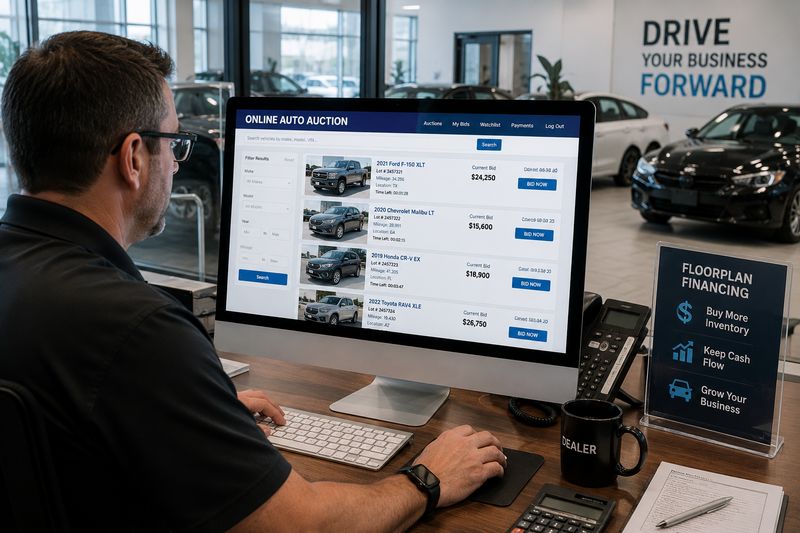
This process allows dealers to continuously replenish inventory without repeatedly using their own capital.
For many dealerships, auction buying and floorplan financing work hand in hand.
Buying Inventory From Copart, IAAI, Manheim, and Dealer Auctions
Dealers source inventory from several major auction platforms, each serving different market segments.
Many dealers use auctions such as Copart and IAAI to purchase damaged, repairable, repossessed, or salvage vehicles.
Others rely on Manheim and dealer-only auctions to acquire clean-title inventory suitable for immediate retail sale.
Each auction source offers different opportunities and risks.
For example:
- Copart may offer lower acquisition costs but potentially higher repair expenses.
- IAAI may provide access to insurance vehicles with varying damage levels.
- Manheim often focuses on dealer trade-ins, lease returns, and wholesale inventory.
- Regional dealer auctions may provide opportunities to acquire local inventory quickly.
Floorplan financing gives dealers flexibility to purchase from multiple sources without needing separate cash reserves for each auction.
This allows dealerships to diversify inventory and respond more effectively to customer demand.
Why Budget Dealers Use Auction Floorplan Financing
Many small and budget-focused dealerships depend heavily on auction floorplan financing.
Unlike large franchise dealerships, independent dealers often operate with limited capital. Their business model frequently relies on buying affordable vehicles, reconditioning them, and selling them quickly.
For example, a small dealer may specialize in vehicles priced between $5,000 and $15,000. Their goal is often rapid inventory turnover rather than large profit margins on individual vehicles.
Floorplan financing helps these dealers purchase more inventory than their available cash would otherwise allow.
Instead of buying five vehicles, they may be able to purchase fifteen or twenty. This larger inventory increases sales opportunities and improves the chances of finding vehicles that match customer preferences.
For budget dealers, maintaining inventory turnover is often more important than maintaining large profit margins on individual units. Auction floorplan financing supports this strategy by providing consistent access to inventory.
Risks of Overpaying at Auction
While floorplan financing increases purchasing power, it can also create risks if dealers are not disciplined.
One of the biggest mistakes dealers make is overpaying at auction.
The availability of financing can sometimes create a false sense of affordability. Because the dealer is not immediately spending cash, it may be tempting to bid beyond the vehicle's realistic resale value.
For example, a dealer may become involved in a bidding war for a popular SUV. Winning the vehicle feels like a success, but if the purchase price leaves little room for profit after repairs, transportation, and financing costs, the deal may become unprofitable.
Overpaying creates several problems:
- Reduced profit margins
- Higher financing costs
- Increased inventory aging risk
- Greater exposure to market depreciation
- Cash flow pressure from curtailment payments
Experienced dealers establish maximum bid limits before entering an auction and refuse to exceed them.
Successful auction buying is often about disciplined purchasing rather than winning the most bids.
How Dealers Manage Transportation and Reconditioning Costs
The auction purchase price is only one part of a vehicle's total cost.
Many new dealers focus solely on the winning bid and overlook the additional expenses required to prepare inventory for sale.
For example, after purchasing a vehicle at auction, a dealer may face:
- Auction fees
- Buyer fees
- Transportation charges
- Storage fees
- Mechanical repairs
- Bodywork expenses
- Tire replacement
- Detailing costs
- State inspection fees
These costs can significantly affect profitability.
Imagine a dealer purchases a vehicle for $8,000 at auction. Transportation costs $700, auction fees add another $600, and reconditioning requires $1,500. The true vehicle cost is now $10,800 before any financing expenses are considered.
Successful dealers calculate total landed cost before placing bids.
Many also work with trusted transport providers and repair facilities to control expenses and speed up inventory preparation.
The goal is not simply to buy vehicles cheaply. The goal is to understand exactly how much each vehicle will cost before it is ready for sale.
Requirements to Qualify for Floorplan Financing
Floorplan financing can be a powerful tool for growing a dealership, but not every business automatically qualifies for it. Because lenders are financing inventory that may remain unsold for weeks or months, they carefully evaluate each dealer before approving a credit line.
The exact requirements vary between lenders, but most providers review a combination of licensing, business history, financial strength, sales performance, and available collateral. Understanding these requirements can help dealers prepare for the application process and improve their chances of approval.
Dealer License Requirements
A valid dealer license is usually the first requirement for obtaining floorplan financing.
Most lenders only work with licensed vehicle dealers because floorplan financing is specifically designed for businesses that buy and sell vehicles as inventory.
For example, an individual who occasionally buys and sells personal vehicles generally will not qualify for dealer floorplan financing. The lender expects the applicant to operate a legitimate dealership that complies with state regulations.
Requirements may vary by state, but dealers typically need:
- An active dealer license
- A registered business entity
- A physical business location
- Compliance with local regulations
- Any required state permits or registrations
Lenders often verify licensing status before considering other aspects of the application.
For new dealers, obtaining the proper license is usually the first step toward accessing inventory financing.
Business Credit and Financial History
Lenders want evidence that a dealership can manage debt responsibly.
One of the main tools used to evaluate this is business credit history. Strong credit demonstrates that the dealership has successfully handled financial obligations in the past.
For example, lenders may review:
- Business credit reports
- Existing loans
- Payment history
- Outstanding debt
- Banking relationships
- Financial statements
A dealership with a history of on-time payments and responsible borrowing is generally viewed as a lower-risk applicant.
New dealerships without established business credit may face additional scrutiny. In these cases, lenders often rely more heavily on the owner's personal financial profile.
Even if a dealer is profitable, poor credit history can make approval more difficult or result in higher financing costs.
Minimum Time in Business
Many floorplan lenders prefer to work with businesses that have already demonstrated operational stability.
As a result, some lenders require dealerships to be in business for a minimum period before approving financing.
For example, a lender may prefer dealers that have operated for six months, one year, or longer.
The reasoning is simple. A dealership that has already survived its early stages is often viewed as less risky than a newly formed business.
However, not all lenders have strict time-in-business requirements. Some specialize in helping newer dealers and may offer smaller credit lines designed for startups.
For example, a new independent dealer might begin with a modest floorplan facility and gradually qualify for larger credit limits as sales volume increases.
The longer a dealership operates successfully, the easier it often becomes to obtain favorable financing terms.
Inventory and Sales Volume Requirements
Lenders want to see evidence that inventory can be sold efficiently.
A dealership that consistently buys vehicles but struggles to sell them creates greater risk than one with strong inventory turnover.
For this reason, many lenders evaluate factors such as:
- Monthly sales volume
- Inventory turnover rate
- Average days to sell a vehicle
- Current inventory levels
- Gross profit margins
For example, a dealer selling 25 vehicles per month may be viewed more favorably than a dealer selling only three or four vehicles monthly.
Strong sales performance demonstrates that inventory is moving and financing balances are likely to be repaid quickly.
Lenders may also use inventory levels to determine an appropriate credit limit. A dealer with a 20-car lot typically requires a different financing structure than a dealer managing 200 vehicles.
The goal is to align financing capacity with actual business activity.
Down Payments and Reserve Requirements
Some floorplan lenders require dealers to contribute their own funds toward inventory purchases.
This contribution may come in the form of a down payment, equity participation, or reserve account.
For example, a lender may finance 90% of a vehicle's purchase price while requiring the dealer to provide the remaining 10%.
This reduces lender risk and ensures the dealer has financial commitment to the inventory.
In addition to down payments, lenders may require reserve funds to remain available within the business.
These reserves act as a financial cushion that can help cover:
- Interest payments
- Curtailment obligations
- Unexpected expenses
- Market downturns
- Temporary sales slowdowns
A dealership with strong cash reserves is generally viewed as more financially stable than one operating with minimal available funds.
Maintaining adequate reserves can improve approval chances and may help dealers qualify for larger credit lines.
Personal Guarantees and Collateral
Especially for small and independent dealerships, lenders often require personal guarantees from business owners.
A personal guarantee means the owner agrees to take responsibility for the debt if the business cannot repay it.
From the lender's perspective, this adds another layer of protection and demonstrates the owner's confidence in the business.
For example, if a dealership defaults on its floorplan obligations, the lender may have legal rights to pursue repayment from the guarantor according to the terms of the agreement.
Collateral is another important consideration.
In most floorplan arrangements, the financed vehicles themselves serve as primary collateral. If a dealer fails to meet repayment obligations, the lender may have the right to repossess inventory.
Some lenders may also consider additional collateral depending on the size of the credit facility and the dealership's financial profile.
While personal guarantees and collateral requirements may seem intimidating, they are common throughout the lending industry and help lenders manage risk when providing substantial inventory financing.
Key Metrics Dealers Should Track Before Using Floorplan Finance
Floorplan financing can help dealerships grow inventory and increase sales opportunities, but it also adds financial responsibility. Before taking on inventory financing, dealers should understand the key performance metrics that affect profitability and cash flow.
Many dealers focus only on how much inventory they can buy. However, successful dealerships pay close attention to how quickly vehicles sell, how much profit they generate, and whether cash flow can support financing costs.
Tracking the right metrics helps dealers make smarter inventory decisions, avoid unnecessary financing expenses, and reduce the risk of carrying vehicles that sit unsold for long periods.
Average Monthly Vehicle Sales
One of the most important numbers any dealer should know is average monthly vehicle sales.
This metric shows how many vehicles the dealership typically sells each month and helps determine how much inventory is actually needed.
For example, if a dealership sells 20 vehicles per month, there may be little reason to finance 80 vehicles. Excess inventory often leads to higher interest costs and slower turnover.
Lenders also review sales volume when evaluating floorplan applications. Strong and consistent sales suggest that financed inventory is likely to move quickly and generate repayment cash flow.
Dealers should track sales over several months rather than relying on a single strong month. This provides a more realistic picture of long-term performance.
Inventory Turnover Rate
Inventory turnover measures how efficiently a dealership converts inventory into sales.
A high turnover rate generally indicates healthy inventory management, while a low turnover rate may signal that vehicles are sitting too long and accumulating financing costs.
For example, Dealer A sells through inventory every 45 days, while Dealer B takes 120 days. Even if both dealers sell the same number of vehicles annually, Dealer A will typically incur lower floorplan costs and generate cash more efficiently.
Strong inventory turnover is often one of the clearest indicators that a dealership is ready to benefit from floorplan financing.
Dealers should focus not only on acquiring inventory but also on how quickly that inventory can be sold.
Average Days to Sell a Vehicle
Closely related to turnover is the average number of days required to sell a vehicle.
This metric tracks how long inventory remains on the lot before being sold.
For example, a dealer specializing in affordable commuter vehicles may average 30 to 45 days per sale. Another dealer focusing on luxury vehicles may average 90 days or more.
The longer vehicles remain unsold, the more financing costs accumulate.
Floorplan interest, curtailments, insurance expenses, and depreciation all increase as inventory ages.
Monitoring average days to sell helps dealers identify inventory categories that move quickly and those that create unnecessary carrying costs.
Many successful dealers build their auction-buying strategy around vehicles that consistently sell within a predictable timeframe.
Average Used Vehicle Price
The average purchase price of inventory has a direct impact on financing needs.
Higher-priced vehicles consume more floorplan credit and often carry larger interest expenses.
For example, a dealer purchasing vehicles at an average cost of $8,000 can typically stock far more units than a dealer purchasing vehicles averaging $25,000 each.
Budget-focused dealerships often benefit from concentrating on affordable vehicles with strong demand because they can diversify inventory while maintaining manageable financing exposure.
Tracking average vehicle cost also helps dealers determine how much floorplan capacity they actually need.
A dealership that understands its average acquisition cost can better forecast inventory requirements and avoid overextending credit lines.
Number of Vehicles on the Lot
The total number of vehicles in inventory is another important metric.
Many new dealers assume that larger inventory automatically leads to more sales. In reality, carrying excessive inventory can increase costs without improving profitability.
For example, a dealer selling 15 vehicles per month may not need 80 vehicles on the lot. The additional units may simply generate higher floorplan interest and greater aging inventory risk.
Dealers should align inventory levels with actual sales volume.
A balanced inventory allows customers to choose from multiple options without burdening the business with unnecessary carrying costs.
Regularly monitoring inventory size helps prevent overbuying and supports healthier cash flow management.
Gross Profit Per Vehicle
Profitability matters just as much as sales volume.
A dealership may sell many vehicles each month but still struggle financially if profit margins are too small to cover financing expenses and operating costs.
Gross profit per vehicle measures how much money remains after accounting for acquisition costs and direct vehicle expenses.
For example, if a dealer purchases a vehicle for $10,000 and sells it for $13,500, the gross profit is not necessarily $3,500. Transportation, auction fees, reconditioning, and financing costs must also be considered.
Tracking gross profit helps dealers identify which inventory segments produce the strongest returns.
Many successful dealers focus on vehicles that provide consistent profit margins rather than simply pursuing high sales volume.
Cash Flow Stability
Floorplan financing depends heavily on stable cash flow.
Even profitable dealerships can encounter difficulties if cash enters the business inconsistently.
For example, a dealer may have significant profits tied up in vehicles that have not yet sold. Meanwhile, financing payments, payroll, rent, and operating expenses continue.
Cash flow stability measures the dealership's ability to consistently meet financial obligations while carrying financed inventory.
Dealers should monitor:
- Monthly revenue trends
- Operating expenses
- Available cash reserves
- Inventory aging
- Debt obligations
Strong cash flow reduces the risk of missed payments and provides flexibility during slower sales periods.
Before increasing inventory through floorplan financing, dealers should ensure their cash flow can comfortably support additional obligations.
Reconditioning and Repair Costs
One of the most commonly overlooked metrics is reconditioning expense.
Many dealers focus heavily on purchase price while underestimating the cost of preparing vehicles for retail sale.
For example, a vehicle purchased at auction for $7,500 may require:
- Tires
- Brake work
- Mechanical repairs
- Paint correction
- Detailing
- Safety inspections
These costs can quickly add thousands of dollars to the true vehicle investment.
When combined with floorplan interest and auction fees, excessive reconditioning expenses can significantly reduce profitability.
Successful dealers carefully track average repair costs and factor them into every purchasing decision.
Many experienced auction buyers establish maximum repair budgets before bidding to ensure vehicles remain profitable after all expenses are considered.
Strategic Benefits of Floorplan Financing
When used responsibly, floorplan financing can do much more than simply help dealers buy inventory. It can become a strategic tool that supports growth, improves cash flow, and allows dealerships to compete more effectively in a changing market.
Many successful dealerships view floorplan financing as a way to increase flexibility rather than simply borrow money. By preserving cash and expanding purchasing power, dealers can respond faster to opportunities and maintain a stronger inventory position.
For independent dealers and auction buyers, these advantages can make a significant difference in profitability and long-term growth.
Keeping More Working Capital Available
One of the biggest strategic advantages of floorplan financing is preserving working capital.
Every dealership has ongoing expenses beyond vehicle purchases. Rent, payroll, advertising, transportation, insurance, and repairs all require cash. If too much money is tied up in inventory, a dealership may struggle to cover these operating costs.
For example, a dealer with $250,000 in available cash could spend nearly all of it purchasing inventory. While the lot might be full of vehicles, there would be little cash left for daily operations.
With floorplan financing, that same dealer can acquire inventory while keeping much of their cash available for business needs.
This flexibility can be especially valuable during slower sales periods or unexpected market disruptions when access to cash becomes critical.
Strong working capital often provides more financial stability than simply owning a large inventory outright.
Growing Inventory Faster
Floorplan financing allows dealerships to grow inventory much faster than relying solely on cash purchases.
Without financing, inventory growth is often limited by how quickly the dealership generates profits and accumulates cash reserves. This process can take years.
With floorplan financing, dealers gain immediate purchasing power that can accelerate growth.
For example, a dealer with enough cash to purchase ten vehicles may be able to stock thirty or forty vehicles using a floorplan credit line. This larger inventory creates more opportunities to attract customers and generate sales.
The ability to scale inventory quickly is especially important for growing dealerships that are trying to establish a stronger market presence.
Many successful independent dealers use floorplan financing as a tool to expand inventory while maintaining healthy cash reserves.
Responding to Market Demand Changes
Vehicle demand can change rapidly.
Fuel prices, economic conditions, seasonal trends, and consumer preferences all influence which vehicles sell quickly and which remain on the lot.
Dealers who have access to floorplan financing can respond more quickly when market conditions shift.
For example, rising fuel prices may suddenly increase demand for compact cars and fuel-efficient sedans. A dealer with available floorplan credit can immediately begin acquiring more of these vehicles at auction.
Similarly, growing demand for SUVs or pickup trucks may create opportunities that require rapid inventory adjustments.
Without financing, dealers may miss these opportunities because their available cash is already tied up in existing inventory.
Floorplan financing provides the flexibility needed to adapt inventory strategies as market conditions evolve.
Improving Competitive Advantage
Inventory selection is one of the most important factors influencing dealership competitiveness.
Customers often compare multiple dealerships before making a purchase. If one dealer offers significantly more choices, buyers are more likely to visit that location first.
Floorplan financing helps dealers maintain broader and more diverse inventory.
For example, instead of offering only economy sedans, a dealership may be able to stock:
- Compact cars
- SUVs
- Pickup trucks
- Luxury vehicles
- Hybrid models
- Family vehicles
This wider selection increases the likelihood that customers will find a vehicle that fits their needs and budget.
A larger inventory also creates stronger online visibility. More vehicles listed on marketplaces and dealership websites often lead to more customer inquiries and showroom traffic.
For independent dealers competing against larger franchise stores, inventory diversity can provide a significant competitive advantage.
Increasing Sales Opportunities
Every vehicle on a dealership lot represents a potential sale.
The more inventory a dealer can offer, the greater the chance of matching customer preferences.
For example, two customers may arrive looking for completely different vehicles. One wants an affordable commuter sedan, while the other wants a three-row SUV for a growing family.
A dealership with limited inventory may lose one or both sales opportunities.
A dealership with a larger inventory financed through floorplan credit has a much better chance of satisfying both customers.
This increased inventory availability often leads to:
- Higher sales volume
- More repeat customers
- Greater referral business
- Improved customer satisfaction
Many dealers discover that inventory growth directly supports revenue growth when managed properly.
The key is maintaining a balance between inventory size and inventory turnover.
Managing Seasonal Demand More Effectively
Vehicle demand often changes throughout the year.
Certain vehicle types perform better during specific seasons, and successful dealers adjust inventory accordingly.
For example:
- Convertibles often attract more interest during warmer months.
- Four-wheel-drive trucks and SUVs may become more popular before winter.
- Tax refund season often increases demand for affordable used vehicles.
- Commercial vehicles may see stronger demand during certain business cycles.
Floorplan financing allows dealers to prepare for these seasonal trends in advance.
For example, a dealer anticipating increased demand for budget vehicles during tax season can purchase additional inventory before customer traffic increases.
Without financing, acquiring extra inventory at the right time may not be possible.
This ability to adjust inventory levels ahead of seasonal demand can help dealerships maximize sales opportunities while reducing the risk of stock shortages.
Risks and Challenges of Floorplan Finance
Floorplan financing can help dealerships grow faster and stock more inventory, but it is not without risk. When managed properly, it can support expansion and improve cash flow. When managed poorly, it can quickly create financial pressure and profitability problems.
Many dealerships run into trouble not because floorplan financing is inherently bad, but because they underestimate the costs and risks associated with carrying inventory. Interest charges, aging vehicles, market fluctuations, and slower sales can all affect a dealer's ability to manage financed inventory successfully.
Understanding these risks is essential before increasing inventory through floorplan credit.
Rising Interest Rates and Carrying Costs
One of the most significant risks associated with floorplan financing is rising interest expense.
Floorplan financing is rarely a fixed cost. Interest rates can change over time, especially during periods of economic uncertainty or rising borrowing costs.
For example, a dealer may build a business model around a certain financing cost. If interest rates increase, every vehicle sitting on the lot becomes more expensive to carry.
Even a small increase in rates can have a noticeable impact when dozens or hundreds of vehicles are financed.
Higher carrying costs reduce profit margins because more money must be paid to the lender before the dealership can keep the profit from a sale.
This is why successful dealers closely monitor financing expenses and adjust purchasing strategies when borrowing costs increase.
The longer vehicles remain unsold, the greater the impact of rising interest rates on profitability.
Aging Inventory Problems
Inventory aging is one of the most common challenges dealerships face.
Every day a vehicle remains unsold, it continues generating costs. Interest accrues, insurance remains active, and the vehicle occupies valuable lot space.
For example, a dealer may purchase a used SUV expecting it to sell within 30 days. If it remains on the lot for six months, the dealer may face hundreds or even thousands of dollars in additional carrying costs.
Aging inventory can also create pricing pressure.
As newer inventory enters the market, older vehicles may become less attractive to buyers. Dealers often respond by lowering prices, which reduces profit margins even further.
Many lenders also require curtailment payments on vehicles that remain financed for extended periods.
As a result, aging inventory can create a combination of:
- Higher interest costs
- Curtailment obligations
- Increased depreciation
- Reduced profitability
- Cash flow pressure
Successful dealerships actively monitor inventory age and take action before vehicles become long-term liabilities.
Overleveraging and Excess Inventory
Access to financing can sometimes encourage dealers to buy more inventory than their business can realistically support.
This is known as overleveraging.
For example, a dealer may qualify for a $1 million floorplan line and assume they should use the entire amount immediately. However, if sales volume does not justify that inventory level, problems can develop quickly.
More inventory does not automatically mean more profit.
Excess inventory often leads to:
- Slower turnover
- Higher carrying costs
- Increased interest expense
- Greater depreciation exposure
- More cash flow strain
Many new dealers mistakenly focus on filling every available lot space rather than managing inventory efficiently.
Experienced operators understand that inventory quality and turnover are often more important than inventory quantity.
A smaller inventory that sells quickly is usually more profitable than a larger inventory that sits unsold.
Late Payments and Default Risks
Floorplan financing agreements come with strict repayment requirements.
When vehicles are sold, lenders expect prompt repayment of the financed balance. Dealers must also remain current on interest charges, curtailment payments, and other financing obligations.
If cash flow problems develop, meeting these requirements can become difficult.
For example, a dealership experiencing slower sales may struggle to generate enough cash to cover both operating expenses and financing payments.
Late payments can result in:
- Additional fees
- Higher borrowing costs
- Reduced credit availability
- Damage to business credit
- Increased lender oversight
In severe cases, continued payment problems can lead to default.
If a dealer defaults, lenders may have the right to repossess financed inventory and take legal action according to the financing agreement.
Maintaining strong cash flow and conservative inventory levels is often the best defense against repayment problems.
Market Depreciation on Used Vehicles
Used vehicle values can change quickly.
Market conditions, fuel prices, economic trends, consumer demand, and seasonal factors all influence vehicle pricing.
A vehicle purchased today may be worth significantly less several months later.
For example, a dealer may purchase a truck during a period of strong demand. If market conditions shift and truck prices decline, the dealership may have to lower its asking price to remain competitive.
This becomes particularly problematic when financing costs continue accumulating while vehicle values decrease.
The dealer may eventually find that the vehicle can only be sold at a much smaller profit than originally expected.
In some situations, depreciation can completely eliminate profit margins.
This is why successful dealers constantly monitor market trends and avoid holding inventory longer than necessary.
Economic Uncertainty and Slower Sales
Broader economic conditions can have a major impact on floorplan financing performance.
During periods of economic uncertainty, consumers often delay major purchases. Higher interest rates, inflation, unemployment concerns, and reduced consumer confidence can all contribute to slower vehicle sales.
For example, a dealership that normally sells 25 vehicles per month may suddenly sell only 15. Inventory begins accumulating while financing costs continue growing.
The result is increased pressure on cash flow and profitability.
Economic slowdowns often create a difficult combination of:
- Reduced customer demand
- Longer inventory aging
- Higher financing costs
- Lower profit margins
- Increased repayment pressure
Dealers who rely heavily on financing without maintaining adequate cash reserves may struggle during these periods.
This is why many experienced dealers maintain conservative inventory levels and strong cash positions, even when business conditions are favorable.
Floorplan Financing Fees and Costs Explained
Many dealers focus on the benefits of floorplan financing, but understanding the costs is just as important. A floorplan line can help a dealership grow inventory and improve cash flow, yet every financed vehicle comes with expenses that affect profitability.
Successful dealers do not evaluate a vehicle based solely on its purchase price. They calculate the total cost of acquiring, transporting, financing, repairing, and selling that vehicle. Small costs can add up quickly, especially when dozens of vehicles are financed at the same time.
Before using floorplan financing, dealers should understand every fee that may affect their bottom line.
Interest Rates and APR
Interest is usually the largest direct cost associated with floorplan financing.
Just like any other type of financing, lenders charge interest on the money used to purchase inventory. The amount paid depends on factors such as the interest rate, the size of the credit line, and how long each vehicle remains financed.
For example, if a dealer purchases a vehicle using floorplan credit and sells it within two weeks, the interest cost may be relatively small. If that same vehicle remains unsold for four or five months, the interest expense can increase significantly.
Some lenders advertise attractive interest rates, but dealers should pay attention to the Annual Percentage Rate (APR), which reflects the overall cost of borrowing.
When comparing floorplan providers, dealers should evaluate:
- Interest rates
- APR
- Promotional periods
- Variable versus fixed rates
- Minimum finance charges
- Payment schedules
A slightly lower rate can save thousands of dollars annually for dealerships carrying large inventories.
Auction and Transaction Fees
Every vehicle purchased at auction typically comes with additional fees beyond the winning bid.
Many new dealers underestimate these expenses and focus only on the purchase price. In reality, auction fees can significantly increase the total acquisition cost.
Common auction-related expenses include:
- Buyer fees
- Internet bidding fees
- Gate fees
- Documentation fees
- Administrative fees
- Payment processing fees
For example, a dealer may win a vehicle for $8,000 at auction. After auction fees are added, the actual acquisition cost may exceed $8,800 or $9,000 before transportation is even considered.
Some floorplan lenders also charge transaction fees each time inventory is funded.
These charges may seem small individually, but they can add up quickly when a dealership purchases large numbers of vehicles each month.
Successful dealers include every transaction fee when calculating expected profit margins.
Curtailment Fees
Curtailments are partial principal payments required when vehicles remain financed beyond a certain period.
Most floorplan lenders do not want inventory sitting indefinitely. To reduce risk, they require dealers to begin paying down financed balances as vehicles age.
For example, a lender may require:
- A 10% curtailment after 90 days
- Another 10% after 120 days
- Additional payments at later intervals
If a dealer finances a vehicle for $15,000, a 10% curtailment would require a $1,500 payment even if the vehicle has not yet been sold.
While curtailments reduce outstanding debt, they also place pressure on cash flow.
Dealers with excessive aging inventory can quickly find themselves making large curtailment payments across multiple vehicles.
This is one reason inventory turnover is so important when using floorplan financing.
Audit and Inspection Costs
Most floorplan lenders conduct regular audits to verify inventory and protect their investment.
During these audits, lenders confirm that financed vehicles remain in inventory and that recently sold vehicles have been properly paid off.
Audits help prevent fraud and ensure compliance with financing agreements.
Some lenders perform:
- Monthly audits
- Quarterly audits
- Random inventory checks
- Physical lot inspections
- Electronic inventory verification
Depending on the financing program, audit expenses may be charged directly to the dealership.
For example, a lender may assess recurring audit fees to cover administrative and inspection costs.
Although these fees are often relatively small compared to interest expenses, they should still be included when evaluating the total cost of financing.
Transportation and Storage Expenses
Transportation is often one of the largest non-financing costs associated with auction inventory.
After purchasing a vehicle, dealers must move it from the auction location to their dealership or reconditioning facility.
For example, a vehicle purchased several states away may require:
- Open carrier transportation
- Enclosed transportation
- Port transportation
- Local towing
- Temporary storage
Shipping costs can range from a few hundred dollars to well over $1,000 depending on distance and vehicle type.
Storage expenses can also become significant if vehicles remain at auction facilities beyond free storage periods.
Many auctions charge daily storage fees for vehicles that are not picked up promptly.
When transportation and storage costs are combined with financing expenses, the total investment can increase substantially.
Experienced dealers calculate these costs before placing bids rather than after the purchase has already been made.
Hidden Costs Dealers Should Watch For
Some of the most expensive costs associated with floorplan financing are the ones dealers fail to anticipate.
Hidden costs often erode profit margins because they are not included in initial purchase calculations.
Examples may include:
- Late payment penalties
- Additional interest charges
- Extended storage fees
- Vehicle depreciation
- Unexpected repairs
- Insurance expenses
- Compliance fees
- Reconditioning overruns
- Title processing delays
- Reduced resale values
Consider a dealer who purchases a vehicle expecting a $3,000 profit. After financing charges, transportation, auction fees, additional repairs, and price reductions, the actual profit may shrink dramatically.
This is why experienced dealers focus on total vehicle cost rather than purchase price alone.
Before bidding, many successful dealers calculate:
Purchase Price + Auction Fees + Transportation + Reconditioning + Financing Costs + Selling Expenses = Total Investment
Only after determining the total investment do they estimate potential profit.
Floorplan Finance vs. Other Dealer Financing Options
Dealerships have several ways to finance their operations and inventory. Floorplan financing is one of the most common options in the automotive industry, but it is not the only source of funding available.
Some dealers use traditional bank loans, while others rely on business lines of credit or general inventory financing programs. Each option has advantages and disadvantages depending on the dealership's size, inventory strategy, cash flow needs, and growth goals.
Understanding how floorplan financing compares to other financing methods can help dealers choose the solution that best fits their business model.
Floorplan Finance vs. Traditional Bank Loans
Traditional bank loans and floorplan financing both provide access to capital, but they are designed for very different purposes.
A traditional business loan typically provides a lump sum of money that is repaid over a fixed period through scheduled payments. The funds can often be used for various business purposes, including facility improvements, equipment purchases, marketing, or working capital.
For example, a dealer might obtain a $250,000 bank loan to renovate a showroom, purchase equipment, or expand operations.
Floorplan financing works differently.
Instead of providing a single lump sum, it creates a revolving credit facility specifically designed for inventory purchases. The dealer uses the credit to acquire vehicles and repays the financed balance when each vehicle is sold.
Key differences include:
- Bank loans provide fixed funding amounts.
- Floorplan financing revolves as inventory is sold.
- Bank loans may be secured by business assets.
- Floorplan financing is usually secured by inventory.
- Bank loans are often used for long-term investments.
- Floorplan financing is designed for ongoing inventory acquisition.
For dealers focused primarily on purchasing vehicles, floorplan financing is often more flexible and practical than a traditional loan.
Floorplan Finance vs. Business Lines of Credit
A business line of credit is another popular financing option for dealerships.
Like floorplan financing, a line of credit provides access to funds that can be borrowed as needed. The dealer only pays interest on the amount used rather than the full credit limit.
For example, a dealer may have a $100,000 line of credit and use only $30,000 when needed.
The biggest difference is flexibility.
A business line of credit can generally be used for almost any business purpose, including:
- Payroll
- Advertising
- Repairs
- Rent
- Equipment
- Inventory purchases
Floorplan financing is much more specialized. It is designed specifically for vehicle inventory and often offers larger purchasing capacity for dealerships.
For example, a lender may be willing to provide a dealer with a $500,000 floorplan facility because the inventory serves as collateral. Obtaining a general-purpose line of credit at the same level may be more difficult.
Many successful dealerships actually use both financing tools. Floorplan financing supports inventory purchases, while a business line of credit provides flexibility for operating expenses.
Floorplan Finance vs. Inventory Loans
Inventory loans and floorplan financing are closely related, which sometimes causes confusion.
Both involve financing inventory purchases, but the structure is often different.
A traditional inventory loan may provide financing for inventory as a group rather than tracking individual units.
For example, a retailer may receive financing to purchase a large amount of merchandise and repay the loan according to a fixed schedule.
Floorplan financing is generally more detailed and inventory-specific.
Each vehicle is typically tracked separately within the financing system. Interest, repayment requirements, and inventory audits are often tied to individual units.
For example, a dealership may finance 40 vehicles. Each vehicle has its own acquisition cost, funding date, interest calculation, and repayment requirement.
This structure works particularly well in the automotive industry because every vehicle is unique.
Factors such as:
- Make and model
- Mileage
- Vehicle condition
- Market value
- Reconditioning needs
can vary significantly from one unit to another.
For dealerships, floorplan financing is often considered a specialized form of inventory financing built specifically for vehicle inventory management.
Which Financing Option Is Best for Small Dealers?
There is no single financing solution that works for every dealership.
The best choice depends on the dealer's goals, inventory strategy, financial strength, and business stage.
For many small and independent dealers, floorplan financing offers significant advantages because it directly supports inventory growth without requiring large upfront cash investments.
For example, a dealer with limited capital may use floorplan financing to stock 20 vehicles instead of five. This larger inventory can generate more sales opportunities and improve competitiveness.
However, some small dealers may benefit from alternative financing options in certain situations.
A traditional bank loan may be more appropriate if the primary goal is:
- Expanding facilities
- Purchasing equipment
- Renovating a dealership
- Funding long-term business investments
A business line of credit may be useful when flexible access to working capital is needed for day-to-day operations.
Many successful dealers eventually combine multiple financing tools.
For example:
- Floorplan financing for inventory
- Line of credit for operating expenses
- Bank loans for expansion projects
For first-time dealers, starting with a smaller floorplan facility is often a practical approach. This allows them to learn inventory management, understand financing costs, and build a track record before expanding borrowing capacity.
How Dealers Can Reduce Floorplan Costs
Floorplan financing can help dealerships grow, but the cost of carrying inventory can quickly reduce profits if it is not managed carefully. Every day a vehicle sits unsold, financing expenses continue to accumulate. Interest charges, curtailments, depreciation, and storage costs can all affect the dealership's bottom line.
The good news is that many floorplan costs can be controlled through smart inventory management and disciplined buying practices. Successful dealers focus on inventory turnover, market demand, and total acquisition costs rather than simply filling every available space on the lot.
By following a few key strategies, dealerships can significantly reduce financing expenses and improve profitability.
Buying Faster-Selling Vehicles
One of the simplest ways to lower floorplan costs is to purchase vehicles that sell quickly.
The faster a vehicle sells, the less time it spends generating interest charges and carrying costs. This improves cash flow and allows dealers to reuse their available credit more efficiently.
For example, a reliable used sedan priced for budget-conscious buyers may sell within a few weeks. A highly specialized luxury vehicle may take several months to find the right customer.
Even if both vehicles generate similar profit margins, the faster-selling vehicle often produces a better return because financing costs remain lower.
Many successful dealers build their inventory around vehicles with strong demand and predictable turnover.
Examples often include:
- Affordable commuter cars
- Popular midsize sedans
- Family SUVs
- Fuel-efficient vehicles
- Reliable pickup trucks
Focusing on vehicles that consistently move quickly helps reduce inventory aging and financing expenses.
Monitoring Market Trends and Demand
Consumer preferences change constantly.
A vehicle that sold quickly six months ago may not be in high demand today. Dealers who closely monitor market trends are often better positioned to purchase inventory that matches current buyer demand.
For example, rising fuel prices may increase demand for compact vehicles and hybrids. Changes in weather patterns may affect demand for trucks, SUVs, or all-wheel-drive vehicles.
Dealers who understand these trends can make more informed purchasing decisions.
Helpful indicators include:
- Auction sales results
- Local market demand
- Online search activity
- Seasonal buying patterns
- Competitor inventory levels
When inventory aligns with current market demand, vehicles typically sell faster, reducing floorplan costs and improving profitability.
Ignoring market conditions can lead to slow-moving inventory and increased financing expenses.
Avoiding Overstocked Inventory
More inventory does not always mean more sales.
Many inexperienced dealers assume that filling every available lot space will automatically increase revenue. In reality, excessive inventory often creates unnecessary carrying costs.
For example, a dealership that sells 20 vehicles per month may not need 80 or 90 vehicles in inventory. The extra units may simply sit on the lot accumulating interest and depreciation.
Overstocking can create several problems:
- Higher financing costs
- Increased curtailment payments
- More insurance expenses
- Greater depreciation exposure
- Reduced cash flow flexibility
Successful dealers match inventory levels to actual sales performance.
Instead of focusing on quantity alone, they prioritize inventory quality and turnover speed.
Maintaining a balanced inventory often leads to lower costs and healthier profits.
Selling Aging Inventory Quickly
Every dealership eventually acquires vehicles that do not sell as quickly as expected.
The mistake many dealers make is holding these vehicles too long while waiting for the perfect buyer.
For example, a vehicle that has been sitting for 120 days may continue generating interest charges while losing market value. Holding out for a slightly higher selling price can sometimes cost more than accepting a smaller profit today.
Experienced dealers actively monitor inventory age and create plans for moving aging units.
Common strategies include:
- Price reductions
- Special promotions
- Wholesale liquidation
- Auction resale
- Bundled financing offers
Selling an aging vehicle quickly often reduces total losses and frees up credit for more profitable inventory.
The goal is not to maximize profit on every vehicle. The goal is to maximize overall inventory performance.
Using Vehicle History Reports Before Purchase
A vehicle's history can have a major impact on how quickly it sells and how much profit it generates.
Before bidding at auction, many successful dealers review vehicle history reports to identify potential problems that could affect resale value.
For example, history reports may reveal:
- Previous accidents
- Flood damage
- Salvage titles
- Odometer issues
- Multiple ownership changes
- Maintenance history
A vehicle with significant hidden issues may require additional repairs, longer marketing periods, or lower selling prices.
These factors increase floorplan costs because the vehicle remains in inventory longer.
Spending a small amount on vehicle history research before purchase can help dealers avoid expensive mistakes and improve inventory turnover.
Many dealers consider vehicle history reports one of the most valuable tools for controlling inventory risk.
Calculating Total Vehicle Cost Before Bidding
One of the most effective ways to reduce floorplan costs is to calculate the complete vehicle investment before placing a bid.
Many new dealers focus only on the auction purchase price. Experienced dealers know that the winning bid is just one part of the total cost.
For example, a vehicle purchased for $9,000 may also require:
- Auction fees
- Transportation expenses
- Reconditioning costs
- Inspection fees
- Title fees
- Floorplan interest
- Marketing expenses
A vehicle that appears profitable at first glance may become far less attractive after all costs are included.
Before bidding, many dealers calculate:
Purchase Price + Auction Fees + Transportation + Repairs + Financing Costs + Selling Expenses = Total Vehicle Cost
This process helps establish a maximum bid limit and prevents emotional buying during competitive auctions.
Dealers who understand their true costs make better purchasing decisions and avoid inventory that generates weak returns.
Choosing the Right Floorplan Finance Partner
Not all floorplan financing providers offer the same terms, services, or level of support. Choosing the right financing partner can have a major impact on a dealership's profitability, inventory growth, and long-term success.
A floorplan lender becomes an important part of a dealer's business operation. The right provider can help support expansion and improve cash flow. The wrong provider can create unnecessary costs, restrictive terms, and operational challenges.
Before signing any financing agreement, dealers should carefully evaluate multiple lenders and compare more than just interest rates. Funding speed, flexibility, customer service, and dealer support tools can all influence the overall value of a floorplan program.
What to Look for in a Floorplan Lender
The best floorplan lender is not always the one offering the largest credit line.
Dealers should look for a financing partner that understands their business model and supports their growth goals.
Important factors to evaluate include:
- Credit line size
- Interest rates
- Funding speed
- Inventory eligibility
- Repayment terms
- Curtailment schedules
- Industry experience
- Dealer support resources
For example, a lender that specializes in franchise dealerships may not be the best fit for a small independent dealer focused on auction inventory.
A provider that understands the used vehicle market may offer more practical solutions and greater flexibility.
Dealers should also review the lender's reputation, customer reviews, and experience within the automotive industry before making a decision.
Comparing Interest Rates and Terms
Interest rates are often the first thing dealers compare, but they should not be the only consideration.
A lender offering the lowest interest rate may have other fees or restrictions that increase overall financing costs.
When comparing providers, dealers should review:
- Interest rates
- Annual Percentage Rate (APR)
- Curtailment requirements
- Audit fees
- Transaction fees
- Late payment penalties
- Credit line renewal fees
- Inventory aging policies
For example, two lenders may advertise similar rates, but one may require aggressive curtailments after 60 days while the other provides more flexibility.
The overall financing structure often matters more than a small difference in interest rates.
Successful dealers compare total financing costs rather than focusing on a single number.
Flexibility for Independent Dealers
Independent dealerships often have different needs than large franchise groups.
Many independent dealers purchase inventory from auctions, carry smaller inventories, and operate with more limited resources. As a result, flexibility can be extremely valuable.
Some lenders offer programs specifically designed for independent dealers, including:
- Lower minimum volume requirements
- Smaller starting credit lines
- Flexible inventory limits
- Faster approvals
- Easier qualification standards
For example, a dealer selling 15 vehicles per month may not need the same financing structure as a dealership selling 200 vehicles per month.
A lender that allows credit lines to grow gradually alongside the business may provide a better long-term solution.
Independent dealers should look for providers that understand their specific challenges rather than forcing them into programs designed for much larger operations.
Auction Access and Funding Speed
Speed matters when buying inventory at auctions.
Good deals often disappear quickly, and dealers who cannot secure funding promptly may miss profitable opportunities.
This is especially important for dealerships that rely heavily on online auto auctions and wholesale marketplaces.
For example, a dealer purchasing inventory from Copart, IAAI, Manheim, or dealer-only auctions needs confidence that funding will be available when vehicles are won.
When evaluating lenders, dealers should consider:
- How quickly purchases are funded
- Which auctions are supported
- Whether funding is automated
- How easy the purchasing process is
- Whether same-day funding is available
A lender with efficient funding processes can help dealers compete more effectively and secure inventory before opportunities disappear.
Fast funding often becomes a major competitive advantage in active auction environments.
Customer Support and Dealer Tools
Strong customer support can be just as valuable as competitive financing terms.
Problems occasionally arise with inventory funding, repayments, audits, title processing, or account management. When these issues occur, dealers need responsive support from people who understand the automotive industry.
A quality floorplan provider should offer:
- Accessible account representatives
- Fast problem resolution
- Clear communication
- Inventory management tools
- Online account access
- Reporting and analytics
Many modern lenders also provide digital platforms that help dealers monitor inventory aging, available credit, financing costs, and repayment schedules.
For example, automated alerts can notify dealers when vehicles approach curtailment deadlines, helping prevent unnecessary fees.
These tools can improve inventory management and reduce administrative workload.
Common Mistakes Dealers Make When Choosing a Provider
Many dealers focus on the wrong factors when selecting a floorplan financing partner.
One of the most common mistakes is choosing a lender based solely on the advertised interest rate.
While financing costs are important, other factors can have an equally significant impact on profitability.
Additional mistakes include:
- Ignoring hidden fees
- Overestimating inventory needs
- Accepting overly restrictive terms
- Failing to compare multiple lenders
- Overlooking funding speed
- Ignoring customer support quality
- Choosing the largest credit line available instead of the most appropriate one
For example, a dealer may accept a very large credit facility believing it will support growth. However, if the inventory cannot be sold quickly enough, the additional financing capacity may create unnecessary risk rather than opportunity.
Another common mistake is failing to read the full financing agreement. Curtailments, audit requirements, penalties, and repayment obligations can vary significantly between providers.
Dealers who take time to understand these details are often better positioned to avoid surprises later.
Is Floorplan Financing Right for Your Dealership?
Floorplan financing can be an excellent tool for dealership growth, but it is not the right solution for every business. Some dealerships use floorplan credit to expand inventory, improve cash flow, and increase sales. Others may find that financing creates more pressure than benefits if their operations are not prepared for it.
Before applying for a floorplan line, dealers should carefully evaluate their sales performance, inventory management practices, and financial stability. The goal is not simply to qualify for financing but to determine whether financing will actually help the business grow profitably.
Understanding when floorplan financing makes sense—and when it does not—can help dealers avoid costly mistakes.
Signs Your Dealership May Benefit From Floorplan Finance
Floorplan financing is often most beneficial for dealerships that already have a proven ability to sell vehicles consistently.
One of the strongest indicators is steady sales volume.
For example, if a dealership regularly sells 15 to 30 vehicles per month but struggles to maintain enough inventory, floorplan financing may provide the additional purchasing power needed to support growth.
Other signs that a dealership may benefit include:
- Consistent inventory turnover
- Stable cash flow
- Limited available capital for inventory purchases
- Strong demand from customers
- Regular auction buying activity
- Plans to expand inventory selection
Imagine a dealer who frequently finds profitable vehicles at auction but cannot purchase them because cash is tied up in existing inventory. A floorplan line may allow that dealer to acquire more vehicles and generate additional sales opportunities.
Dealers with strong inventory management systems often benefit the most because they can use financing efficiently without allowing vehicles to age excessively.
When Floorplan Financing May Not Be a Good Fit
While floorplan financing offers many advantages, there are situations where it may not be the best choice.
For example, dealerships with inconsistent sales volume may struggle to manage financed inventory. If vehicles regularly remain unsold for long periods, financing costs can quickly reduce profitability.
Floorplan financing may also be a poor fit for dealers who:
- Have weak cash flow
- Frequently experience late payments
- Lack inventory management processes
- Have significant existing debt
- Are already carrying excessive inventory
- Do not track profitability carefully
Consider a dealer who sells only a few vehicles per month and already has aging inventory on the lot. Adding more financed inventory may increase financial pressure rather than improve business performance.
In these situations, improving inventory turnover and cash flow management may be more important than expanding inventory through financing.
The ability to borrow money does not automatically mean borrowing is the best decision.
Questions Dealers Should Ask Before Applying
Before committing to a floorplan program, dealers should carefully evaluate both their business and the financing provider.
Asking the right questions can prevent future problems and help identify the most suitable financing option.
Important questions include:
- How many vehicles do we sell each month?
- How quickly does our inventory turn?
- Can our cash flow support financing payments?
- What are the total financing costs?
- How do curtailments work?
- What happens if vehicles remain unsold?
- Are there hidden fees or penalties?
- How quickly can inventory be funded?
- How much inventory do we realistically need?
Dealers should also analyze historical performance.
For example, reviewing the average number of days required to sell a vehicle can help estimate future financing costs.
The more accurately a dealership understands its operations, the easier it becomes to determine whether floorplan financing is a good fit.
How New Dealers Can Start With Smaller Credit Lines
Many new dealers assume they need a large floorplan facility immediately. In reality, starting small is often the safer and more effective approach.
A smaller credit line allows a dealer to gain experience managing financed inventory without taking on excessive risk.
For example, a new dealer may begin with enough financing to purchase 10 to 15 vehicles rather than attempting to stock 50 vehicles immediately.
This approach offers several advantages:
- Lower interest expenses
- Reduced financial risk
- Easier inventory management
- Better cash flow control
- Opportunity to build lender relationships
- Ability to establish a performance history
As sales volume grows and inventory turnover improves, the dealer can gradually request larger credit limits.
Many successful independent dealerships expanded this way. They started with modest inventory levels, developed efficient processes, and increased financing capacity over time.
Growing gradually often produces more sustainable results than expanding too aggressively from the beginning.
Tips for First-Time Dealers Using Floorplan Financing
For new dealers, floorplan financing can be both an opportunity and a challenge. Access to financing makes it possible to acquire more inventory, but it can also create problems if purchasing decisions are not carefully managed.
Many first-time dealers focus on buying as many vehicles as possible once financing becomes available. Experienced dealers know that success comes from controlling risk, managing inventory turnover, and protecting profit margins.
The goal is not simply to use the entire credit line. The goal is to use financing strategically to generate consistent profits while maintaining healthy cash flow.
The following tips can help new dealers avoid common mistakes and build a strong foundation for long-term success.
Start With Fast-Moving Budget Vehicles
One of the smartest strategies for new dealers is to focus on affordable vehicles with strong demand.
Budget-friendly vehicles often attract a larger pool of buyers because they appeal to customers looking for reliable transportation at reasonable prices.
For example, many buyers search for:
- Affordable sedans
- Compact SUVs
- Fuel-efficient commuter cars
- Reliable family vehicles
- Popular pickup trucks
These vehicles often sell faster than luxury cars, specialty vehicles, or high-priced inventory.
Fast-moving inventory helps dealers:
- Reduce floorplan interest costs
- Improve cash flow
- Reuse credit more quickly
- Gain experience with inventory management
Imagine a new dealer with a $150,000 floorplan line. Purchasing ten affordable vehicles that sell within 30 days is often a better strategy than purchasing three expensive vehicles that may sit on the lot for several months.
For first-time dealers, inventory turnover is usually more important than maximizing profit on individual vehicles.
Focus on Inventory Turnover Instead of Volume
Many new dealers make the mistake of measuring success by the number of vehicles on the lot.
In reality, the speed at which inventory sells is often far more important than inventory size.
For example, Dealer A has 20 vehicles and sells 15 every month. Dealer B has 60 vehicles but sells only 10 per month.
Even though Dealer B has a larger inventory, Dealer A may generate stronger cash flow and lower financing costs because inventory moves more efficiently.
Floorplan financing works best when vehicles are constantly being sold and replaced.
Dealers should focus on:
- Average days to sell
- Inventory turnover rate
- Monthly sales volume
- Profitability per vehicle
A smaller inventory that sells quickly is often more profitable than a large inventory that sits unsold.
For new dealers, managing turnover effectively is one of the most important skills to develop.
Avoid Emotional Buying at Auctions
Auto auctions can be exciting and highly competitive environments.
Many first-time dealers become focused on winning bids instead of making profitable purchases. This emotional approach can lead to overpaying and reduced profit margins.
For example, a dealer may enter an auction with a maximum budget of $8,000 for a vehicle. After becoming involved in a bidding war, they may end up paying $9,500 or more simply because they do not want to lose.
The problem is that floorplan financing does not eliminate the need for profitability.
Every dollar spent above market value reduces potential profit and increases financial risk.
Experienced dealers establish clear bidding limits before an auction begins and refuse to exceed them.
Helpful practices include:
- Researching market values in advance
- Estimating repair costs beforehand
- Setting maximum bid limits
- Walking away from overpriced vehicles
Successful dealers understand that missing one vehicle is better than buying the wrong vehicle at the wrong price.
Build Relationships With Reliable Auction Platforms
Inventory sourcing is a critical part of dealership success.
The more consistently a dealer can find quality inventory, the easier it becomes to maintain strong sales performance.
This is why many successful dealers build long-term relationships with trusted auction platforms and marketplaces.
Examples may include:
- Copart
- IAAI
- Manheim
- Dealer-only auctions
- Regional wholesale auctions
Over time, dealers learn which platforms provide the best inventory for their target customers.
For example, one dealer may find strong opportunities in affordable commuter vehicles, while another may focus on trucks or SUVs.
Consistent sourcing helps dealers:
- Find inventory more efficiently
- Reduce purchasing mistakes
- Improve inventory quality
- Increase buying confidence
New dealers who become familiar with reliable auction sources often make better purchasing decisions and achieve more predictable results.
Track Profit Margins on Every Vehicle
One of the most valuable habits a new dealer can develop is tracking profitability on every vehicle sold.
Many dealers know whether they are making money overall, but fewer understand exactly which vehicles generate the strongest returns.
Each vehicle should be analyzed individually.
Key expenses typically include:
- Purchase price
- Auction fees
- Transportation costs
- Reconditioning expenses
- Floorplan interest
- Marketing expenses
- Administrative costs
For example, a vehicle purchased for $7,000 and sold for $10,000 may appear to generate a $3,000 profit. After accounting for all related expenses, the actual profit may be significantly lower.
Tracking these numbers allows dealers to identify:
- The most profitable vehicle types
- The fastest-selling inventory categories
- Common purchasing mistakes
- Areas where costs can be reduced
Over time, this information helps dealers build a more effective inventory strategy and make better buying decisions.
The Future of Floorplan Finance in 2025 and Beyond
The automotive industry continues to evolve rapidly, and dealer financing is evolving with it. Changes in technology, vehicle sourcing, consumer behavior, and economic conditions are transforming the way dealerships manage inventory and access capital.
Floorplan financing remains one of the most important tools for inventory acquisition, but the systems supporting it are becoming faster, more digital, and more data-driven. Dealers who understand these changes will be better positioned to control costs, acquire inventory efficiently, and remain competitive in an increasingly dynamic marketplace.
As online auctions expand and financing technology improves, floorplan financing is likely to become more accessible and more flexible for dealers of all sizes.
Digital Lending and Automated Dealer Financing
One of the biggest changes in dealer financing is the shift toward digital lending platforms.
In the past, obtaining financing often required extensive paperwork, manual approvals, and lengthy funding processes. Today, many lenders offer online systems that simplify applications, approvals, inventory tracking, and account management.
Modern floorplan platforms may allow dealers to:
- Apply for financing online
- Receive faster approvals
- Monitor inventory in real time
- Track available credit
- Manage repayments digitally
- Receive automated inventory alerts
For example, a dealer purchasing vehicles at an online auction may receive funding approval almost immediately instead of waiting days for manual processing.
Automation also reduces administrative work for both lenders and dealers.
As technology continues improving, digital financing systems are expected to become even more efficient, allowing dealers to spend less time on paperwork and more time managing inventory and sales.
How Market Conditions Affect Dealer Financing
Floorplan financing does not operate independently from the broader economy.
Interest rates, inflation, consumer confidence, vehicle supply, and economic growth all influence dealer financing conditions.
For example, during periods of high interest rates, borrowing costs generally increase. Dealers may become more selective when purchasing inventory because carrying costs rise.
Conversely, when financing costs are lower and consumer demand is strong, dealers may expand inventory more aggressively.
Market conditions can affect:
- Interest rates
- Credit availability
- Vehicle values
- Inventory turnover
- Consumer purchasing behavior
- Lender risk tolerance
Dealers who closely monitor economic trends often make better financing decisions and adapt more quickly when market conditions change.
The ability to adjust inventory strategies during different economic cycles will remain an important factor in dealership success.
Trends in Used Vehicle Inventory Financing
Used vehicle inventory financing continues to play a growing role in the automotive industry.
Many independent dealers focus primarily on used vehicles because they offer flexibility, diverse inventory options, and often higher profit potential than new vehicles.
As the used vehicle market evolves, lenders are developing financing programs that better support independent dealerships and auction buyers.
Emerging trends include:
- More flexible credit structures
- Faster funding approvals
- Data-driven risk assessments
- Inventory-specific financing tools
- Improved digital account management
Lenders increasingly use sales performance, inventory turnover, and market data to evaluate dealerships rather than relying solely on traditional credit metrics.
This approach may create additional opportunities for smaller dealers to access financing and expand inventory.
As used vehicle sales remain a major segment of the automotive market, financing solutions are expected to become increasingly tailored to the needs of independent dealers.
The Growing Role of Online Auto Auctions
Online auto auctions have fundamentally changed how dealerships acquire inventory.
Instead of relying solely on local auctions, dealers now have access to nationwide inventory from their computers or mobile devices.
Platforms such as Copart, IAAI, Manheim, and other dealer auction networks provide access to thousands of vehicles every day.
This shift has increased the importance of financing speed and flexibility.
For example, dealers may identify profitable opportunities across multiple auctions within a single day. Access to efficient floorplan financing allows them to act quickly before those opportunities disappear.
As online auctions continue to expand, dealers are likely to demand:
- Faster funding
- Integrated financing systems
- Real-time credit availability
- Simplified purchasing processes
- Improved inventory management tools
The connection between online auctions and floorplan financing will likely become even stronger in the coming years.
Dealers who adapt to digital inventory sourcing will often have a competitive advantage over those relying solely on traditional acquisition methods.
Why Financial Flexibility Matters in an Uncertain Economy
Economic conditions can change quickly, and flexibility often becomes one of the most valuable assets a dealership can have.
Unexpected shifts in consumer demand, vehicle supply, interest rates, or market values can create challenges for even experienced dealers.
Financial flexibility helps dealerships respond to these changes without disrupting operations.
For example, a dealer with available credit and strong cash reserves may be able to:
- Purchase inventory when opportunities arise
- Adjust inventory strategies quickly
- Manage temporary sales slowdowns
- Take advantage of market disruptions
- Preserve working capital during uncertainty
Dealers who depend entirely on cash purchases may have fewer options when market conditions change suddenly.
This is one reason floorplan financing remains such an important tool. When used responsibly, it provides access to capital while allowing dealers to preserve cash for other business needs.
Looking ahead, flexibility will likely become even more important as the automotive market continues evolving.
Conclusion
Floorplan financing has become one of the most important tools in the automotive industry because it allows dealerships to maintain inventory, preserve working capital, and grow without relying solely on cash purchases. From large franchise stores to small independent dealerships, floorplan credit helps businesses acquire vehicles, respond to customer demand, and compete more effectively in a fast-moving market.
However, financing alone does not guarantee success. The dealerships that benefit most are those that combine floorplan financing with disciplined inventory management, careful bidding strategies, and strong cash flow control. Understanding both the advantages and the risks is essential for making smart financing decisions.
Key Takeaways About Floorplan Finance
At its core, floorplan financing is a specialized form of inventory funding designed for vehicle dealers. Instead of paying the full cost of every vehicle upfront, dealers use a revolving credit line to purchase inventory and repay the lender after vehicles are sold.
Some of the most important concepts covered in this guide include:
- Floorplan financing helps preserve working capital.
- Inventory serves as collateral for the financing.
- Interest costs increase as vehicles remain unsold.
- Inventory turnover is critical to profitability.
- Curtailment payments can affect cash flow.
- Total vehicle cost matters more than purchase price alone.
- Auction buying requires careful financial planning.
For many dealerships, floorplan financing creates opportunities to stock more inventory and generate additional sales without committing all available cash to vehicle purchases.
At the same time, financing should always be viewed as a business tool rather than unlimited purchasing power.
How Smart Inventory Financing Helps Dealers Grow
When used strategically, floorplan financing can support long-term dealership growth.
For example, a dealer with limited capital may be able to stock three or four times more inventory through financing than through cash purchases alone. This larger inventory can attract more customers, improve vehicle selection, and increase sales opportunities.
Smart dealers use financing to:
- Expand inventory gradually
- Improve inventory diversity
- Respond to market demand
- Maintain healthy cash reserves
- Increase inventory turnover
- Support business growth
The most successful operators focus on balancing inventory size with sales performance.
Rather than filling every available space on the lot, they concentrate on acquiring vehicles that sell quickly and generate consistent profits.
This approach allows dealerships to grow while keeping financing costs under control.
Over time, efficient inventory management often becomes a greater competitive advantage than simply having access to more financing.
Why Auction Buyers Should Understand Floorplan Costs
Even dealers who regularly use floorplan financing sometimes underestimate the true cost of inventory.
This is especially important for auction buyers.
The winning bid is only one part of a vehicle's total investment. Auction fees, transportation expenses, repairs, reconditioning costs, storage charges, and financing costs can significantly affect profitability.
For example, a vehicle purchased at auction for $10,000 may ultimately cost several thousand dollars more before it is ready for retail sale.
Understanding these expenses helps dealers:
- Set realistic bidding limits
- Avoid overpaying at auction
- Protect profit margins
- Improve inventory turnover
- Reduce financing risk
Successful auction buyers rarely make purchasing decisions based on bid price alone. Instead, they evaluate the complete financial picture before placing a bid.
This disciplined approach becomes even more important when financed inventory is involved.
Ultimately, floorplan financing can be a powerful growth tool for dealerships of all sizes. It allows dealers to acquire more inventory, improve cash flow flexibility, and compete more effectively in today's market. However, long-term success depends on careful inventory management, responsible borrowing, and a clear understanding of all costs associated with vehicle acquisition and ownership. Dealers who combine smart financing decisions with disciplined buying practices are often best positioned to grow profitably and build sustainable businesses in an increasingly competitive automotive industry.
Further Reading:
How to Get an Online Auction License: Step-by-Step Guide
Can Anyone Go to Car Auctions? Your Guide to Accessing Great Deals
What You Need to Buy a Vehicle at Online Auctions
How Do Online Car Auctions Work? A Beginner’s Guide to Smart Bidding
Frequently Asked Questions
- What is floorplan finance?
- How does floor plan financing work?
- What should you never reveal to the dealer when negotiating?
- What is the red flag rule for car dealers?