



Buying a sports car is exciting, but insurance costs can significantly affect your budget. Some sports cars cost only slightly more to insure than regular vehicles, while others can double your annual premium. This guide explains how much sports car insurance typically costs, what factors influence rates, and practical ways to save money. You'll also learn how choosing the right used sports car can help reduce both purchase and insurance expenses.
What Is Sports Car Insurance?
Before comparing insurance prices, it is important to understand what sports car insurance actually means. Many buyers assume sports cars require a completely different type of insurance policy, but that is not exactly how it works.
Insurance companies generally use the same basic coverage types for sports cars and regular vehicles. The difference is that sports cars are often viewed as higher-risk vehicles because of their performance capabilities, repair costs, and claim history.
For budget-conscious buyers, understanding how insurers evaluate sports cars can help avoid unexpected expenses. A used Mazda MX-5 Miata may cost far less to insure than a Porsche 911, even though both are considered sports cars. Knowing these differences before buying can save thousands of dollars over the life of the vehicle.
Is There a Separate Insurance Policy for Sports Cars?
In most cases, there is no special insurance policy called "sports car insurance."
Sports car owners purchase the same types of coverage available to other drivers, including:
- Liability insurance
- Collision coverage
- Comprehensive coverage
- Uninsured motorist coverage
- Medical payments coverage
- Personal injury protection (where required)
The difference is that insurance companies calculate premiums differently when a vehicle is classified as a sports car.
For example, a driver insuring a Toyota Camry and another driver insuring a Toyota GR86 may receive different quotes even if they have identical driving records. The insurer views the GR86 as a higher-performance vehicle and may assign a higher risk level.
Some high-value performance vehicles may require specialized coverage options, particularly for:
- Collector cars
- Exotic vehicles
- Limited-production sports cars
- Modified performance cars
However, for most drivers shopping for vehicles such as a Ford Mustang, Chevrolet Camaro, Subaru BRZ, or Mazda MX-5 Miata, standard auto insurance policies are typically sufficient.
How Sports Car Insurance Differs From Standard Auto Insurance
The main difference between sports car insurance and insurance for a regular vehicle is cost.
Insurance companies examine large amounts of data when determining premiums. If a particular type of vehicle generates more claims, more severe accidents, or higher repair bills, insurers usually charge more to cover that risk.
Sports cars often receive higher premiums because they are associated with:
- Faster acceleration
- Higher top speeds
- More expensive repairs
- Costlier replacement parts
- Increased theft risk
- Larger claim payouts
For example, replacing a damaged bumper on a family sedan may cost significantly less than repairing body panels on a luxury sports car.
Performance vehicles also tend to attract drivers who use the vehicle differently than the average commuter. Even if an individual owner drives responsibly, insurers price policies based on overall risk patterns across thousands of drivers.
That said, not every sports car is expensive to insure.
A used Subaru BRZ or Mazda MX-5 Miata may have insurance rates that are surprisingly reasonable compared to some luxury SUVs or large pickup trucks.
This is why buyers should always compare quotes before assuming a vehicle is unaffordable to insure.
Who Typically Buys Sports Car Insurance?
Sports car insurance is purchased by a wide range of drivers, not just racing enthusiasts or luxury car owners.
Common buyers include:
- Young professionals
- Driving enthusiasts
- Weekend hobby drivers
- Retirees
- First-time sports car owners
- Collectors
- Budget-conscious buyers seeking affordable performance
For example, a 24-year-old buyer may purchase a used Ford Mustang EcoBoost because it offers sporty styling and strong performance without the cost of a high-end luxury vehicle.
Another buyer may choose a used Toyota GR86 from an auto auction because it provides an engaging driving experience while remaining relatively affordable to own.
Some sports car owners use their vehicles every day for commuting, while others drive them only on weekends or for special occasions.
Insurance companies consider these usage patterns when determining premiums. A vehicle driven 5,000 miles per year may cost less to insure than the same model driven 20,000 miles annually.
What Do Insurance Companies Consider a Sports Car?
Many drivers assume that a sports car is simply a vehicle that looks fast or has two doors. Insurance companies see things differently. When insurers classify a vehicle, they focus on risk rather than appearance.
A car's insurance category is usually based on factors such as horsepower, acceleration, repair costs, theft rates, historical claims data, and vehicle value. This is why two vehicles that look similar can have very different insurance premiums.
Understanding what insurers consider a sports car can help buyers avoid surprises when requesting quotes. In some cases, a vehicle that appears practical may be classified as a sports car, while a flashy-looking vehicle may have relatively affordable insurance rates.
Common Characteristics of Sports Cars
Although every insurance company uses its own rating system, most sports cars share several common characteristics.
Typical features include:
- Strong acceleration
- Above-average horsepower
- Sport-tuned suspension
- Performance-oriented handling
- Lightweight construction
- Lower ride height
- Rear-wheel-drive or performance all-wheel-drive systems
- Two-door or coupe body styles
Examples include:
- Mazda MX-5 Miata
- Toyota GR86
- Subaru BRZ
- Nissan Z
- Porsche 911
These vehicles are designed with driving performance as a major priority.
However, appearance alone does not determine classification.
For example, a modern sports sedan may have four doors and a spacious interior but still receive sports car insurance rates because of its performance capabilities.
Insurance companies focus more on how a vehicle performs and how expensive it is to insure than on how it looks.
Performance Features That Affect Insurance Rates
Performance is one of the biggest factors affecting insurance premiums.
The more capable a vehicle is in terms of speed and acceleration, the more likely it is to be classified as a sports car.
Features that often increase insurance costs include:
- High horsepower ratings
- Turbocharged engines
- Supercharged engines
- High-performance braking systems
- Advanced performance packages
- Track-oriented equipment
- Performance tires
For example, a 300-horsepower vehicle will generally be viewed as a greater risk than a similar model producing 180 horsepower.
Insurance companies often associate higher performance with:
- More aggressive driving behavior
- Higher accident severity
- Greater repair expenses
- Increased claim payouts
Acceleration can also play a major role.
A vehicle capable of reaching 60 mph in five seconds may receive higher insurance rates than a vehicle requiring eight seconds, even if both have similar purchase prices.
This does not mean every performance vehicle is expensive to insure, but strong performance characteristics usually contribute to higher premiums.
Sports Cars vs. Muscle Cars vs. Performance Sedans
Many buyers are surprised to learn that insurance companies do not always separate sports cars, muscle cars, and performance sedans into completely different categories.
All three may receive elevated insurance rates because they share similar risk factors.
Sports Cars
Sports cars typically prioritize handling, agility, and driver engagement.
Examples include:
- Mazda MX-5 Miata
- Toyota GR86
- Subaru BRZ
- Porsche 911
- Nissan Z
These vehicles are often smaller, lighter, and designed primarily for performance.
Muscle Cars
Muscle cars traditionally focus on straight-line speed and powerful engines.
Examples include:
- Ford Mustang GT
- Chevrolet Camaro SS
- Dodge Challenger R/T
- Dodge Challenger Scat Pack
Muscle cars frequently have large engines and high horsepower ratings, which can lead to higher insurance premiums.
Performance Sedans
Performance sedans combine practicality with strong performance.
Examples include:
- BMW M3
- Mercedes-AMG C63
- Cadillac CT4-V Blackwing
- Audi RS5 Sportback
Although these vehicles offer four doors and family-friendly features, insurers often view them similarly to sports cars because of their performance capabilities.
From an insurance perspective, all three categories can generate higher premiums if they present increased accident risk or repair costs.
Why Some Cars Are Classified as Sports Cars Even if They Do Not Look Like One
One of the most confusing aspects of sports car insurance is that some vehicles receive sports car classifications despite looking like ordinary sedans or hatchbacks.
This happens because insurance companies rely on data rather than styling.
For example, a vehicle may appear practical but still have:
- A powerful turbocharged engine
- High-performance suspension
- Sport-tuned handling
- Rapid acceleration
- Expensive replacement parts
Vehicles such as:
- Volkswagen Golf R
- Honda Civic Type R
- Hyundai Elantra N
- Tesla Model 3 Performance
may not resemble traditional sports cars, yet they often receive higher insurance rates because of their performance characteristics.
Similarly, some luxury SUVs can cost more to insure than certain sports cars because they are expensive to repair and replace.
This is why buyers should never assume insurance costs based solely on appearance.
A Toyota GR86 may actually cost less to insure than a luxury performance sedan worth twice as much.
Why Is Insurance More Expensive for Sports Cars?
Many buyers are surprised when they request insurance quotes for a sports car and discover that the premium is significantly higher than for a regular sedan or crossover. Even if two vehicles have similar market values, the sports car often costs more to insure.
Insurance companies determine rates by analyzing risk. If a vehicle is more likely to be involved in accidents, stolen, or generate expensive claims, insurers typically charge higher premiums to offset those risks.
Sports cars are often associated with several factors that increase claim costs. Understanding these factors can help buyers make smarter purchasing decisions and avoid unexpected ownership expenses.
Higher Accident Risk
One of the main reasons sports cars cost more to insure is their higher accident risk.
Insurance companies study millions of claims and use historical data to identify patterns. Vehicles that are involved in accidents more frequently often receive higher insurance rates.
Sports cars are commonly associated with:
- Faster driving
- Aggressive acceleration
- Higher-speed travel
- Enthusiast driving behavior
Even though many owners drive responsibly, insurance companies base premiums on overall statistics rather than individual intentions.
For example, a 35-year-old driver may carefully use a Chevrolet Camaro only for commuting, but the insurer evaluates the vehicle based on how Camaro drivers as a group perform in accident data.
Higher accident frequency means:
- More insurance claims
- More repair costs
- Greater financial risk for insurers
As a result, premiums often increase.
Faster Acceleration and Top Speeds
Performance capabilities play a major role in sports car insurance pricing.
Many sports cars are designed to accelerate quickly and achieve higher top speeds than regular passenger vehicles.
Examples include:
- Ford Mustang GT
- Nissan Z
- Chevrolet Corvette
- Porsche 911
- Mercedes-AMG GT
From an insurance perspective, faster acceleration can increase risk because it may contribute to:
- Loss-of-control accidents
- High-speed collisions
- More severe crash damage
For example, a Toyota Camry and a Ford Mustang GT may have similar purchase prices, but the Mustang's performance capabilities often result in higher insurance premiums.
Insurance companies are not necessarily charging for speed itself. Instead, they are pricing the increased likelihood and potential severity of claims associated with high-performance vehicles.
This is one reason why vehicles with powerful engines and rapid acceleration often cost more to insure than economy cars.
More Expensive Repairs and Parts
Repair costs are another major factor.
Sports cars often use specialized components that cost more to repair or replace after an accident.
Examples include:
- Performance brakes
- Specialized suspension systems
- High-performance tires
- Aluminum body panels
- Carbon-fiber components
- Premium lighting systems
Even relatively minor accidents can generate expensive repair bills.
For example, replacing a damaged bumper on a family sedan may cost considerably less than repairing the front-end components of a luxury sports car.
Performance tires alone can cost several times more than standard tires found on economy vehicles.
Luxury sports cars such as:
- Porsche 911
- Jaguar F-Type
- Mercedes-AMG GT
typically have particularly high repair costs because of expensive parts and specialized labor requirements.
Higher repair costs lead directly to higher insurance premiums.
Increased Theft Rates
Sports cars are often attractive targets for thieves.
Their popularity, performance parts, and resale value can make them more vulnerable to theft than many ordinary vehicles.
Insurance companies closely track:
- Vehicle theft frequency
- Recovery rates
- Claim payouts
Some sports cars are stolen because:
- They have valuable components.
- They are desirable on the used-parts market.
- They attract strong demand among thieves.
For example, performance wheels, engines, body panels, and electronic systems can be valuable when sold separately.
If a vehicle model has a history of frequent theft claims, insurers may increase premiums even if the owner has never experienced a theft-related incident.
This additional risk is reflected in comprehensive coverage rates, which protect against theft and related losses.
Higher Claim Severity
Insurance companies focus not only on how often claims occur but also on how expensive those claims become.
This concept is known as claim severity.
Sports car claims are often more costly because accidents involving performance vehicles can result in:
- Greater vehicle damage
- Higher repair bills
- Increased medical expenses
- Larger liability claims
For example, a low-speed parking lot accident involving a compact sedan may result in a relatively small insurance payout.
A similar accident involving a luxury sports car with advanced sensors, premium paint, and specialized body panels may cost several times more to repair.
The higher the average claim payout for a particular model, the more likely insurers are to charge elevated premiums.
This explains why some expensive sports cars can have dramatically higher insurance costs than vehicles with similar purchase prices.
Greater Likelihood of Aggressive Driving
Insurance companies also consider driver behavior patterns associated with certain vehicles.
Sports cars tend to attract buyers who value:
- Performance
- Acceleration
- Handling
- Driving excitement
While most owners drive responsibly, insurers use historical data to evaluate how drivers of specific models behave overall.
Some sports cars have a higher incidence of:
- Speeding violations
- Reckless driving citations
- Performance-related accidents
- High-risk driving behavior
For example, a young driver purchasing a Dodge Challenger Scat Pack may face substantially higher insurance rates than someone driving a midsize sedan with the same driving record.
This does not mean every sports car owner drives aggressively. However, insurance pricing reflects statistical trends observed across thousands of policyholders.
The stronger the correlation between a vehicle model and risky driving behavior, the higher the insurance premiums are likely to be.
How Much Does Sports Car Insurance Cost?
One of the biggest questions buyers ask before purchasing a sports car is how much insurance will actually cost. Unfortunately, there is no single answer. Insurance premiums can vary dramatically depending on the vehicle, driver profile, location, coverage limits, and insurer.
A Mazda MX-5 Miata may cost only slightly more to insure than a family sedan, while a Porsche 911 or Mercedes-AMG GT can cost several times more. This is why insurance should always be considered before purchasing a performance vehicle.
For budget-conscious buyers, understanding the typical cost ranges can help avoid buying a sports car that becomes too expensive to own. Insurance is often one of the largest ongoing expenses associated with a performance vehicle.
Average Annual Cost of Sports Car Insurance
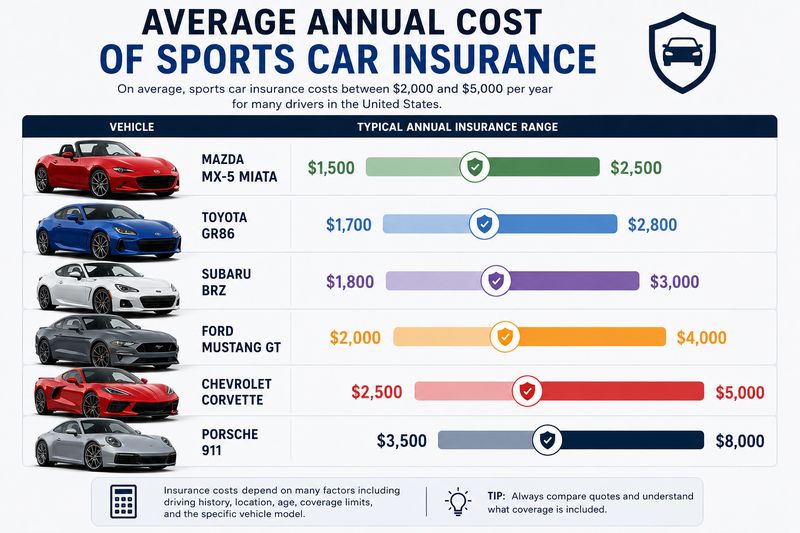
On average, sports car insurance costs between $2,000 and $5,000 per year for many drivers in the United States.
However, actual premiums can vary significantly.
Examples of typical annual insurance ranges include:
- Mazda MX-5 Miata: approximately $1,500–$2,500
- Toyota GR86: approximately $1,700–$2,800
- Subaru BRZ: approximately $1,800–$3,000
- Ford Mustang GT: approximately $2,000–$4,000
- Chevrolet Corvette: approximately $2,500–$5,000
- Porsche 911: approximately $3,500–$8,000+
These figures are only examples and can vary based on:
- Driver age
- Driving history
- ZIP code
- Coverage levels
- Insurance company
For example, a 40-year-old driver with a clean record may pay thousands less per year than a 20-year-old driver insuring the exact same vehicle.
The difference can be substantial enough to change which sports car makes financial sense to purchase.
Average Monthly Cost of Sports Car Insurance
Most drivers think about insurance in monthly terms because it affects their ongoing budget.
Sports car insurance commonly ranges from approximately:
- $125 to $450 per month
For some high-performance vehicles, monthly premiums may exceed:
- $500
- $700
- or even $1,000
for high-risk drivers.
Consider these examples:
- Mazda MX-5 Miata: roughly $125–$210 per month
- Toyota GR86: roughly $140–$230 per month
- Ford Mustang GT: roughly $170–$330 per month
- Chevrolet Corvette: roughly $210–$420 per month
- Porsche 911: roughly $300–$700+ per month
A buyer shopping for a sports car with a monthly budget of $600 should remember that insurance may consume a significant portion of that amount.
For example, purchasing a used Mustang for $350 per month may seem affordable until a $250 monthly insurance bill is added.
Looking at the total monthly ownership cost is often more important than focusing on the vehicle payment alone.
Cost Comparison With Regular Vehicles
Sports cars typically cost more to insure than regular passenger vehicles.
For comparison, many family sedans and compact cars may cost:
- $1,200–$2,000 annually
- $100–$170 monthly
to insure.
Consider a simple example:
Toyota Camry
- Annual insurance: approximately $1,500
- Monthly insurance: approximately $125
Toyota GR86
- Annual insurance: approximately $2,300
- Monthly insurance: approximately $190
The difference may seem manageable.
However, compare a family sedan with a higher-performance vehicle:
Honda Accord
- Annual insurance: approximately $1,600
Chevrolet Corvette
- Annual insurance: approximately $4,000
The gap becomes much larger.
Sports cars generally generate higher premiums because insurers expect:
- Higher repair costs
- Greater accident severity
- Increased theft risk
- More expensive claims
That does not mean every sports car is expensive.
In some cases, an older used sports car may cost less to insure than a newer luxury SUV worth twice as much.
This is why obtaining insurance quotes before purchasing a vehicle is essential.
Insurance Costs by Driver Age Group
Driver age is one of the biggest factors influencing sports car insurance premiums.
Insurance companies view younger drivers as statistically riskier because they have less driving experience and generate more claims on average.
Drivers Under 25
This group often pays the highest premiums.
For example, a 21-year-old insuring a Ford Mustang GT may receive quotes that are two or three times higher than those offered to an older driver.
Many young drivers see annual premiums ranging from:
- $3,000 to $8,000+
depending on the vehicle.
Drivers Ages 25–40
Premiums often decrease significantly after age 25, assuming the driver maintains a clean record.
Many sports car owners in this group receive more competitive rates because they have:
- More driving experience
- Lower claim frequency
- Better insurance histories
Drivers Ages 40–65
This age group often receives some of the lowest sports car insurance rates.
Many insurers consider these drivers relatively low risk, particularly if they have:
- Clean driving records
- Stable insurance histories
- Low annual mileage
Senior Drivers
Rates may remain competitive for many older drivers, although premiums sometimes increase again as insurers adjust for age-related risk factors.
For example, a retired driver who only uses a sports car for weekend trips may qualify for lower premiums because of limited annual mileage.
This demonstrates how insurance pricing depends on far more than the vehicle itself.
Compare Sports Cars Before You Place a Bid
Insurance costs can vary by thousands of dollars depending on the vehicle you choose. Before buying a sports car, browse auction inventory, review vehicle history reports, and compare models that offer the best balance of performance and affordability.
- ✅ 150,000+ vehicles available online
- ✅ Free vehicle history reports
- ✅ Affordable sports cars from U.S. auctions
- ✅ Bid on vehicles from home
Factors That Affect Sports Car Insurance Rates
Many buyers assume that sports car insurance is determined solely by the vehicle itself. In reality, insurance companies evaluate dozens of factors before calculating a premium. Two drivers can insure the same sports car and receive dramatically different quotes.
For example, a 45-year-old driver with a clean record may pay half as much as a 21-year-old driver insuring the same Ford Mustang. Likewise, a used Mazda MX-5 Miata in a low-crime area may cost significantly less to insure than a similar vehicle parked in a major city.
Understanding the factors that influence insurance rates can help buyers make smarter decisions and potentially save hundreds or even thousands of dollars each year.
Vehicle Make and Model
The specific vehicle you choose is one of the biggest factors affecting insurance costs.
Insurance companies maintain extensive databases showing:
- Accident frequency
- Theft rates
- Repair costs
- Claim severity
- Replacement expenses
for nearly every vehicle model on the road.
For example, a Mazda MX-5 Miata is often less expensive to insure than a Chevrolet Corvette because the Corvette generally produces larger claims and higher repair bills.
Similarly, a Toyota GR86 may cost less to insure than a Porsche 911 even though both are considered sports cars.
Insurance companies evaluate each model separately, which is why comparing quotes before purchasing a vehicle is so important.
Vehicle Value and Replacement Cost
More expensive vehicles usually cost more to insure.
If a vehicle is stolen or totaled, the insurance company may have to pay its market value. The higher that value, the greater the insurer's financial risk.
For example:
- A used Subaru BRZ worth $20,000 presents less replacement risk than
- A Porsche 911 worth $120,000.
Vehicle value also affects:
- Comprehensive coverage costs
- Collision coverage costs
- Total-loss claim payouts
Luxury sports cars often carry higher premiums because insurers may be responsible for much larger payouts following serious accidents or thefts.
This is one reason many budget-conscious buyers choose used sports cars rather than new ones.
Engine Size and Horsepower
Performance remains one of the defining characteristics of sports cars.
Vehicles with larger engines and higher horsepower ratings often receive higher insurance premiums because insurers associate them with greater risk.
Examples include:
- Faster acceleration
- Higher top speeds
- Increased accident severity
- Larger claim payouts
Consider two versions of the same vehicle:
- Ford Mustang EcoBoost
- Ford Mustang GT
The GT's larger engine and higher horsepower typically result in more expensive insurance.
Similarly, a Dodge Challenger Hellcat will generally cost much more to insure than a Dodge Challenger with a smaller engine.
While horsepower is not the only factor, it remains an important component of insurance pricing.
Driver Age and Experience
Driver age is one of the most influential factors in sports car insurance.
Insurance companies rely heavily on statistical data, and younger drivers generally produce more claims than experienced drivers.
Drivers under 25 often face the highest premiums because they are statistically more likely to be involved in accidents.
For example:
- A 22-year-old driver insuring a Chevrolet Camaro may pay significantly more than
- A 45-year-old driver with an identical vehicle and coverage package.
Experience matters as well.
Someone who has maintained continuous insurance coverage and a safe driving history for many years is usually viewed as a lower-risk customer.
As drivers gain experience and avoid accidents, premiums often decrease.
Driving Record and Claims History
Insurance companies closely examine your personal driving history.
Common factors include:
- Traffic violations
- Speeding tickets
- At-fault accidents
- Previous claims
- DUI convictions
- License suspensions
A driver with a clean record often receives much better rates than someone with multiple violations.
For example, two drivers may own identical Toyota GR86 models.
One has:
- No accidents
- No tickets
- Ten years of safe driving
The other has:
- Several speeding violations
- A recent at-fault accident
The second driver will likely pay substantially higher premiums.
Maintaining a clean driving record remains one of the most effective ways to reduce sports car insurance costs.
Location and ZIP Code
Where you live can significantly impact insurance rates.
Insurance companies evaluate risk based on geographic data such as:
- Accident frequency
- Vehicle theft rates
- Weather-related claims
- Population density
- Repair costs
A sports car insured in a large metropolitan area often costs more to insure than the same vehicle in a rural community.
For example, drivers in heavily populated cities may face higher premiums because insurers expect:
- More accidents
- More theft claims
- Greater traffic congestion
Even moving a few miles to a different ZIP code can sometimes affect insurance pricing.
This factor is largely outside the driver's control, but it plays a major role in premium calculations.
Annual Mileage
The more you drive, the more opportunities there are for accidents.
As a result, insurance companies often ask applicants to estimate their annual mileage.
Common mileage categories include:
- Under 5,000 miles
- 5,000–10,000 miles
- 10,000–15,000 miles
- More than 15,000 miles
A sports car driven only on weekends may cost less to insure than one used for a long daily commute.
For example:
- A retired owner who drives a Corvette 4,000 miles annually may receive a lower premium than
- A commuter driving the same vehicle 18,000 miles per year.
Lower mileage generally translates into lower risk.
Credit Score (Where Applicable)
In many states, insurance companies use credit-based insurance scores as part of their pricing models.
Research has shown that individuals with stronger credit histories often file fewer insurance claims.
As a result, insurers may offer lower premiums to applicants with higher credit scores.
Factors that may influence these scores include:
- Payment history
- Debt levels
- Credit utilization
- Length of credit history
For example, two drivers with identical vehicles and driving records may still receive different quotes because of differences in their credit profiles.
However, not all states allow insurers to use credit information when determining rates.
Local regulations vary, so the impact depends on where the policy is issued.
Coverage Limits and Deductibles
The amount of coverage you choose directly affects your insurance premium.
Policies with higher protection levels generally cost more.
Examples include:
- Higher liability limits
- Lower deductibles
- Expanded comprehensive coverage
- Additional endorsements
A deductible is the amount you pay before insurance coverage begins.
For example:
- A $500 deductible typically results in higher premiums.
- A $1,000 deductible often reduces premiums.
Many sports car owners lower their insurance costs by choosing higher deductibles, provided they can comfortably afford the out-of-pocket expense if a claim occurs.
The right balance depends on your financial situation and risk tolerance.
Sports Car Insurance Costs by Vehicle Category
Not all sports cars are equally expensive to insure. Some models are surprisingly affordable, while others can generate insurance bills that rival a monthly car payment.
Insurance companies evaluate each vehicle based on factors such as accident history, repair costs, theft rates, horsepower, and claim severity. As a result, two sports cars with similar performance may have very different insurance premiums.
For buyers on a budget, affordable sports cars often provide the best balance between driving enjoyment and manageable ownership costs. These vehicles deliver sporty handling and strong performance without the extreme insurance expenses associated with luxury or exotic models.
Affordable Sports Cars
Affordable sports cars are often the smartest choice for buyers who want a fun driving experience without facing overwhelming insurance costs.
Many of these vehicles offer:
- Good safety ratings
- Moderate horsepower
- Lower repair costs
- Strong reliability records
- Reasonable replacement values
Compared with high-end performance vehicles, they typically generate fewer costly insurance claims and are therefore less expensive to insure.
Popular budget-friendly sports cars include:
- Mazda MX-5 Miata
- Hyundai Veloster N
- Toyota GR86
- Subaru BRZ
While insurance rates vary by driver, these models are generally among the most affordable sports cars to insure in the United States.
Mazda MX-5 Miata Insurance Costs
The Mazda MX-5 Miata is frequently considered one of the cheapest sports cars to insure.
Several factors contribute to its relatively low insurance costs:
- Modest horsepower compared to many sports cars
- Strong safety reputation
- Lightweight design
- Lower purchase price
- Reasonable repair costs
Many drivers pay approximately:
- $1,500–$2,500 per year
- $125–$210 per month
for full coverage insurance.
The Miata is a good example of how a vehicle can provide a genuine sports car experience without generating extreme insurance expenses.
For a buyer comparing a used Miata with a larger V8-powered sports car, the insurance savings alone can amount to hundreds or even thousands of dollars per year.
This makes the Miata particularly attractive for budget-conscious enthusiasts.
Hyundai Veloster N Insurance Costs
The Hyundai Veloster N offers strong performance and sporty handling while often maintaining insurance costs below those of many traditional sports cars.
Although its turbocharged engine provides impressive performance, insurers typically view it differently than high-horsepower muscle cars or luxury sports cars.
Typical insurance costs often fall within:
- $1,700–$2,800 per year
- $140–$235 per month
depending on the driver's profile.
The Veloster N appeals to drivers who want:
- Practical daily transportation
- Sporty performance
- Modern technology
- Lower ownership costs
Because it combines hatchback practicality with performance features, it can be an appealing option for younger buyers seeking a balance between affordability and excitement.
However, younger drivers may still face higher premiums because insurers consider both the vehicle and the driver's age when determining rates.
Toyota GR86 Insurance Costs
The Toyota GR86 has become one of the most popular affordable sports cars on the market.
Its lightweight design and balanced performance make it appealing to enthusiasts, while its relatively modest purchase price helps keep insurance costs manageable.
Typical insurance premiums often range between:
- $1,700–$2,800 annually
- $140–$230 monthly
for many drivers.
The GR86 benefits from:
- Moderate horsepower
- Strong reliability reputation
- Lower replacement costs than luxury sports cars
- Widely available parts
For example, a driver comparing a Toyota GR86 with a Chevrolet Corvette may find that the GR86 costs thousands less per year to insure.
This can significantly reduce overall ownership expenses.
Many buyers shopping through auto auctions specifically target used GR86 models because they offer sports car styling and performance without the financial burden associated with more expensive vehicles.
Subaru BRZ Insurance Costs
The Subaru BRZ shares much of its engineering with the Toyota GR86, which means insurance costs are often similar.
Many drivers can expect to pay approximately:
- $1,800–$3,000 per year
- $150–$250 per month
for full coverage.
The BRZ remains one of the more affordable sports cars to insure because of its:
- Moderate engine output
- Reasonable vehicle value
- Strong safety equipment
- Relatively affordable repair costs
Insurance companies generally view the BRZ as a lower-risk performance vehicle than many high-horsepower muscle cars.
For example, a Subaru BRZ owner may pay substantially less than a driver insuring a Dodge Challenger Scat Pack or Ford Mustang GT.
This difference becomes especially important for younger buyers.
A first-time sports car owner often discovers that the BRZ provides an enjoyable driving experience while keeping insurance costs within a manageable budget.
For many drivers, the BRZ represents one of the best combinations of affordability, reliability, and performance available in the sports car market.
Mid-Range Sports Cars
Mid-range sports cars occupy the middle ground between affordable entry-level performance vehicles and high-end luxury sports cars. They typically offer more horsepower, faster acceleration, and stronger performance than vehicles such as the Mazda MX-5 Miata or Toyota GR86, but they remain significantly less expensive to purchase and insure than exotic models.
Popular vehicles in this category include:
- Ford Mustang
- Chevrolet Camaro
- Dodge Challenger
- Nissan Z
- Chevrolet Corvette
Insurance costs in this segment vary considerably because engine options, vehicle value, repair expenses, and driver demographics can differ greatly from one model to another.
For example, a Ford Mustang EcoBoost may be relatively affordable to insure, while a high-performance Corvette can cost substantially more despite both being considered sports cars.
Ford Mustang Insurance Costs
The Ford Mustang is one of the most recognizable sports cars in America and is available with several engine options that significantly affect insurance costs.
Typical insurance premiums often range between:
- $2,000–$4,000 per year
- $170–$330 per month
depending on:
- Driver age
- Driving history
- Coverage level
- Vehicle trim
The Mustang EcoBoost is usually the least expensive version to insure because it has:
- Lower horsepower than V8 models
- Lower purchase prices
- Reduced repair costs
Meanwhile, Mustang GT and high-performance variants generally command higher premiums because of:
- Larger engines
- Faster acceleration
- Higher claim severity
For example, a 35-year-old driver with a clean record may find a used Mustang EcoBoost surprisingly affordable to insure, while a younger driver purchasing a new Mustang GT may receive much higher quotes.
This is why many budget-conscious buyers view the EcoBoost as one of the most practical entry points into sports car ownership.
Chevrolet Camaro Insurance Costs
The Chevrolet Camaro is another popular performance vehicle that often carries moderate-to-high insurance costs.
Typical annual premiums commonly fall between:
- $2,100–$4,200
- $175–$350 per month
Insurance rates depend heavily on the engine configuration.
Camaro models equipped with:
- Four-cylinder engines
- V6 engines
are generally less expensive to insure than:
- SS models
- ZL1 performance variants
The Camaro's sporty image and strong performance capabilities contribute to higher insurance rates compared with many ordinary passenger vehicles.
However, compared to some luxury sports cars, insurance costs often remain relatively manageable.
Buyers shopping for a used Camaro can frequently reduce both purchase costs and insurance expenses by selecting older model years with lower replacement values.
Dodge Challenger Insurance Costs
The Dodge Challenger presents a unique case because it is available in an extremely wide range of performance levels.
Insurance premiums typically range from:
- $2,200–$4,500 per year
- $185–$375 per month
for many drivers.
Several factors influence Challenger insurance costs:
- Engine size
- Horsepower
- Theft rates
- Driver demographics
Base V6 models are generally much more affordable to insure than high-performance versions such as:
- R/T
- Scat Pack
- Hellcat
- Demon
The Challenger's popularity, powerful engine options, and relatively high theft rates can contribute to elevated insurance premiums.
For example, a Challenger Hellcat may cost thousands more per year to insure than a V6 Challenger, even when driven by the same person.
Budget-focused buyers often find that lower-trim Challenger models deliver the desired styling and comfort without the extreme insurance costs associated with high-horsepower versions.
Nissan Z Insurance Costs
The Nissan Z continues the legacy of Nissan's long-running line of sports cars and generally falls in the middle of the insurance-cost spectrum.
Many drivers pay approximately:
- $2,000–$3,800 annually
- $165–$320 monthly
for full coverage insurance.
Several factors help shape Nissan Z insurance costs:
- Sports car classification
- Strong performance capabilities
- Moderate production volumes
- Specialized parts
Although the Nissan Z offers impressive acceleration and performance, it typically remains less expensive to insure than many luxury sports cars.
For buyers who want a modern sports car experience without stepping into luxury pricing territory, the Nissan Z often represents a reasonable compromise.
A used Nissan Z purchased through an auto auction may also provide additional savings by lowering the vehicle's replacement value, which can help reduce insurance costs.
Chevrolet Corvette Insurance Costs
The Chevrolet Corvette is often considered one of the most affordable ways to access true high-performance sports car capabilities.
However, insurance companies still view the Corvette as a higher-risk vehicle than most cars in this category.
Typical premiums often range between:
- $2,500–$5,000 per year
- $210–$420 per month
depending on the driver's profile and vehicle generation.
Several factors contribute to higher Corvette insurance costs:
- Powerful engines
- Expensive body components
- Higher repair costs
- Larger claim payouts
Newer Corvette models often cost more to insure because:
- Replacement values are higher.
- Repair procedures are more complex.
- Parts are more expensive.
That said, older Corvettes can sometimes offer surprisingly affordable insurance rates because depreciation reduces replacement costs.
For example, a well-maintained used Corvette purchased at auction may cost significantly less to insure than a new luxury sports sedan with a similar market value.
Many enthusiasts consider the Corvette one of the best performance-per-dollar values available, but insurance should always be factored into the overall ownership budget.
Luxury and High-Performance Sports Cars
Luxury and high-performance sports cars sit at the top end of the insurance spectrum. These vehicles combine powerful engines, advanced technology, premium materials, and high replacement values, all of which contribute to higher insurance costs.
While they offer exceptional performance and prestige, they also present greater financial risk for insurance companies. Expensive repairs, specialized parts, and large claim payouts often result in significantly higher premiums than those associated with affordable or mid-range sports cars.
For buyers considering one of these vehicles, insurance costs should be included in the overall ownership budget before making a purchase decision.
Porsche 911 Insurance Costs
The Porsche 911 is one of the most iconic sports cars in the world and is often among the more expensive vehicles to insure.
Typical insurance costs frequently range between:
- $3,500–$8,000+ per year
- $300–$700+ per month
Several factors contribute to these higher premiums:
- High vehicle value
- Expensive replacement parts
- Specialized repair procedures
- Powerful performance capabilities
- Luxury-car claim history
Different Porsche 911 variants can also produce very different insurance costs.
For example:
- Carrera models typically cost less to insure than
- Turbo, GT3, or Turbo S models.
A used Porsche 911 may be less expensive to insure than a brand-new example because depreciation reduces the vehicle's replacement value.
However, maintenance and repair costs remain important considerations regardless of age.
BMW i8 Insurance Costs
The BMW i8 occupies a unique position in the sports car market because it combines exotic styling with hybrid technology.
Insurance premiums often range from:
- $3,000–$6,500 annually
- $250–$550 monthly
The i8's insurance costs are influenced by:
- High original purchase price
- Specialized hybrid components
- Carbon-fiber construction
- Limited production volume
- Advanced technology systems
Although the BMW i8 is not the most powerful sports car in its class, its repair costs can be substantial due to its complex engineering and unique materials.
For example, damage to carbon-fiber components may require specialized repairs that are significantly more expensive than repairs on traditional steel-bodied vehicles.
Buyers considering a used i8 should obtain insurance quotes before purchasing, as premiums can vary widely among insurers.
Jaguar F-Type Insurance Costs
The Jaguar F-Type combines luxury and performance in a package that often commands above-average insurance rates.
Typical premiums commonly fall between:
- $2,800–$6,000 per year
- $235–$500 per month
Insurance companies consider several factors when pricing F-Type coverage:
- Luxury vehicle classification
- Expensive replacement parts
- Performance-oriented engines
- Higher repair labor costs
- Relatively limited parts availability
Models equipped with supercharged V8 engines generally cost more to insure than four-cylinder or V6 variants.
The Jaguar brand's luxury positioning can also increase claim costs because repairs often require specialized service facilities.
While used F-Type models may offer attractive purchase prices, buyers should factor insurance and maintenance expenses into their long-term ownership plans.
Tesla Model S Plaid Insurance Costs
The Tesla Model S Plaid is one of the fastest production sedans available today, and its insurance costs often reflect its extraordinary performance capabilities.
Many owners pay approximately:
- $3,500–$7,500 annually
- $300–$625 monthly
for full coverage.
Several factors contribute to these premiums:
- Extremely rapid acceleration
- High vehicle value
- Advanced electronics
- Expensive battery systems
- Costly repair procedures
Despite its excellent safety ratings, the Model S Plaid can be expensive to insure because even relatively minor collisions may involve costly repairs.
For example, repairing:
- Battery-related components
- Cameras
- Sensors
- Body panels
can result in substantial claim payouts.
Tesla's specialized repair network and parts availability can also influence insurance pricing.
As electric performance vehicles become more common, insurance costs may evolve, but the Plaid currently remains one of the more expensive vehicles to insure.
Mercedes-AMG GT Insurance Costs
The Mercedes-AMG GT represents the luxury performance segment at its highest level and often carries some of the most expensive insurance premiums among non-exotic sports cars.
Typical insurance costs often range between:
- $4,000–$9,000+ per year
- $335–$750+ per month
depending on:
- Model year
- Vehicle value
- Driver profile
- Coverage levels
The AMG GT's premiums are influenced by:
- High horsepower ratings
- Luxury vehicle status
- Expensive replacement parts
- Sophisticated technology systems
- High repair costs
Insurance companies recognize that accidents involving AMG GT models often generate large claims because repairs require specialized parts and labor.
Higher-performance AMG variants can push premiums even further upward.
For many buyers, insurance becomes one of the largest recurring ownership expenses associated with this vehicle.
Which Sports Cars Have the Cheapest Insurance?
Many people assume that every sports car comes with expensive insurance. While this is true for some high-performance and luxury models, there are several sports cars that offer relatively affordable insurance rates.
Insurance companies generally charge less for vehicles that have:
- Moderate horsepower
- Strong safety ratings
- Lower repair costs
- Affordable replacement parts
- Lower claim severity
For budget-conscious buyers, choosing one of these models can significantly reduce total ownership costs. In some cases, the insurance savings over several years can amount to thousands of dollars compared to more powerful performance vehicles.
The following sports cars are often among the least expensive to insure in the United States.
Mazda MX-5 Miata
The Mazda MX-5 Miata is consistently one of the cheapest sports cars to insure.
Many drivers pay approximately:
- $1,500–$2,500 per year
- $125–$210 per month
for full coverage insurance.
Several factors contribute to the Miata's affordability:
- Relatively modest horsepower
- Lightweight construction
- Strong reliability record
- Reasonable repair costs
- Lower purchase price than many competitors
Unlike many sports cars, the Miata focuses more on handling and driving enjoyment than outright speed.
Insurance companies generally view it as a lower-risk performance vehicle because it produces fewer costly claims than many larger sports cars.
For example, a buyer comparing a used Miata and a Chevrolet Corvette may discover that the Miata costs significantly less to insure while still providing an engaging driving experience.
This combination of fun and affordability makes it one of the most popular choices for budget-minded enthusiasts.
Toyota GR86
The Toyota GR86 is another sports car that often delivers surprisingly affordable insurance rates.
Typical premiums frequently range between:
- $1,700–$2,800 annually
- $140–$230 monthly
The GR86 benefits from several characteristics insurers like:
- Moderate engine output
- Relatively low vehicle value
- Good safety equipment
- Affordable replacement parts
- Lower repair expenses than luxury sports cars
Although the GR86 is designed for performance driving, it is not associated with the extreme horsepower levels found in many muscle cars and high-performance vehicles.
For example, a Toyota GR86 often costs considerably less to insure than:
- Chevrolet Corvette
- Porsche 911
- Dodge Challenger Scat Pack
For buyers who want a modern sports coupe without overwhelming insurance expenses, the GR86 is often one of the strongest options available.
Subaru BRZ
The Subaru BRZ shares much of its design and engineering with the Toyota GR86, which means insurance costs are usually similar.
Many drivers pay approximately:
- $1,800–$3,000 per year
- $150–$250 per month
for full coverage.
Insurance companies generally view the BRZ favorably because of its:
- Moderate horsepower
- Lower replacement cost
- Strong safety technologies
- Reasonable repair costs
Compared with V8-powered muscle cars, the BRZ often presents less risk from an insurance perspective.
For example, a young driver may find that a BRZ costs substantially less to insure than a Ford Mustang GT or Chevrolet Camaro SS.
This makes the BRZ particularly appealing to first-time sports car owners who want manageable ownership costs.
Ford Mustang EcoBoost
Not every Mustang is expensive to insure.
While V8-powered Mustang GT models often carry higher premiums, the Mustang EcoBoost is frequently among the more affordable performance cars in its class.
Typical insurance costs often range from:
- $1,800–$3,200 annually
- $150–$270 monthly
Several factors help keep costs lower than many performance-oriented Mustang variants:
- Smaller turbocharged engine
- Lower purchase price
- Reduced claim severity
- Lower repair costs than some V8 models
The EcoBoost version allows buyers to enjoy:
- Sporty styling
- Strong acceleration
- Modern technology
- Everyday practicality
without facing the insurance costs often associated with larger-engine muscle cars.
For many drivers, the EcoBoost represents a practical compromise between performance and affordability.
Factors That Make Some Sports Cars Cheaper to Insure
Not all sports cars are priced the same by insurance companies. Certain characteristics consistently lead to lower premiums.
Some of the most important factors include:
Moderate Horsepower
Vehicles with moderate power outputs generally present less risk than cars capable of extreme acceleration and very high speeds.
For example:
- Toyota GR86
- Subaru BRZ
- Mazda MX-5 Miata
typically cost less to insure than high-horsepower muscle cars.
Lower Vehicle Value
Less expensive vehicles usually require smaller claim payouts if they are stolen or declared a total loss.
This reduces risk for insurers and often results in lower premiums.
Affordable Repair Costs
Sports cars that use widely available parts and conventional repair procedures tend to cost less to insure.
Vehicles requiring specialized parts or highly skilled labor generally generate larger claims.
Strong Safety Ratings
Advanced safety systems and strong crash-test performance can help lower insurance costs by reducing accident severity.
Features such as:
- Automatic emergency braking
- Lane-departure warnings
- Blind-spot monitoring
may contribute to lower premiums.
Lower Theft Rates
Vehicles that are stolen less frequently typically receive lower comprehensive insurance rates.
Insurers carefully monitor theft statistics when calculating premiums.
Driver Demographics
Some sports cars attract older and more experienced owners who generally file fewer claims.
This can positively influence insurance pricing for specific models.
Which Sports Cars Are the Most Expensive to Insure?
While some sports cars have surprisingly affordable insurance premiums, others sit at the opposite end of the spectrum. High-performance vehicles, luxury sports cars, and exotic models often generate some of the highest insurance costs on the road.
Insurance companies charge more for these vehicles because they typically involve:
- Higher repair costs
- Larger claim payouts
- More expensive replacement parts
- Greater theft risk
- Higher accident severity
For budget-conscious buyers, understanding which vehicles tend to have the highest premiums can help prevent costly surprises. In some cases, insurance costs can add thousands of dollars per year to the total cost of ownership.
High-Horsepower Performance Cars
One of the biggest factors driving insurance costs is horsepower.
Vehicles with extremely powerful engines often cost significantly more to insure because insurance companies associate them with:
- Faster acceleration
- Higher speeds
- Increased accident severity
- Larger claim payouts
Examples of high-horsepower performance cars that frequently carry elevated insurance premiums include:
- Dodge Challenger Hellcat
- Chevrolet Camaro ZL1
- Ford Mustang Shelby GT500
- Chevrolet Corvette Z06
- Cadillac CT5-V Blackwing
Many of these vehicles produce:
- 500 horsepower
- 600 horsepower
- 700 horsepower or more
Insurance companies recognize that accidents involving these vehicles can be particularly expensive.
For example, a Dodge Challenger Hellcat may cost substantially more to insure than a Mustang EcoBoost, even if both are driven by the same person.
The difference often comes down to risk statistics and claim history.
Buyers attracted to high-performance models should always obtain insurance quotes before purchasing because premiums can sometimes exceed expectations.
Luxury Sports Cars
Luxury sports cars combine performance with premium materials, advanced technology, and higher vehicle values.
As a result, they often generate higher insurance costs than mainstream sports cars.
Examples include:
- Porsche 911
- Jaguar F-Type
- BMW i8
- Mercedes-AMG GT
- Audi R8
Several factors contribute to higher premiums:
- Expensive body panels
- Advanced electronic systems
- Specialized repair procedures
- High replacement values
- Luxury-brand repair costs
For example, repairing a Porsche 911 after a collision may cost significantly more than repairing a Toyota GR86 because:
- Parts are more expensive.
- Labor requirements are greater.
- Specialized technicians may be required.
Insurance companies account for these costs when calculating premiums.
Even drivers with excellent records often face higher rates simply because the vehicle itself represents a larger financial risk.
Exotic and Supercars
Exotic vehicles and supercars typically occupy the highest insurance category.
Examples include:
- Lamborghini Huracán
- Ferrari 296 GTB
- Ferrari F8 Tributo
- McLaren 750S
- Aston Martin Vantage
- Lamborghini Revuelto
Insurance premiums for these vehicles can easily exceed:
- $10,000 per year
- $15,000 per year
- $20,000+ per year
depending on:
- Driver profile
- Location
- Coverage limits
- Vehicle value
Several characteristics make these vehicles expensive to insure:
- Extremely high purchase prices
- Limited-production parts
- Specialized repair facilities
- Exceptional performance capabilities
- High theft attractiveness
For example, a minor collision involving a supercar may result in repair bills that exceed the total value of many ordinary vehicles.
Some insurers even require specialized policies for exotic vehicles because traditional auto insurance products may not adequately address their unique risks.
Fortunately, most budget-conscious buyers shopping through online auto auctions are unlikely to consider vehicles in this category due to both purchase and ownership costs.
Vehicles With High Theft Rates
Insurance costs are influenced not only by performance but also by theft statistics.
Some sports cars are stolen more frequently than others, which increases the risk for insurance companies.
When a vehicle has a history of frequent theft claims, insurers often raise comprehensive coverage premiums.
Examples of factors that increase theft-related insurance costs include:
- High demand for parts
- Strong resale value
- Popularity among thieves
- Ease of resale in illegal markets
Certain versions of vehicles such as:
- Dodge Challenger
- Dodge Charger performance models
- Chevrolet Camaro
- Ford Mustang
have historically appeared on theft-related reports more frequently than many ordinary passenger vehicles.
Even if an owner takes precautions, insurance companies still consider overall theft data when calculating rates.
Vehicles equipped with:
- Tracking systems
- Immobilizers
- Anti-theft devices
- Secure storage
may qualify for discounts, but theft risk remains an important factor in sports car insurance pricing.
Lower Your Total Sports Car Ownership Cost
Choosing the right vehicle is one of the easiest ways to reduce long-term expenses. BidNDrive gives buyers access to used sports cars that can cost significantly less than dealership inventory while still delivering the driving experience they want.
- ✅ Lower purchase prices through online auctions
- ✅ Popular models like Mustang, BRZ, GR86, and Miata
- ✅ Transparent auction and service fees
- ✅ Support throughout the buying process
How Much Coverage Do You Need for a Sports Car?
Choosing the right amount of insurance coverage is just as important as choosing the right sports car. While many drivers focus on finding the lowest premium, inadequate coverage can become extremely expensive after an accident, theft, or major vehicle damage.
The ideal coverage depends on factors such as:
- Vehicle value
- Driver age
- Financial situation
- State requirements
- Loan or lease obligations
- How often the vehicle is driven
For example, a driver who purchases a used Mazda MX-5 Miata for $15,000 may need a different coverage strategy than someone insuring a new Porsche 911 worth more than $120,000.
Understanding each type of coverage can help sports car owners balance protection and affordability.
Liability Insurance
Liability insurance is the foundation of every auto insurance policy and is required in most states.
This coverage pays for damages and injuries you cause to other people if you are responsible for an accident.
Liability insurance typically includes:
- Bodily injury liability
- Property damage liability
For example, if you accidentally hit another vehicle and cause injuries, liability coverage may help pay for:
- Medical expenses
- Vehicle repairs
- Legal costs
- Settlement claims
State minimum requirements are often relatively low.
However, sports car owners may benefit from higher liability limits because serious accidents can generate substantial costs.
For example, a driver causing a multi-vehicle accident could face expenses far beyond minimum state coverage requirements.
Many insurance professionals recommend purchasing liability limits that exceed the legal minimum whenever possible.
Comprehensive Coverage
Comprehensive coverage protects against damage that is not caused by a collision.
Examples include:
- Theft
- Vandalism
- Fire
- Flooding
- Hail damage
- Falling objects
- Animal collisions
This coverage is particularly important for sports cars because many performance vehicles are attractive targets for thieves.
For example, a Dodge Challenger, Chevrolet Camaro, or Ford Mustang may be more vulnerable to theft than an average commuter vehicle.
If a sports car is stolen and not recovered, comprehensive coverage may help pay for its value.
Owners of newer or higher-value sports cars generally benefit from maintaining comprehensive coverage.
Collision Coverage
Collision coverage pays for damage to your own vehicle after an accident, regardless of who caused it.
This coverage can help repair or replace your sports car after:
- Vehicle collisions
- Single-car accidents
- Impact with objects
- Rollover accidents
For example, if a driver loses control and strikes a guardrail, collision coverage may help pay for repairs.
Sports cars often have:
- Expensive body panels
- Specialized paint
- Performance components
- Advanced electronics
which can make repairs costly.
A minor accident involving a Corvette or Porsche 911 may result in repair bills that would be difficult for many owners to pay out of pocket.
For most financed sports cars, lenders require collision coverage.
Uninsured and Underinsured Motorist Coverage
Not every driver on the road carries adequate insurance.
Uninsured motorist coverage helps protect you if you are hit by a driver who has no insurance.
Underinsured motorist coverage applies when the at-fault driver's insurance limits are insufficient to cover damages.
This protection can be especially valuable because sports cars often cost more to repair than ordinary vehicles.
For example, if an uninsured driver damages a Jaguar F-Type, repair costs may exceed tens of thousands of dollars.
Without adequate coverage, the sports car owner may struggle to recover those losses.
Many drivers overlook this coverage, but it can provide important financial protection.
Personal Injury Protection (PIP)
Personal Injury Protection, commonly known as PIP, is required in some states and optional in others.
PIP helps cover medical expenses and certain related costs after an accident, regardless of who caused it.
Depending on the policy and state laws, PIP may cover:
- Medical bills
- Rehabilitation expenses
- Lost wages
- Essential services
- Funeral expenses
For example, if a driver is injured in an accident and cannot work for several weeks, PIP may help offset some of the financial burden.
This coverage is especially valuable for individuals who depend heavily on their income and want additional financial protection after an accident.
Medical Payments Coverage
Medical Payments Coverage, often called MedPay, helps pay medical expenses resulting from a vehicle accident.
Unlike liability insurance, MedPay focuses on medical costs for:
- The driver
- Passengers
- Family members in some situations
Covered expenses may include:
- Emergency treatment
- Hospital bills
- Ambulance fees
- Surgery costs
- Follow-up care
MedPay can complement health insurance and provide additional protection after an accident.
For sports car owners who frequently carry passengers, this coverage can offer added peace of mind.
Gap Insurance
Gap insurance is particularly important for owners of newer sports cars that are financed.
When a vehicle is totaled, standard insurance generally pays only the current market value.
However, the remaining loan balance may be higher than that value.
Gap insurance covers the difference between:
- The vehicle's actual cash value
- The remaining loan balance
For example:
- Loan balance: $45,000
- Insurance payout: $38,000
Without gap insurance, the owner could still owe $7,000 on a vehicle that no longer exists.
Sports cars often depreciate quickly during the first few years of ownership, making gap insurance especially valuable for financed vehicles.
New Car Replacement Coverage
Some insurers offer new car replacement coverage for recently purchased vehicles.
Instead of paying only the depreciated value of a totaled vehicle, this coverage may help replace it with a new vehicle of similar type and equipment.
For example, if a one-year-old Nissan Z is declared a total loss, new car replacement coverage may provide significantly more protection than standard actual cash value coverage.
This option can be particularly attractive for buyers purchasing:
- New sports cars
- Recently released models
- Vehicles with rapid depreciation
Although it increases premiums, some owners consider the extra protection worthwhile.
Agreed Value Coverage for Collector Sports Cars
Collector and specialty sports cars often require a different insurance approach.
Standard insurance policies typically use actual cash value, which accounts for depreciation.
However, collector vehicles may appreciate over time.
Agreed value coverage allows the owner and insurer to establish a specific value for the vehicle before a loss occurs.
Examples of vehicles that may benefit from agreed value coverage include:
- Classic Corvettes
- Vintage Porsche models
- Rare muscle cars
- Limited-production sports cars
For example, if a collector-owned Porsche has an agreed value of $150,000, that amount may be paid if the vehicle is declared a total loss, subject to policy terms.
This type of coverage helps protect owners from disputes over market value after a claim.
Sports Car Insurance for Young Drivers
For many young drivers, owning a sports car is a dream. Vehicles like the Ford Mustang, Toyota GR86, Subaru BRZ, and Mazda MX-5 Miata offer exciting performance and sporty styling at relatively affordable purchase prices. However, insurance is often where the real financial challenge begins.
Drivers under 25 generally face the highest insurance premiums in the market, especially when insuring sports cars. While this may seem unfair to responsible young drivers, insurance companies base rates on statistical risk rather than individual intentions.
The good news is that some sports cars are much cheaper to insure than others, and there are several ways young drivers can reduce their premiums without giving up the vehicle they want.
Why Drivers Under 25 Pay More
Age is one of the most important factors insurance companies use when calculating premiums.
According to insurance industry data, younger drivers are statistically more likely to:
- Be involved in accidents
- File insurance claims
- Receive traffic citations
- Engage in risky driving behavior
Because of this, insurers consider drivers under 25 to be higher-risk customers.
For example, a 22-year-old driver insuring a Ford Mustang GT may receive a quote that is twice as high as a quote for a 40-year-old driver with the same vehicle and coverage.
The difference is not necessarily related to the individual driver. Instead, it reflects accident and claim patterns across millions of policyholders.
Sports cars can make the situation even more expensive because insurers also consider:
- Horsepower
- Acceleration
- Vehicle value
- Repair costs
- Theft rates
For example:
- A 22-year-old insuring a Chevrolet Corvette may face significantly higher premiums than
- A 22-year-old driving a Toyota Camry.
This combination of youth and vehicle performance is one reason sports car insurance can become a major expense for younger drivers.
The Most Affordable Sports Cars for Young Drivers
Not every sports car comes with extreme insurance costs.
Some models are generally more affordable because they combine sporty performance with reasonable repair costs and moderate horsepower levels.
Popular options often include:
- Mazda MX-5 Miata
- Toyota GR86
- Subaru BRZ
- Ford Mustang EcoBoost
- Hyundai Veloster N
These vehicles typically cost less to insure than:
- Dodge Challenger Hellcat
- Chevrolet Camaro ZL1
- Porsche 911
- Mercedes-AMG GT
For example, a young driver may find that a used Mazda MX-5 Miata costs hundreds or even thousands of dollars less per year to insure than a high-horsepower V8 muscle car.
The Toyota GR86 and Subaru BRZ are also popular among younger enthusiasts because they provide:
- Rear-wheel-drive handling
- Sporty styling
- Reasonable purchase prices
- Manageable insurance costs
Similarly, the Mustang EcoBoost often offers lower premiums than Mustang GT models because of its smaller engine and lower claim severity.
For buyers shopping on a budget, these vehicles can provide a more realistic path to sports car ownership.
Tips for Lowering Insurance Costs as a New Driver
Although younger drivers cannot change their age, they can take several steps to reduce insurance costs.
Choose a Lower-Risk Sports Car
Vehicle selection matters.
For example, a Mazda MX-5 Miata or Toyota GR86 will often cost less to insure than a Corvette or Challenger Hellcat.
Obtaining insurance quotes before purchasing a vehicle can prevent expensive surprises.
Maintain a Clean Driving Record
Avoiding accidents and traffic violations remains one of the most effective ways to lower premiums.
Insurance companies reward drivers who demonstrate safe driving habits over time.
Even a single speeding ticket can increase rates significantly.
Increase Your Deductible
Choosing a higher deductible can lower monthly insurance costs.
For example:
- A $1,000 deductible often costs less than
- A $500 deductible.
However, drivers should ensure they can comfortably afford the deductible if a claim occurs.
Stay on a Family Policy When Possible
Many younger drivers save money by remaining on a parent's insurance policy.
In many cases, this option produces substantially lower premiums than purchasing an individual policy.
Ask About Discounts
Many insurers offer discounts for:
- Good students
- Defensive driving courses
- Safe driving programs
- Multi-policy bundles
- Low annual mileage
These savings can add up over time.
Limit Annual Mileage
Drivers who use a sports car only occasionally may qualify for lower premiums.
For example, driving 6,000 miles per year generally presents less risk than driving 18,000 miles annually.
Consider a Used Sports Car
Older sports cars often have lower replacement values, which can reduce insurance costs.
A used Subaru BRZ purchased through an online auto auction may be significantly cheaper to insure than a brand-new model while delivering a similar driving experience.
Sports Car Insurance for Used Vehicles
Many buyers assume that every sports car comes with expensive insurance premiums. However, used sports cars are often much more affordable to insure than their brand-new counterparts. In some cases, buying a used performance vehicle can reduce both the purchase price and the ongoing insurance costs.
For budget-conscious buyers, this can make sports car ownership far more realistic. Instead of paying for a new Corvette, Mustang, or Porsche, many drivers choose older models that still offer strong performance while generating lower insurance premiums.
Understanding how insurers evaluate used sports cars can help buyers identify vehicles that deliver both excitement and long-term affordability.
Is It Cheaper to Insure a Used Sports Car?
In many cases, yes.
Used sports cars often cost less to insure because they are worth less than new vehicles.
Insurance companies consider several factors when calculating premiums, including:
- Vehicle value
- Repair costs
- Replacement costs
- Theft risk
- Historical claims data
When a vehicle's market value decreases over time, the potential payout for a total loss also decreases.
For example:
- A brand-new Chevrolet Corvette worth $80,000 may cost significantly more to insure than
- A 10-year-old Corvette worth $30,000.
The same principle applies to vehicles such as:
- Ford Mustang
- Nissan Z
- Subaru BRZ
- Mazda MX-5 Miata
Although performance characteristics remain important, depreciation often helps lower insurance costs.
This is one reason many enthusiasts purchase used sports cars rather than new ones.
How Depreciation Affects Insurance Costs
Depreciation is one of the biggest reasons insurance costs often decrease as vehicles age.
Most new vehicles lose value during their first several years of ownership.
As market value declines:
- Comprehensive coverage risk decreases.
- Collision claim payouts become smaller.
- Total-loss settlements become less expensive.
For example, consider two identical sports cars separated by several model years.
A new Toyota GR86 valued at $32,000 may generate higher premiums than:
- A five-year-old GR86 valued at $20,000.
Even though both vehicles offer similar performance, the insurance company's financial exposure is lower with the older vehicle.
However, depreciation does not reduce every aspect of insurance pricing.
Other factors still matter, including:
- Driver age
- Driving history
- Location
- Theft rates
- Repair costs
A vehicle that is inexpensive to replace may still be costly to insure if it has a history of expensive claims or frequent theft.
Nevertheless, depreciation remains one of the most effective ways to reduce sports car insurance costs.
Why Auction-Bought Sports Cars May Cost Less to Insure
Many buyers use online auto auctions to find sports cars at prices below traditional dealership retail values.
Purchasing a sports car at auction does not automatically reduce insurance costs, but it can create indirect savings.
Insurance companies primarily care about:
- Vehicle value
- Vehicle condition
- Repair history
- Title status
If a buyer purchases a used sports car at a lower price because it has already depreciated significantly, insurance costs may also be lower due to the vehicle's reduced market value.
For example:
- A used Mustang purchased through an auction may have a substantially lower replacement value than a brand-new Mustang purchased from a dealership.
As a result, comprehensive and collision premiums may be lower.
Budget-conscious buyers often use auctions to purchase vehicles such as:
- Mazda MX-5 Miata
- Ford Mustang
- Chevrolet Camaro
- Nissan Z
- Subaru BRZ
at prices that make ownership more affordable.
However, buyers should remember that insurance companies may evaluate certain auction vehicles differently if they have:
- Salvage titles
- Rebuilt titles
- Prior major damage
- Incomplete repair documentation
This is why proper research is critical before making a purchase.
Things to Check Before Insuring a Used Performance Car
Before purchasing insurance for a used sports car, buyers should perform a thorough review of the vehicle's history and condition.
A lower purchase price does not always guarantee lower ownership costs.
Important items to verify include:
Vehicle History Reports
Review reports from providers such as:
to identify:
- Previous accidents
- Title issues
- Odometer discrepancies
- Damage history
Insurance companies may consider some of these factors when determining coverage options.
Title Status
Check whether the vehicle has:
- Clean title
- Rebuilt title
- Salvage title
- Flood title
Some insurers may charge more for certain title brands, while others may limit coverage options.
Repair History
Verify that major repairs were completed properly.
Poor repairs can affect:
- Vehicle safety
- Future claims
- Resale value
and may complicate insurance coverage.
Modifications
Many sports cars have aftermarket upgrades such as:
- Turbochargers
- Suspension modifications
- Performance exhaust systems
- Custom wheels
Some insurers require modifications to be disclosed when applying for coverage.
Failing to report modifications could create problems during a future claim.
Current Market Value
Understanding the vehicle's actual market value can help buyers choose appropriate coverage levels.
For example, carrying extensive coverage on a low-value sports car may not always be financially efficient.
A careful review of value and risk can help balance protection and affordability.
How Insurance Companies Calculate Risk for Sports Cars
Insurance companies do not choose sports car premiums randomly. Every quote is based on extensive data analysis designed to predict the likelihood and cost of future claims.
When an insurer evaluates a sports car, it looks at far more than horsepower or purchase price. Companies analyze accident statistics, repair costs, theft rates, driver behavior patterns, and vehicle safety performance to determine how risky a particular vehicle is to insure.
This is why two sports cars with similar performance can have very different insurance premiums. Understanding how insurers calculate risk can help buyers make informed decisions and avoid unexpected ownership costs.
Vehicle Safety Ratings
Safety ratings play an important role in insurance pricing.
Insurance companies review crash-test results and safety performance data from organizations such as:
- Insurance Institute for Highway Safety (IIHS)
- National Highway Traffic Safety Administration (NHTSA)
Vehicles that perform well in crash testing may qualify for lower insurance premiums because they are often associated with:
- Fewer injuries
- Lower medical costs
- Reduced claim severity
- Better occupant protection
Modern sports cars frequently include advanced safety features such as:
- Automatic emergency braking
- Blind-spot monitoring
- Lane-keeping assistance
- Adaptive cruise control
- Rear cross-traffic alerts
For example, a newer Toyota GR86 equipped with advanced safety systems may be viewed more favorably than an older sports car lacking modern driver-assistance technologies.
However, strong safety ratings do not automatically guarantee low insurance costs. Performance, repair expenses, and theft risk still influence the final premium.
Historical Claim Data
One of the most powerful tools insurance companies use is historical claim data.
Insurers maintain records covering millions of claims and use that information to identify patterns associated with specific vehicle models.
They analyze factors such as:
- Accident frequency
- Average repair costs
- Total-loss rates
- Injury claims
- Theft claims
- Liability payouts
For example, if a particular sports car consistently generates large insurance claims, future owners of that vehicle may face higher premiums.
This helps explain why two vehicles with similar prices and horsepower can have very different insurance costs.
Insurance companies are not predicting what an individual driver will do. Instead, they are evaluating how thousands of owners of the same vehicle have behaved historically.
The larger the claims associated with a model, the greater the risk from the insurer's perspective.
Repair Frequency and Costs
Repair-related expenses are another major factor in sports car insurance pricing.
Insurance companies closely track:
- How often vehicles need repairs after accidents
- The average cost of those repairs
- Parts availability
- Labor requirements
Sports cars often have more expensive repair costs because they use:
- Performance brakes
- Specialized suspension systems
- Premium body materials
- Advanced electronics
- High-performance tires
For example, repairing a damaged bumper on a Mazda MX-5 Miata may cost significantly less than repairing the front-end components of a Porsche 911.
Luxury performance vehicles frequently require:
- Specialized technicians
- Manufacturer-specific tools
- Expensive replacement parts
As repair costs increase, insurance premiums generally increase as well.
Even vehicles with excellent reliability can receive higher insurance rates if collision repairs tend to be expensive.
Driver Demographics
Insurance companies also evaluate the types of drivers who commonly own specific sports cars.
This is known as demographic risk analysis.
Factors often considered include:
- Age
- Driving experience
- Gender (where permitted by law)
- Claim history
- Traffic violation rates
For example, some sports cars attract younger drivers who statistically file more claims.
Others tend to be purchased by older enthusiasts with long histories of safe driving.
A vehicle frequently purchased by experienced drivers may receive more favorable insurance pricing than a vehicle associated with higher-risk demographics.
Consider the difference between:
- A Mazda MX-5 Miata
- A Dodge Challenger Hellcat
Although both are performance vehicles, insurers may observe very different claim patterns among their owners.
Historical driver behavior influences how risk is calculated for every vehicle model.
Theft and Recovery Statistics
Theft is another important component of insurance pricing.
Insurance companies track:
- How often a vehicle is stolen
- How frequently stolen vehicles are recovered
- Average theft claim costs
- Geographic theft patterns
Some sports cars are particularly attractive to thieves because of:
- Strong resale value
- High demand for parts
- Powerful engines
- Popularity among enthusiasts
Examples of vehicles that have historically appeared on theft-related reports include certain versions of:
- Dodge Challenger
- Chevrolet Camaro
- Ford Mustang
When theft rates rise, comprehensive insurance costs often increase as well.
Recovery rates matter too.
If stolen vehicles are frequently recovered with minimal damage, insurers may view the risk differently than vehicles that are rarely recovered.
Modern anti-theft technologies can help reduce risk, including:
- Immobilizers
- GPS tracking systems
- Vehicle recovery services
- Smart-key security systems
Drivers may even qualify for insurance discounts when these systems are installed.
How to Get the Cheapest Insurance for a Sports Car
Sports car insurance does not have to break your budget. While performance vehicles often cost more to insure than standard cars, there are many ways to reduce premiums without sacrificing important protection.
The difference between the highest and lowest insurance quote for the same driver can sometimes be thousands of dollars per year. This is why smart shopping is just as important as choosing the right vehicle.
Whether you drive a Mazda MX-5 Miata, Toyota GR86, Ford Mustang, or Chevrolet Corvette, taking a few simple steps can significantly lower your insurance costs and make sports car ownership more affordable.
Compare Quotes From Multiple Insurers
One of the easiest ways to save money is to compare quotes from several insurance companies.
Every insurer uses its own formula to calculate risk.
As a result, the same driver may receive dramatically different quotes for the same vehicle.
For example, one company may quote:
- $2,000 per year
while another offers:
- $3,000 per year
for identical coverage on the same sports car.
This difference occurs because insurers weigh factors differently, including:
- Driver age
- Vehicle type
- Location
- Claims history
- Mileage
Before purchasing a sports car, it is a good idea to obtain quotes from at least three to five insurers.
Many buyers are surprised to discover that the cheapest sports car insurance provider for one vehicle may not be the cheapest for another.
Increase Your Deductible
A deductible is the amount you agree to pay out of pocket before insurance coverage begins after a claim.
Common deductible options include:
- $250
- $500
- $1,000
- $2,000
Generally, higher deductibles result in lower premiums.
For example:
- A policy with a $500 deductible may cost noticeably more than
- The same policy with a $1,000 deductible.
Insurance companies charge less because you assume more of the financial risk.
However, drivers should only choose a deductible they can comfortably afford.
Saving a few dollars per month is not worthwhile if an unexpected accident creates a financial hardship.
For many sports car owners, a $1,000 deductible offers a reasonable balance between premium savings and financial protection.
Bundle Insurance Policies
Many insurance companies reward customers who purchase multiple policies.
This strategy is known as bundling.
Common combinations include:
- Auto and home insurance
- Auto and renters insurance
- Multiple vehicle policies
- Auto and motorcycle insurance
Bundling discounts often reduce premiums by:
- 5%
- 10%
- 15%
- or even more
depending on the insurer.
For example, a driver insuring a Toyota GR86 may receive a lower rate by combining auto coverage with a homeowners policy.
Since these discounts require little effort, bundling is often one of the easiest ways to reduce insurance costs.
Maintain a Clean Driving Record
A clean driving record remains one of the most effective ways to secure affordable sports car insurance.
Insurance companies closely monitor:
- Speeding tickets
- At-fault accidents
- Reckless driving citations
- DUI convictions
- Claims history
Drivers with clean records generally receive the lowest premiums.
For example:
- A 35-year-old driver with no violations may pay significantly less than
- A driver with multiple speeding tickets.
This difference can amount to hundreds or even thousands of dollars annually.
Safe driving habits not only reduce insurance costs but also decrease the likelihood of expensive accidents and repairs.
Take Advantage of Safe Driver Discounts
Many insurers offer discounts specifically designed to reward safe driving behavior.
Available discounts often include:
- Safe driver programs
- Accident-free discounts
- Defensive driving course discounts
- Telematics programs
- Good student discounts
Telematics programs use mobile apps or tracking devices to monitor driving behavior such as:
- Speed
- Braking habits
- Mileage
- Time of day driven
Drivers who demonstrate safe habits may qualify for substantial savings.
For younger sports car owners, good student discounts can be especially valuable.
Maintaining strong academic performance may help reduce insurance costs significantly.
Before purchasing coverage, ask insurers about every available discount because many drivers fail to claim savings they qualify for.
Install Anti-Theft Devices
Sports cars can be attractive targets for thieves, especially popular models such as:
- Ford Mustang
- Chevrolet Camaro
- Dodge Challenger
Because theft affects insurance risk, many companies offer discounts for anti-theft equipment.
Examples include:
- Vehicle immobilizers
- GPS tracking systems
- Alarm systems
- Steering-wheel locks
- Vehicle recovery services
These devices reduce the likelihood of theft and improve recovery rates if a vehicle is stolen.
For example, a GPS tracking system may help law enforcement locate a stolen vehicle quickly, reducing losses for both the owner and insurer.
Although discounts vary, anti-theft equipment can contribute to lower comprehensive insurance premiums.
Reduce Annual Mileage
The more miles you drive, the more opportunities there are for accidents.
Because of this, insurance companies often consider annual mileage when determining premiums.
Drivers who travel fewer miles generally represent lower risk.
For example:
- A sports car driven 5,000 miles per year may cost less to insure than
- The same vehicle driven 20,000 miles annually.
This is especially common among:
- Weekend sports car owners
- Retirees
- Seasonal drivers
- Collector car enthusiasts
If you do not use your sports car as a daily commuter vehicle, be sure to provide accurate mileage estimates when requesting quotes.
Overestimating mileage can sometimes result in unnecessarily high premiums.
Choose the Right Coverage Limits
Selecting appropriate coverage levels is another important part of controlling insurance costs.
Some drivers purchase far more coverage than they realistically need, while others choose limits that are too low to provide adequate protection.
The goal is to find the right balance.
Factors to consider include:
- Vehicle value
- Personal assets
- Loan requirements
- State minimum requirements
- Risk tolerance
For example, a driver with a used Mazda MX-5 Miata worth $12,000 may not need the same coverage strategy as someone insuring a new Porsche 911 worth $140,000.
Reviewing coverage annually can help ensure that premiums remain aligned with the vehicle's current value and your financial situation.
Common Mistakes That Increase Sports Car Insurance Costs
Many drivers focus on finding the cheapest insurance quote but overlook mistakes that can quietly increase their premiums. In some cases, these mistakes can cost hundreds or even thousands of dollars per year without the driver realizing it.
The good news is that most of these problems are entirely avoidable. By understanding how insurance companies calculate premiums and reviewing coverage regularly, sports car owners can often reduce costs without sacrificing important protection.
Whether you drive a Mazda MX-5 Miata, Ford Mustang, Chevrolet Corvette, or Porsche 911, avoiding these common mistakes can help keep your insurance budget under control.
Choosing Excessive Coverage
More coverage is not always better.
Some sports car owners purchase coverage levels that far exceed the actual value of the vehicle or their financial needs.
For example, a driver may continue carrying expensive coverage options designed for a new vehicle long after the car has significantly depreciated.
This can lead to unnecessarily high premiums.
Common examples include:
- Extremely high coverage limits that exceed practical needs
- Low deductibles that dramatically increase premiums
- Optional endorsements that provide little benefit
- Duplicate coverage through multiple policies
For example, carrying extensive coverage on a 15-year-old sports car worth $8,000 may not always make financial sense.
This does not mean drivers should reduce protection carelessly. Instead, coverage should be reviewed regularly to ensure it still matches:
- Vehicle value
- Personal assets
- Financial goals
- Risk tolerance
The objective is to purchase adequate protection, not the most expensive policy available.
Failing to Compare Quotes
One of the most expensive mistakes sports car owners make is accepting the first insurance quote they receive.
Insurance companies evaluate risk differently.
As a result, premiums can vary dramatically between insurers.
For example, one company may quote:
- $2,200 per year
while another offers:
- $3,400 per year
for the same driver and vehicle.
This difference can occur because insurers weigh factors differently, including:
- Driver age
- Vehicle model
- Driving history
- ZIP code
- Mileage
Many drivers renew their policies automatically year after year without checking competing offers.
Unfortunately, loyalty does not always result in lower rates.
Comparing quotes annually is often one of the simplest ways to reduce insurance costs.
A few minutes of research could potentially save hundreds of dollars every year.
Modifying the Vehicle Without Notification
Sports car owners frequently personalize their vehicles.
Common modifications include:
- Performance exhaust systems
- Turbocharger upgrades
- Suspension modifications
- Custom wheels
- Engine tuning
- Body kits
While these upgrades may improve appearance or performance, they can also affect insurance coverage.
Many drivers make modifications without informing their insurance company.
This creates several potential problems:
- Increased premiums after a claim
- Coverage disputes
- Claim denials
- Underinsured modifications
For example, installing several thousand dollars' worth of aftermarket performance parts without notifying the insurer may leave those components unprotected.
Insurance companies generally require accurate information about the vehicle they are insuring.
Before modifying a sports car, owners should verify:
- How the modification affects premiums
- Whether additional coverage is available
- Which modifications must be disclosed
Being transparent helps prevent unpleasant surprises during the claims process.
Underestimating Annual Mileage
Annual mileage plays a significant role in insurance pricing.
Insurance companies assume that the more a vehicle is driven, the greater the chance of an accident.
Because of this, insurers often ask drivers to estimate how many miles they expect to drive each year.
Some drivers unintentionally underestimate mileage.
Others may deliberately report lower figures in hopes of obtaining cheaper rates.
Both situations can create problems.
For example, a driver who reports:
- 5,000 miles annually
but actually drives:
- 18,000 miles annually
may face complications if a claim investigation reveals a significant discrepancy.
Accurate mileage reporting helps ensure:
- Proper pricing
- Smooth claims handling
- Appropriate coverage
Weekend sports cars often qualify for lower premiums because they accumulate fewer miles.
However, mileage estimates should always be realistic and honest.
Ignoring Available Discounts
Many drivers pay more than necessary simply because they fail to ask about available discounts.
Insurance companies frequently offer savings opportunities that policyholders never use.
Common discounts may include:
- Safe driver discounts
- Good student discounts
- Multi-vehicle discounts
- Bundling discounts
- Low-mileage discounts
- Defensive driving course discounts
- Anti-theft device discounts
- Telematics program discounts
For example, a young driver with excellent grades may qualify for a substantial good student discount.
Similarly, a sports car owner who bundles auto and homeowners insurance may receive a lower premium than someone purchasing separate policies.
Over time, multiple discounts can produce significant savings.
Many drivers leave money on the table simply because they never ask what discounts are available.
Reviewing eligibility each year can help ensure that no opportunities are missed.
Should You Buy a Sports Car if Insurance Is Expensive?
High insurance costs cause many buyers to reconsider purchasing a sports car. While insurance is certainly an important expense, it should not be the only factor influencing your decision.
A sports car can still be affordable if the overall ownership costs fit your budget. In many cases, buyers focus so heavily on insurance premiums that they overlook other expenses that may have an even bigger impact on their finances.
The key is to evaluate the total cost of ownership and determine whether the vehicle delivers enough value to justify the ongoing expenses.
For some drivers, the answer is yes. For others, choosing a different model or purchasing a used vehicle may be the smarter financial decision.
Total Cost of Ownership Beyond Insurance
Insurance is only one piece of the ownership puzzle.
Before purchasing a sports car, buyers should consider all recurring and long-term expenses, including:
- Vehicle payment
- Insurance premiums
- Fuel costs
- Maintenance
- Repairs
- Registration fees
- Tires
- Depreciation
For example, two sports cars may have similar insurance costs but very different ownership expenses.
Consider:
- A Toyota GR86
- A Porsche 911
Even if both vehicles are insured by the same driver, the Porsche will generally cost more to maintain, repair, and replace.
Similarly, some vehicles require:
- Premium fuel
- Expensive tires
- Specialized service
which can significantly increase annual ownership costs.
A buyer who focuses only on insurance may underestimate the true financial commitment.
The smartest approach is to calculate the total annual cost of ownership before making a purchase.
Balancing Performance and Affordability
A sports car does not have to be the fastest or most expensive model available to be enjoyable.
Many budget-conscious buyers find that moderate-performance vehicles provide the best balance between driving excitement and affordability.
Examples include:
- Mazda MX-5 Miata
- Toyota GR86
- Subaru BRZ
- Ford Mustang EcoBoost
- Hyundai Veloster N
These vehicles often deliver:
- Engaging handling
- Sporty styling
- Strong reliability
- Reasonable insurance costs
without generating the extreme ownership expenses associated with high-end performance cars.
For example, a buyer may initially dream of owning a Chevrolet Corvette but later realize that a Toyota GR86 offers:
- Lower insurance costs
- Better fuel economy
- Lower maintenance expenses
while still providing an enjoyable sports car experience.
Choosing a vehicle that fits your budget often leads to a more satisfying ownership experience than stretching finances to purchase a more expensive model.
When a Used Sports Car Makes More Financial Sense
For many buyers, a used sports car represents the best value.
Depreciation causes most vehicles to lose value over time, but the driving experience often remains largely unchanged.
For example:
- A five-year-old Mazda MX-5 Miata
- A six-year-old Ford Mustang
- A used Subaru BRZ
can still provide excellent performance while costing significantly less than a new model.
Benefits of buying used often include:
- Lower purchase price
- Lower insurance costs
- Reduced depreciation
- Lower registration expenses
Insurance companies typically charge less for older vehicles because:
- Replacement values are lower.
- Total-loss payouts are smaller.
- Comprehensive and collision risks decrease.
For budget-minded drivers, this can create substantial savings.
A used sports car may allow someone to enjoy performance ownership while maintaining a manageable monthly budget.
How Auto Auctions Can Help Reduce Overall Costs
Auto auctions can provide another opportunity to lower sports car ownership costs.
Many buyers assume that sports cars are automatically expensive, but auctions often offer vehicles at prices below traditional dealership retail levels.
Popular sports cars frequently available through online auctions include:
- Ford Mustang
- Chevrolet Camaro
- Mazda MX-5 Miata
- Subaru BRZ
- Toyota GR86
- Chevrolet Corvette
Purchasing a vehicle at a lower price can reduce overall ownership costs in several ways.
First, a lower acquisition cost means less money invested upfront.
Second, buyers may avoid some of the depreciation associated with purchasing a new vehicle.
Third, lower vehicle values can sometimes contribute to reduced insurance costs.
For example, purchasing a used Mustang through an online auction may cost thousands less than buying a comparable vehicle from a retail dealership.
Those savings can then be applied toward:
- Insurance premiums
- Maintenance
- Future repairs
- Emergency funds
However, buyers should always review:
- Vehicle history reports
- Auction photos
- Title information
- Repair records
before purchasing any auction vehicle.
Careful research helps ensure that a lower purchase price does not lead to unexpected expenses later.
Conclusion: How Much Does Insurance Go Up for a Sports Car?
Sports car insurance is almost always more expensive than insurance for a standard vehicle, but the difference varies greatly depending on the car and the driver. Some affordable sports cars may cost only a few hundred dollars more per year to insure than a family sedan, while high-performance luxury models can increase insurance costs by several thousand dollars annually.
The most important lesson for buyers is that insurance should never be viewed in isolation. Purchase price, maintenance, fuel costs, depreciation, and financing expenses all contribute to the total cost of ownership.
Fortunately, there are many ways to enjoy sports car ownership without overspending. By choosing the right vehicle, comparing insurance quotes, and considering used cars and auto auctions, buyers can often find a balance between performance and affordability.
Key Factors That Influence Premiums
Insurance companies evaluate a wide range of factors when determining sports car premiums.
Some of the most important include:
- Vehicle make and model
- Horsepower and engine size
- Vehicle value
- Driver age
- Driving history
- ZIP code
- Annual mileage
- Theft statistics
- Repair costs
- Coverage selections
For example, a Mazda MX-5 Miata and a Porsche 911 are both sports cars, but they present very different levels of risk to insurers.
Similarly, a 45-year-old driver with a clean record will often pay far less than a 22-year-old driver insuring the same vehicle.
This is why there is no universal answer to the question of how much sports car insurance costs.
Insurance premiums are highly individualized, and obtaining quotes before purchasing a vehicle is one of the smartest steps any buyer can take.
The Cheapest Ways to Reduce Insurance Costs
Although sports car insurance can be expensive, there are several proven ways to lower premiums.
The most effective strategies include:
- Comparing quotes from multiple insurers
- Choosing a higher deductible
- Maintaining a clean driving record
- Taking advantage of available discounts
- Bundling insurance policies
- Installing anti-theft devices
- Limiting annual mileage
- Selecting appropriate coverage limits
Vehicle choice also matters.
Sports cars such as:
- Mazda MX-5 Miata
- Toyota GR86
- Subaru BRZ
- Ford Mustang EcoBoost
often cost significantly less to insure than:
- Porsche 911
- Mercedes-AMG GT
- Dodge Challenger Hellcat
- Chevrolet Corvette Z06
For many buyers, selecting a moderately powered sports car can provide most of the driving enjoyment while dramatically reducing insurance expenses.
Over several years of ownership, these savings can add up to thousands of dollars.
Finding Affordable Sports Cars Through Auto Auctions and Used Vehicle Markets
For budget-conscious buyers, one of the best ways to reduce overall ownership costs is to purchase a used sports car.
Depreciation often lowers both:
- Purchase price
- Insurance costs
without significantly affecting the driving experience.
Popular used sports cars that frequently offer strong value include:
- Mazda MX-5 Miata
- Toyota GR86
- Subaru BRZ
- Ford Mustang
- Chevrolet Camaro
- Nissan Z
Online auto auctions can provide additional savings by giving buyers access to vehicles that may be priced below traditional dealership retail levels.
For example, purchasing a used sports car through an auction may allow a buyer to:
- Spend less upfront
- Avoid the steepest depreciation
- Potentially lower insurance costs due to reduced vehicle value
However, buyers should always research:
- Vehicle history reports
- Title information
- Maintenance records
- Previous damage history
before making a purchase.
A well-chosen used sports car can often deliver an excellent balance of performance, reliability, and affordability.
Ultimately, sports car insurance is higher because insurers view performance vehicles as greater risks. However, expensive insurance does not automatically make sports car ownership unaffordable. By understanding the factors that influence premiums, selecting the right vehicle, and exploring used-car and auction opportunities, buyers can often enjoy the benefits of sports car ownership while keeping their overall costs under control. For many enthusiasts, the smartest sports car is not necessarily the fastest one—it is the one that delivers the best value for the money.
Start Bidding on Affordable Performance Vehicles Today
Whether you're looking for a Mazda MX-5 Miata, Toyota GR86, Ford Mustang, Chevrolet Camaro, or Nissan Z, BidNDrive helps you access thousands of auction vehicles at competitive prices. Find your next sports car and potentially save thousands compared to traditional retail buying.
- ✅ Access to IAAI and Copart inventory
- ✅ Free vehicle history reports
- ✅ 150,000+ auction vehicles daily
- ✅ Experienced support team available
Further Reading:
A Guide to Different Car Insurance Coverages You Need
10 Common Car Insurance Questions
Essential Tips for Choosing Used Car Insurance
10 Essential Tips for Switching Car Insurance
Frequently Asked Questions
- Does a sports car make insurance go up?
- What is the $3,000 rule for cars?
- How much is insurance typically for a sports car?
- Is $50,000/$100,000 car insurance good?