



Cybersecurity and data protection have become critical responsibilities for modern auto dealerships. The FTC Safeguards Rule requires dealers to protect customer financial information, reduce security risks, and maintain written compliance programs. This guide explains the rule in simple terms, helping dealership owners and managers understand the requirements, avoid costly mistakes, strengthen data security, and build customer trust.
What Is the FTC Safeguards Rule?
The FTC Safeguards Rule is a federal regulation that requires businesses handling consumer financial information to protect that data from unauthorized access, theft, or misuse. For auto dealerships, the rule is especially important because dealers regularly collect sensitive customer information during vehicle sales, financing, leasing, and credit applications.
Many dealership owners focus on selling cars, managing inventory, and serving customers. However, customer data has become one of the most valuable assets inside a dealership. The Safeguards Rule helps businesses create procedures that reduce cybersecurity risks and protect both customers and the dealership itself.
Purpose of the FTC Safeguards Rule
The primary purpose of the FTC Safeguards Rule is to protect customer information. The rule requires businesses to develop, implement, and maintain a written information security program that matches the size and complexity of the company.
The goal is not simply to satisfy regulators. The rule aims to prevent situations such as:
- stolen customer identities;
- unauthorized access to financing records;
- ransomware attacks;
- leaked Social Security numbers;
- stolen credit applications;
- compromised bank account information.
For example, a small used car dealership may keep financing documents on an office computer. If that computer becomes infected with malware, customer information could be exposed. The Safeguards Rule requires businesses to identify these risks and reduce them before a problem occurs.
The rule focuses on prevention rather than reacting after a security breach happens.
The Gramm-Leach-Bliley Act (GLBA) Connection
The FTC Safeguards Rule originates from the Gramm-Leach-Bliley Act, commonly called the GLBA. This federal law was passed to protect consumers' financial information and to establish privacy requirements for businesses that handle financial data.
Under the GLBA, companies that provide financial products or services must protect customer information. Because many dealerships arrange financing, process credit applications, or offer payment plans, they often qualify as financial institutions under the law.
Many dealers are surprised to learn this. A dealership may think of itself as a vehicle retailer, but the government may view it as a financial institution because it helps customers obtain financing.
For example, if a dealership:
- submits credit applications;
- arranges vehicle loans;
- collects income information;
- verifies employment;
- handles financing contracts;
it may fall under the Safeguards Rule requirements.
The FTC enforces these requirements to ensure businesses protect sensitive customer data.
Why the Rule Applies to Auto Dealerships
Modern dealerships collect a large amount of personal and financial information. During a single vehicle sale, a dealer may receive:
- driver's licenses;
- Social Security numbers;
- bank statements;
- credit reports;
- employment records;
- income documentation;
- insurance information;
- payment details.
This information can be valuable to cybercriminals. A stolen customer file may contain enough information to commit identity theft or financial fraud.
Consider a small independent dealership that stores scanned driver's licenses and credit applications on an office computer without passwords or encryption. If an employee clicks on a phishing email, the dealership may experience a data breach affecting dozens or even hundreds of customers.
Because dealerships handle sensitive financial information, the FTC considers them responsible for protecting that data.
The Safeguards Rule recognizes that dealerships are no longer simply car lots. They are businesses that manage significant amounts of consumer financial information.
Which Dealerships Must Comply?
Many automotive businesses fall under the Safeguards Rule. Compliance is not limited to large franchise dealers.
Businesses that may need to comply include:
- franchised dealerships;
- independent used car dealers;
- Buy Here Pay Here dealers;
- leasing companies;
- finance companies;
- vehicle brokers;
- auction dealers;
- dealerships arranging customer financing.
Size does not determine whether the rule applies. A small dealership with only a few employees may still have compliance obligations if it handles customer financial information.
For example, a small used car dealer that helps customers obtain loans from local banks may be subject to the rule even if it only sells a few vehicles each month.
Many smaller dealerships face budget limitations and may not have dedicated IT staff. The Safeguards Rule recognizes that businesses differ in size, but it still expects reasonable security measures based on the risks involved.
Key Updates to the Safeguards Rule
The FTC updated the Safeguards Rule to address modern cybersecurity threats. The newer requirements are more detailed than earlier versions and place greater responsibility on businesses.
Important updates include:
- appointing a Qualified Individual to oversee security;
- conducting formal risk assessments;
- implementing multi-factor authentication;
- monitoring and testing security controls;
- encrypting sensitive information;
- developing incident response plans;
- overseeing service providers;
- reporting security findings to management.
These changes reflect the reality that cyberattacks have become more common and more expensive.
For example, a dealership may have previously relied on antivirus software alone. Under the updated rule, that is usually not enough. Businesses are expected to evaluate risks, train employees, document procedures, and continuously improve their security programs.
The updated Safeguards Rule does not require every dealership to build a large IT department. However, it does require dealerships to take customer information seriously and implement reasonable safeguards that match their operations.
Why the FTC Safeguards Rule Matters for Auto Dealers
Many dealerships think of cybersecurity as a problem for large corporations, banks, or technology companies. In reality, auto dealerships have become attractive targets for cybercriminals because they collect large amounts of valuable customer information.
The FTC Safeguards Rule matters because a data breach can affect both customers and the dealership itself. Lost data, financial losses, legal expenses, and damaged customer trust can create serious problems for businesses of any size. Even a small dealership with only a few employees can become a target.
Growing Cybersecurity Threats in the Automotive Industry
Cyberattacks against automotive businesses have increased significantly in recent years. Dealerships use digital systems for inventory management, financing, customer records, marketing, accounting, and communication. Every connected system creates a potential security risk.
Common threats include:
- phishing emails;
- ransomware attacks;
- stolen passwords;
- malware infections;
- unauthorized system access;
- fake vendor invoices;
- data theft;
- social engineering scams.
For example, an employee may receive an email that appears to come from a finance company or software provider. After clicking a link, malware may gain access to customer files stored on the dealership network.
Small dealerships can be especially vulnerable because they often operate with limited IT resources. Some businesses still use outdated computers, shared passwords, or unsecured wireless networks.
Cybercriminals do not only target large dealerships. Smaller businesses may actually become easier targets because their security systems are less advanced.
Types of Customer Information Dealerships Collect
Many people do not realize how much sensitive information dealerships collect during a vehicle transaction. A single deal file may contain enough information to commit identity theft or financial fraud.
Dealerships commonly collect:
- full names;
- home addresses;
- phone numbers;
- email addresses;
- driver's licenses;
- Social Security numbers;
- employment information;
- income records;
- bank account information;
- credit applications;
- insurance documents;
- financing agreements.
Buy Here Pay Here dealers often collect even more financial information because they handle their own financing programs.
For example, a customer applying for a vehicle loan may provide tax documents, pay stubs, bank statements, and personal identification. If this information is not properly protected, it may be exposed during a security incident.
Both paper files and electronic records must be protected under the Safeguards Rule.
Financial Risks of Data Breaches
A data breach can become extremely expensive for a dealership. The cost goes far beyond repairing computer systems.
Potential financial consequences include:
- legal expenses;
- forensic investigations;
- customer notifications;
- credit monitoring services;
- system recovery costs;
- business interruption;
- regulatory penalties;
- lawsuits;
- lost sales;
- increased insurance costs.
Consider a small dealership that experiences a ransomware attack. Employees may lose access to customer records, financing systems, and sales documents. The dealership may be unable to complete transactions for several days while systems are restored.
Even if the business survives the incident, recovery costs can be substantial.
For dealerships operating on small profit margins, a major security incident can become a serious financial burden.
Customer Trust and Reputation Protection
Trust is extremely important in the automotive business. Customers provide sensitive information because they believe the dealership will protect it.
A security incident can damage that trust very quickly.
If customers learn that their personal information was exposed, they may:
- avoid future purchases;
- leave negative reviews;
- share their experience online;
- file complaints;
- recommend competitors;
- lose confidence in the dealership.
For example, a family purchasing their first vehicle may submit credit applications, income documents, and identification records. If those documents are later compromised, the customer may never return to that dealership.
Small businesses often depend heavily on local reputation and referrals. A damaged reputation can affect future sales long after the security incident is resolved.
Strong security practices help demonstrate that the dealership takes customer information seriously.
Regulatory Expectations for Modern Dealerships
Government agencies increasingly expect dealerships to protect customer information using reasonable security practices. The FTC Safeguards Rule reflects these expectations.
Regulators now expect businesses to:
- identify security risks;
- document security procedures;
- train employees;
- monitor systems;
- control access to data;
- manage vendors;
- respond to security incidents;
- review security programs regularly.
Many dealerships still rely on practices that worked years ago, such as shared passwords, unlocked filing cabinets, or employee access to all customer records. These approaches may no longer be sufficient.
For example, a dealership with ten employees does not necessarily need a large cybersecurity department. However, it should know:
- where customer information is stored;
- who can access it;
- how data is protected;
- how employees are trained;
- what happens if a security incident occurs.
The FTC recognizes that businesses vary in size and resources. The expectation is not perfection. The expectation is reasonable protection based on the risks involved.
Buy Inventory Securely Through Trusted Auction Channels
Modern dealerships manage sensitive customer information every day. BidNDrive helps dealers purchase vehicles through a secure and transparent auction platform while providing access to verified inventory and reliable transaction processes.
- ✅ Access to dealer-only auction inventory
- ✅ Transparent vehicle purchasing process
- ✅ Free vehicle history reports with active deposit
- ✅ Support for independent and franchised dealers
Which Auto Businesses Must Follow the FTC Safeguards Rule?
Many automotive businesses assume that the FTC Safeguards Rule only applies to large franchised dealerships. In reality, the rule covers a much wider range of businesses that handle customer financial information.
If a business helps arrange financing, collects credit information, processes payments, or stores sensitive customer records, it may fall under the rule. The size of the company is less important than the type of information it collects and how that information is used.
Understanding whether your business must comply is the first step toward building an effective information security program.
Franchised Auto Dealerships
Franchised dealerships are among the businesses most clearly covered by the FTC Safeguards Rule. New vehicle dealerships regularly collect financial and personal information during the sales and financing process.
These dealerships often handle:
- credit applications;
- financing agreements;
- lease contracts;
- trade-in documentation;
- driver's licenses;
- insurance information;
- employment verification;
- income records.
Because franchised dealerships work closely with lenders, manufacturers, and finance companies, they process large amounts of customer data every day.
A dealership selling dozens or hundreds of vehicles each month may have thousands of customer records stored in its systems. Protecting this information is one of the primary reasons the Safeguards Rule applies.
Many large dealerships already have IT departments and compliance teams, but they still must maintain documented security programs and regularly evaluate risks.
Independent Used Car Dealers
Independent used car dealerships are often surprised to learn that they may also be covered by the rule.
Even a small dealer with only a few employees may collect:
- financing applications;
- copies of driver's licenses;
- Social Security numbers;
- income documents;
- bank information;
- customer payment records.
For example, an independent dealer may help a customer obtain financing through a local bank or finance company. Once the dealership collects and transmits financial information, compliance obligations may apply.
Small dealers often face additional challenges because they may not have dedicated cybersecurity staff. Customer information may be stored on office computers, external hard drives, email accounts, or cloud storage systems.
The FTC expects businesses to implement reasonable safeguards based on their size and risk level. A small dealership does not need the same resources as a large dealer group, but it still needs security controls.
Buy Here Pay Here (BHPH) Dealers
Buy Here Pay Here dealerships usually have significant compliance responsibilities because they directly finance customers.
BHPH dealers often collect extensive financial information, including:
- credit applications;
- employment records;
- income verification;
- banking information;
- payment histories;
- references;
- identification documents.
Since these dealerships act as both seller and lender, they handle sensitive financial information throughout the entire customer relationship.
For example, a BHPH dealership may manage customer payment records for several years after the vehicle sale. This means customer information remains stored in company systems long after the transaction is complete.
Because of this increased exposure, BHPH dealers often face higher data security risks and must pay close attention to information protection.
Auto Finance Companies
Auto finance companies clearly fall within the scope of the Safeguards Rule because their primary business involves financial services.
These companies routinely manage:
- loan applications;
- credit reports;
- payment information;
- account records;
- customer financial data;
- collection information.
Finance companies often maintain large databases containing highly sensitive information. A security breach affecting a finance company can expose thousands of customer records.
Because of the amount of financial information involved, finance companies typically maintain more extensive cybersecurity programs, risk assessments, and monitoring systems.
Their compliance responsibilities are often broader than those of smaller dealerships.
Leasing Companies
Vehicle leasing companies may also be subject to the Safeguards Rule because leasing transactions involve financial services and customer financial information.
Leasing companies frequently collect:
- credit information;
- income documentation;
- payment information;
- insurance records;
- employment verification;
- identification documents.
Customers often enter lease agreements for several years, meaning companies may store sensitive information for extended periods.
For example, a leasing company may maintain customer records throughout the lease term and beyond for legal, tax, or business purposes.
As a result, proper data security becomes an important part of their operations.
Auction Dealers and Vehicle Brokers
Auction dealers, vehicle brokers, and automotive intermediaries may also fall under the Safeguards Rule depending on their business activities.
These businesses often:
- assist with financing;
- collect customer information;
- process deposits;
- arrange vehicle purchases;
- communicate with lenders;
- handle transaction documents.
For example, an auction broker helping customers purchase vehicles may collect copies of driver's licenses, financing information, wire instructions, or identification documents.
Vehicle brokers who only connect buyers and sellers without handling financial information may face fewer compliance obligations. However, once customer financial data is collected or transmitted, Safeguards Rule requirements may apply.
Businesses involved in online vehicle transactions should carefully evaluate the information they collect and how it is stored.
Exemptions and Special Cases
Not every automotive business automatically falls under the FTC Safeguards Rule. Certain businesses may qualify for exemptions depending on their activities.
For example, a dealership that accepts only cash payments and never arranges financing may have different obligations than a dealer that regularly submits credit applications.
Some factors that may affect coverage include:
- whether financing is offered;
- whether customer financial information is collected;
- whether credit applications are processed;
- whether payment information is stored;
- the type of business operations.
However, many dealerships underestimate their exposure. A business may believe it is exempt because it does not provide direct financing, while still collecting and transmitting customer financial information to lenders.
For example, a small used car dealer that sends customer credit applications to outside banks may still be subject to the rule.
Because each business operates differently, dealership owners should carefully evaluate their activities and seek professional guidance if necessary.
Understanding the FTC Safeguards Rule Requirements
The FTC Safeguards Rule requires covered dealerships to create a clear system for protecting customer information. This does not mean every dealer needs a large cybersecurity department. It means the dealership must understand what customer data it collects, where that data is stored, who can access it, and how it is protected.
For small and mid-sized dealers, compliance can feel overwhelming at first. The best approach is to break the rule into practical steps: assign responsibility, assess risks, write policies, train employees, control access, monitor systems, manage vendors, and prepare for security incidents.
Overview of the Eight Core Compliance Requirements
The Safeguards Rule includes several important requirements that work together to protect customer information. For dealerships, these requirements should be treated as a practical security framework rather than a one-time paperwork task.
Key compliance areas include:
- appointing a Qualified Individual to oversee the security program;
- conducting a written risk assessment;
- creating and maintaining a written information security program;
- implementing safeguards to control identified risks;
- training employees;
- monitoring and testing security controls;
- overseeing third-party service providers;
- preparing an incident response plan;
- reporting security information to ownership or management.
Some guides describe these as eight core requirements, while the FTC explains the rule through several required program elements. The main point is the same: dealerships must build a security program that is written, active, and based on real risks inside the business.
For example, a small independent dealer may not need the same tools as a large dealer group. But it still needs to protect credit applications, scanned IDs, customer financing records, and payment information from unauthorized access.
Building a Written Information Security Program (WISP)
A Written Information Security Program, often called a WISP, is the main document that explains how the dealership protects customer information.
A WISP should describe:
- what customer information the dealership collects;
- where that information is stored;
- who has access to it;
- what safeguards protect it;
- how employees are trained;
- how vendors are reviewed;
- how incidents are handled;
- how the program is updated over time.
The WISP should not be a generic file that sits in a folder and is never used. It should reflect how the dealership actually operates.
For example, if a dealership stores credit applications in a cloud-based dealer management system, the WISP should mention that system and explain who can access it. If paper deal jackets are kept in filing cabinets, the WISP should explain how those cabinets are secured and who is responsible for them.
A simple but accurate WISP is often more useful than a long template that does not match the business.
Risk-Based Compliance Approach
The Safeguards Rule uses a risk-based approach. This means dealerships should focus on the risks that actually apply to their business.
A small used car dealer with five employees may have different risks than a large franchised dealer with multiple locations. A Buy Here Pay Here dealer may face additional risks because it stores payment records and customer financial data for a longer period.
A risk-based approach asks practical questions:
- What customer information do we collect?
- Where do we store it?
- Who can access it?
- How could it be lost, stolen, or misused?
- What systems are most vulnerable?
- What would happen if we had a data breach?
- What safeguards are reasonable for our size and operations?
For example, if employees share one login to access customer records, that is a clear risk. If old laptops contain customer files and are not encrypted, that is another risk. If former employees still have access to dealership email or software, that risk should be addressed quickly.
The goal is not perfection. The goal is to identify real threats and take reasonable steps to reduce them.
Documentation and Recordkeeping Requirements
Documentation is a major part of compliance. If a dealership cannot show what it has done, it may be difficult to prove that it has a real security program.
Important records may include:
- written information security program;
- written risk assessments;
- employee training records;
- vendor review records;
- access control policies;
- incident response plan;
- security testing results;
- management reports;
- records of program updates.
For example, if a dealership trains employees on phishing emails, it should keep a record of when the training happened and who completed it. If the dealership reviews a software provider, it should keep notes or documents showing that review.
Good documentation also helps the business operate better. When a new employee is hired, written procedures make onboarding easier. When a vendor changes, records help management understand what data the vendor can access. If a security incident occurs, documentation helps the dealership respond faster.
For small dealerships with limited staff, documentation does not need to be complicated. A clear folder with updated policies, training records, vendor information, and risk assessments is a strong starting point.
Appointing a Qualified Individual
One of the key requirements of the FTC Safeguards Rule is appointing a Qualified Individual to oversee the dealership’s information security program. This person is responsible for making sure the program is not just written on paper, but actually used in daily operations.
For auto dealers, this role is important because customer information moves through many parts of the business: sales, finance, accounting, service, management, vendors, and software systems. Without one responsible person or team, security tasks can be missed.
Who Can Serve as the Qualified Individual?
The Qualified Individual does not have to hold a specific job title. The FTC does not require this person to be called a Chief Information Security Officer or to have a particular certification.
The person may be:
- an owner;
- a general manager;
- an office manager;
- an IT manager;
- a compliance manager;
- an outside cybersecurity consultant;
- a managed IT service provider.
What matters most is that the person has the ability, authority, and knowledge needed to oversee the information security program.
For a large dealership group, the Qualified Individual may be a dedicated cybersecurity professional. For a small used car dealer, it may be the owner working with an outside IT provider.
For example, a three-person independent dealership may not have an internal IT department. In that case, the owner may appoint an outside security consultant to help manage risk assessments, employee training, access controls, and incident planning.
The role should be clearly documented so employees know who is responsible for security decisions.
Internal vs External Security Leadership
Dealerships can appoint someone inside the business or hire an outside expert to serve or support the Qualified Individual role. Each approach has advantages and challenges.
An internal person understands the dealership’s daily operations. They know how sales staff collect documents, how financing files are stored, which vendors are used, and where common workflow problems occur.
However, an internal employee may not have enough technical knowledge to manage cybersecurity risks alone.
An external provider may bring stronger technical experience. They can help with:
- risk assessments;
- network security;
- employee training;
- written policies;
- incident response planning;
- vendor security reviews;
- security testing.
The drawback is that an outside provider may not fully understand the dealership’s actual workflow unless management gives clear information.
For many small and mid-sized dealerships, the best solution is a combination. An internal manager coordinates the program, while an outside IT or cybersecurity provider supports technical work.
Responsibilities of the Qualified Individual
The Qualified Individual is responsible for overseeing the dealership’s information security program. This does not mean they must do every task alone, but they must make sure the required work is completed.
Key responsibilities may include:
- overseeing the Written Information Security Program;
- coordinating risk assessments;
- reviewing security risks;
- helping select safeguards;
- monitoring employee training;
- reviewing vendor security practices;
- checking access controls;
- helping prepare the incident response plan;
- monitoring updates to the security program;
- reporting to ownership or management.
For example, if employees are storing customer credit applications in personal email accounts, the Qualified Individual should identify that risk and recommend a safer process.
If a former employee still has access to dealership software, the Qualified Individual should make sure access is removed quickly.
The role is practical. It connects written compliance requirements with real dealership behavior.
Reporting Requirements to Ownership and Management
The Safeguards Rule expects the Qualified Individual to report regularly to senior management or ownership. This helps ensure that security is treated as a business issue, not just an IT problem.
Reports should explain:
- current security risks;
- results of risk assessments;
- status of safeguards;
- employee training progress;
- vendor issues;
- security incidents;
- needed improvements;
- budget or resource needs.
For a small dealership, this report does not need to be overly complicated. A short written summary may be enough if it clearly shows what has been reviewed and what needs attention.
For example, a quarterly report might state that all employees completed phishing training, one former employee account was removed, the dealership updated password rules, and a vendor review is still pending.
The purpose of reporting is accountability. Owners and managers need to know whether customer information is being protected and whether the dealership is meeting its obligations.
Ongoing Oversight and Accountability
Appointing a Qualified Individual is not a one-time task. The person must continue overseeing the security program as the dealership changes.
Security risks can change when:
- new software is added;
- employees are hired or leave;
- vendors change;
- remote access is introduced;
- new financing processes are used;
- customer records move to cloud storage;
- cyber threats increase.
For example, a dealership may start using a new customer relationship management system. The Qualified Individual should evaluate who can access the system, what customer data is stored there, and whether vendor protections are adequate.
Accountability also matters. If no one checks whether security rules are followed, employees may return to unsafe habits like sharing passwords, emailing sensitive documents, or leaving customer files on desks.
The Qualified Individual should help keep the program active, updated, and realistic.
Conducting a Comprehensive Risk Assessment
A risk assessment is one of the most important parts of FTC Safeguards Rule compliance. It helps a dealership understand where customer information is stored, how it could be exposed, and what steps are needed to reduce risk.
For many small dealerships, this process does not have to be complicated. The main goal is to look honestly at daily operations. Where are credit applications kept? Who can access customer files? Are passwords shared? Are documents sent by unsecured email? These simple questions can reveal serious security gaps.
Identifying Sensitive Customer Information
The first step in a risk assessment is identifying what sensitive information the dealership collects and stores. Many dealers underestimate how much customer data moves through the business during a normal vehicle sale.
Sensitive customer information may include:
- credit applications;
- Social Security numbers;
- driver’s licenses;
- home addresses;
- phone numbers;
- email addresses;
- employment records;
- income documents;
- bank statements;
- payment information;
- loan and lease documents;
- insurance records;
- trade-in documents.
For example, a used car dealer may collect a customer’s driver’s license for a test drive, then collect income information for financing, then store a signed purchase agreement after the sale. Each of these records may contain private data.
The dealership should list what information it collects, where it is stored, how long it is kept, and who can access it.
Both paper records and digital records matter. A locked filing cabinet and a secure cloud system may both be part of the same risk assessment.
Evaluating Internal Security Risks
Internal risks come from the dealership’s own systems, processes, and habits. These risks are often easier to fix once they are identified.
Common internal risks include:
- shared employee passwords;
- unlocked file cabinets;
- old computers without updates;
- customer files stored on desktops;
- unsecured Wi-Fi networks;
- weak email security;
- lack of employee access controls;
- missing backups;
- outdated software;
- poor document disposal practices.
For example, if every salesperson uses the same login to access financing records, the dealership may not know who viewed or changed customer information. This creates both security and accountability problems.
Another common issue is storing scanned customer documents on a shared office computer. If that computer is not protected, customer information may be exposed.
A strong risk assessment should review how the dealership actually works day to day, not just what the written policy says.
Assessing External Threats and Cyberattacks
External threats come from outside the dealership. These may include hackers, scammers, malware, ransomware groups, phishing campaigns, and criminals trying to steal customer data.
Dealerships are attractive targets because they collect financial information and often work with lenders, vendors, auctions, transport companies, and software providers.
External threats may include:
- phishing emails that look like lender messages;
- fake invoices from vendors;
- ransomware attacks;
- stolen login credentials;
- malware from unsafe downloads;
- attacks on cloud software;
- unauthorized remote access;
- compromised vendor accounts.
For example, an employee may receive an email that appears to come from a finance company asking them to open an attachment. If the attachment contains malware, the dealership’s customer files could be at risk.
The risk assessment should evaluate how the dealership protects itself from these threats. This may include email filtering, multi-factor authentication, antivirus tools, secure backups, employee training, and vendor controls.
Evaluating Employee-Related Risks
Employees play a major role in dealership security. Even strong software cannot protect customer information if employees are not trained or if access is poorly managed.
Employee-related risks may include:
- lack of cybersecurity training;
- sharing passwords;
- clicking phishing links;
- sending sensitive documents by unsecured email;
- leaving customer files on desks;
- using personal devices for work;
- accessing information they do not need;
- failing to report suspicious activity;
- former employees keeping system access.
For example, a former salesperson may still have access to the dealership’s CRM or email account after leaving the company. If that account is later misused, customer information could be exposed.
The dealership should review employee access regularly. Each employee should only have access to the information needed for their job.
Training is also important. Employees should know how to recognize phishing emails, protect documents, use strong passwords, and report security concerns quickly.
Prioritizing and Documenting Findings
After identifying risks, the dealership should prioritize them. Not every issue has the same level of urgency.
High-risk issues should be addressed first. These may include:
- customer data stored without passwords;
- no multi-factor authentication;
- former employees with active access;
- unencrypted sensitive files;
- unsecured remote access;
- unresolved malware infections;
- lack of backups;
- flood of phishing attempts;
- missing incident response procedures.
Lower-risk issues can still matter, but dealerships with limited budgets need to focus first on problems that could cause the most harm.
For example, replacing all office computers may be expensive and take time. But removing former employee access and enabling multi-factor authentication may be faster and reduce major risk quickly.
Documentation is essential. The dealership should record:
- identified risks;
- risk level;
- affected systems or records;
- recommended fixes;
- responsible person;
- target completion date;
- completed actions.
This documentation shows that the dealership is actively managing risk instead of ignoring it.
Updating Risk Assessments Over Time
A risk assessment is not a one-time project. Dealership operations change, technology changes, and cyber threats change.
The dealership should update its risk assessment when major changes happen, such as:
- adding new software;
- changing finance providers;
- hiring or terminating employees;
- moving records to cloud storage;
- adding remote access;
- expanding to another location;
- changing payment systems;
- experiencing a security incident.
At minimum, dealerships should review their risk assessment regularly and update it when new risks appear.
For example, a dealer may start using a new online credit application tool. Before using it fully, the Qualified Individual should review what customer information the tool collects, where the data is stored, and how the vendor protects it.
Regular updates help keep the information security program realistic and useful.
Customer Information Covered by the Safeguards Rule
Many dealerships are surprised by how much customer information falls under the FTC Safeguards Rule. The rule does not only apply to loan applications or bank records. It covers a wide range of personal and financial information collected during vehicle sales, financing, leasing, and service transactions.
Understanding what information must be protected is essential for compliance. If a dealership does not know what data it has, it cannot properly secure it. Both paper documents and electronic records may contain sensitive information that requires protection.
Financial Information
Financial information is one of the primary categories covered by the Safeguards Rule. Dealerships often collect financial data to help customers obtain financing, verify their ability to pay, or complete transactions.
Financial information may include:
- credit scores;
- loan amounts;
- monthly income;
- down payment information;
- debt obligations;
- payment history;
- financing terms;
- account balances;
- financial statements.
For example, a customer applying for a vehicle loan may provide information about monthly income, housing expenses, and existing debts. This information helps lenders make credit decisions, but it also creates a responsibility to protect that data.
Unauthorized access to financial information can lead to fraud, identity theft, and financial losses for customers.
Credit Applications and Loan Documents
Credit applications contain some of the most sensitive information collected by dealerships. These documents often combine financial information with personal identification details.
Typical documents may include:
- credit applications;
- retail installment contracts;
- loan approvals;
- financing agreements;
- lender communications;
- credit reports;
- co-signer information;
- loan disclosures.
For example, a dealership finance office may collect a completed credit application and submit it to multiple lenders. Copies of these documents may be stored in paper files, dealer management systems, email accounts, or cloud storage.
Because these documents contain large amounts of sensitive information, they should only be accessible to authorized employees.
Improper handling of credit applications is one of the most common security risks in automotive businesses.
Driver’s Licenses and Government IDs
Dealerships frequently collect copies of driver's licenses and other government-issued identification documents. These records may be used during:
- test drives;
- financing applications;
- vehicle purchases;
- identity verification;
- insurance verification;
- title transfers.
A driver's license contains valuable personal information, including:
- full legal name;
- address;
- date of birth;
- license number;
- physical description;
- identification photographs.
For example, a salesperson may scan a customer's driver's license before a test drive. If those images are stored on an unsecured computer or shared folder, the dealership may create unnecessary security risks.
Government-issued identification should be protected just like financial records.
Social Security Numbers
Social Security numbers are among the most sensitive pieces of customer information a dealership may collect.
These numbers are commonly used during:
- credit applications;
- loan processing;
- identity verification;
- financing approvals.
Criminals often seek Social Security numbers because they can be used for identity theft, fraudulent loans, or financial fraud.
For example, a customer applying for financing may provide a Social Security number to multiple lenders through the dealership. If that information is exposed, the customer may face long-term financial consequences.
Access to Social Security numbers should be strictly limited. Employees who do not need this information to perform their jobs should not have access to it.
Encryption, secure storage, and proper disposal procedures are especially important when handling these records.
Bank Account and Payment Information
Many dealerships collect banking information to process payments, arrange automatic withdrawals, or verify customer accounts.
This information may include:
- bank account numbers;
- routing numbers;
- debit card information;
- payment authorization forms;
- electronic payment records;
- ACH information;
- account verification documents.
Buy Here Pay Here dealerships may collect this information to manage recurring payments. Other dealerships may use it for down payments, deposits, or financing transactions.
For example, a dealership that stores customer banking information in unsecured spreadsheets creates a significant security risk. If unauthorized access occurs, customers may experience financial losses.
Payment information should be stored securely and only retained as long as necessary.
Employment and Income Verification Records
Lenders often require proof of employment and income before approving vehicle financing. As a result, dealerships may collect documents that reveal significant personal information.
Examples include:
- pay stubs;
- tax returns;
- employer information;
- bank statements;
- income verification letters;
- self-employment records;
- retirement income documents.
A customer may provide several months of financial records during the financing process. These documents often contain account numbers, employer information, addresses, and income details.
Because these records contain both financial and personal information, they require strong protection.
Dealerships should review how these documents are collected, transmitted, stored, and eventually destroyed.
Digital Records and Electronic Communications
The Safeguards Rule applies to electronic records just as much as paper files. Modern dealerships often store customer information in multiple digital systems.
Examples include:
- customer relationship management systems;
- dealer management software;
- email accounts;
- cloud storage platforms;
- accounting systems;
- financing portals;
- scanned documents;
- text messages;
- online applications;
- digital contracts.
For example, an employee may email a customer's credit application to a lender. Another employee may store scanned documents in a shared network folder. A salesperson may receive customer information through text messages.
All of these records may contain protected customer information.
Electronic communications can create risks if they are not properly secured. Unencrypted emails, weak passwords, shared accounts, and unsecured cloud storage may expose customer information to unauthorized access.
Dealerships should understand where electronic information is stored, who can access it, how it is protected, and how long it is retained.
Technical Safeguards Required for Compliance
The FTC Safeguards Rule does not require dealerships to purchase the most expensive cybersecurity tools. However, it does require businesses to implement reasonable technical safeguards to protect customer information.
Technical safeguards help prevent unauthorized access, data theft, malware infections, and security breaches. Even small dealerships with limited budgets can significantly reduce risk by implementing basic security controls. The goal is to protect customer information wherever it is stored, transmitted, or accessed.
Multi-Factor Authentication (MFA)
Multi-factor authentication, commonly called MFA, is one of the most important security requirements under the Safeguards Rule.
MFA requires users to provide two or more forms of verification before accessing a system. This usually includes:
- a password;
- a code sent to a mobile device;
- an authentication application;
- a security key;
- biometric verification.
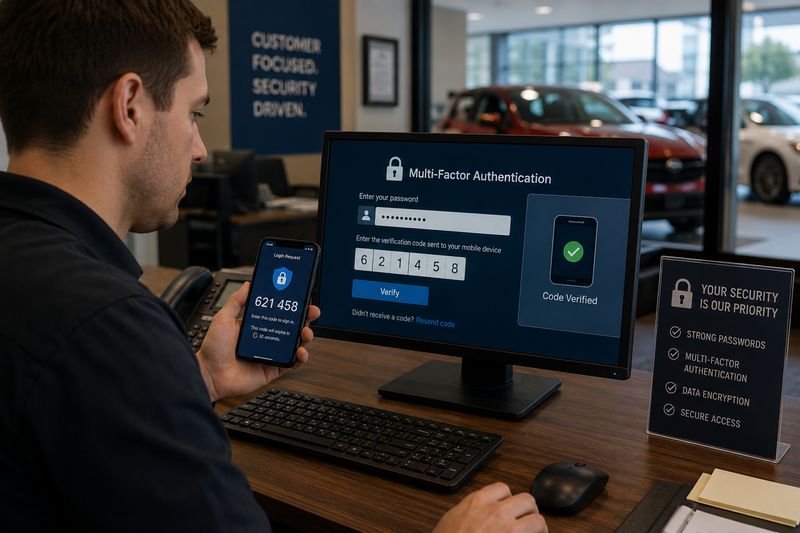
For example, a finance manager may enter a password and then receive a verification code on their phone before accessing customer credit applications.
Without MFA, a stolen password may give criminals immediate access to sensitive information. With MFA enabled, an attacker often cannot log in even if the password has been compromised.
MFA should be used whenever possible for:
- email accounts;
- dealer management systems;
- cloud storage;
- remote access;
- financial software;
- customer databases;
- vendor portals.
For many dealerships, enabling MFA is one of the fastest and most effective ways to improve security.
Data Encryption Requirements
Encryption protects information by converting it into unreadable data that can only be accessed with the proper authorization.
If encrypted data is stolen, it is often much more difficult for criminals to use.
Encryption may be used for:
- stored customer records;
- laptops and mobile devices;
- backup systems;
- cloud storage;
- emails containing sensitive information;
- data transferred between systems.
For example, if a dealership laptop containing customer records is stolen from an employee's vehicle, encryption may prevent unauthorized access to the information stored on the device.
Encryption is particularly important for:
- Social Security numbers;
- bank account information;
- credit applications;
- payment records;
- driver's license images.
Dealerships should work with their software providers and IT professionals to determine where encryption should be applied.
Secure Data Storage Practices
Customer information should be stored securely regardless of whether it exists in paper or electronic form.
Secure storage practices may include:
- password-protected systems;
- restricted access folders;
- encrypted storage devices;
- locked filing cabinets;
- secure cloud platforms;
- backup systems;
- access logs.
For example, scanned credit applications should not be saved on a shared desktop computer where every employee has access. Instead, they should be stored in protected systems that limit access to authorized personnel.
Dealerships should also review where information is stored. Customer records may exist in:
- dealer management software;
- CRM systems;
- email accounts;
- cloud drives;
- accounting systems;
- office computers;
- mobile devices.
Understanding where data is located is essential for protecting it.
Network Security Controls
The dealership network serves as the foundation for many business operations. Weak network security can expose multiple systems at the same time.
Network security controls may include:
- secure Wi-Fi networks;
- separate guest networks;
- access restrictions;
- network monitoring;
- secure routers;
- virtual private networks;
- administrative controls.
For example, customers using dealership Wi-Fi should not have access to internal business systems. A separate guest network can help reduce this risk.
Remote employees and outside vendors should also use secure connections when accessing dealership systems.
Strong network controls help prevent unauthorized access and reduce opportunities for attackers to move between systems.
Endpoint Protection and Antivirus Solutions
Endpoints are devices that connect to the dealership network. These include:
- desktop computers;
- laptops;
- tablets;
- smartphones;
- point-of-sale systems;
- office workstations.
Each endpoint can become an entry point for malware or cyberattacks.
Endpoint protection software helps detect and stop:
- viruses;
- ransomware;
- spyware;
- malicious downloads;
- suspicious activity.
For example, an employee may accidentally open a harmful email attachment. Antivirus and endpoint protection software may identify the threat before it spreads through the dealership network.
Modern endpoint protection often provides additional monitoring and alerts that help identify security problems quickly.
Small dealerships may not need advanced enterprise systems, but they should maintain updated protection on every device that stores or accesses customer information.
Firewalls and Intrusion Detection Systems
Firewalls help control traffic entering and leaving the dealership network. They act as a barrier between internal systems and outside threats.
A firewall may help:
- block unauthorized access;
- monitor network traffic;
- restrict suspicious activity;
- prevent certain attacks.
Intrusion detection systems monitor networks for unusual behavior and may alert administrators to possible attacks.
For example, if an unknown user attempts repeated login attempts against a dealership server, the system may generate an alert.
While large dealership groups may use advanced security monitoring tools, smaller dealers can still benefit from properly configured firewalls and managed security services.
These controls help reduce the risk of unauthorized access and improve overall network security.
Patch Management and Software Updates
Outdated software is one of the most common security weaknesses.
Cybercriminals often target known software vulnerabilities that have already been fixed by vendors. If dealerships delay updates, they may remain exposed to attacks.
Software that should be updated regularly includes:
- operating systems;
- dealer management software;
- accounting software;
- antivirus programs;
- web browsers;
- mobile applications;
- network equipment.
For example, an older office computer running unsupported software may create a security risk for the entire dealership.
Patch management means:
- identifying available updates;
- installing security patches;
- removing unsupported software;
- testing critical updates.
Regular updates help close known vulnerabilities before attackers can exploit them.
Secure Disposal of Customer Information
Customer information should not remain accessible after it is no longer needed. Improper disposal creates unnecessary risk.
Secure disposal methods may include:
- shredding paper documents;
- permanently deleting electronic files;
- wiping hard drives;
- destroying storage devices;
- securely erasing mobile devices;
- following retention policies.
For example, throwing old credit applications into a trash bin may expose customer information. Similarly, selling old computers without removing stored files may create serious security risks.
The dealership should establish clear retention and disposal procedures that explain:
- how long records are kept;
- who approves disposal;
- how records are destroyed;
- how destruction is documented.
Secure disposal is often overlooked, but it remains an important part of protecting customer information.
Access Controls and User Management
One of the simplest ways to protect customer information is to control who can access it. Many dealership data breaches happen not because of sophisticated hackers, but because too many employees have access to sensitive information.
The FTC Safeguards Rule expects dealerships to limit access to customer data and establish clear rules for managing user accounts. Every employee should only have access to the information necessary to perform their job.
Good access controls help reduce both internal mistakes and external threats.
Limiting Employee Access to Sensitive Data
Not every employee needs access to every customer record. Sales staff, finance managers, accounting personnel, service advisors, and managers often require different levels of access.
Sensitive information should only be available to employees who need it to perform their duties.
Examples include:
- Social Security numbers;
- credit reports;
- financing applications;
- bank account information;
- income verification documents;
- payment records;
- loan agreements.
For example, a salesperson may need access to customer contact information but may not need access to bank statements or credit reports. Likewise, a service advisor usually does not need access to financing documents.
Many smaller dealerships give all employees access to the same systems because it is easier to manage. However, broad access increases risk. If one account is compromised, more customer information may become exposed.
Limiting access reduces the potential damage from mistakes, stolen credentials, or unauthorized activity.
Role-Based Permissions
Role-based access means employees receive system permissions based on their job responsibilities.
Common dealership roles may include:
- sales staff;
- finance managers;
- accounting personnel;
- service employees;
- office managers;
- general managers;
- IT administrators.
Each role should have access only to the information required for that position.
For example:
- sales employees may access CRM records and customer contact information;
- finance personnel may access credit applications and loan documents;
- accounting staff may access payment information;
- management may review reports and security information.
This approach helps reduce unnecessary exposure to sensitive data.
Role-based permissions also make user management easier. When an employee changes positions, access rights can be updated without rebuilding the entire account structure.
For dealerships using dealer management systems, CRM software, or cloud applications, role-based permissions are often available through built-in settings.
Password Policies and Authentication Controls
Weak passwords remain one of the most common security problems in small businesses.
Examples of poor password practices include:
- shared passwords;
- simple passwords;
- passwords written on paper;
- passwords that never change;
- using the same password for multiple systems.
Dealerships should establish password policies that encourage stronger security.
Good password practices may include:
- unique passwords for each user;
- long and complex passwords;
- regular password updates when necessary;
- password managers;
- multi-factor authentication;
- account lockout settings.
For example, a shared login such as "Sales123" creates accountability problems because management cannot determine who accessed customer information.
Multi-factor authentication adds another layer of protection. Even if a password is stolen, an attacker may still be unable to access the account.
Authentication controls are particularly important for:
- email accounts;
- finance systems;
- dealer management software;
- cloud applications;
- remote access systems.
Monitoring User Activity
Monitoring user activity helps dealerships understand how customer information is accessed and used.
Activity monitoring may include:
- login records;
- access logs;
- failed login attempts;
- password changes;
- file downloads;
- administrative actions;
- unusual account behavior.
For example, if an employee account suddenly downloads hundreds of customer files after business hours, this activity may indicate a security problem.
Many modern software systems automatically record user actions. These records can help:
- identify unauthorized access;
- investigate incidents;
- support compliance efforts;
- improve accountability.
Monitoring does not mean constantly watching employees. Instead, it provides visibility into how systems are being used and helps identify unusual behavior.
For dealerships with limited IT resources, even basic logging and reporting can provide valuable information.
Managing Former Employee Access
One of the most common dealership security mistakes is leaving former employee accounts active after someone leaves the company.
Former employees may still have access to:
- email accounts;
- CRM systems;
- dealer management software;
- cloud storage;
- financing systems;
- remote access tools.
For example, a salesperson who left six months ago may still have access to customer records through an old login account. If those credentials are later stolen or misused, customer information could be exposed.
The dealership should establish procedures to:
- disable accounts immediately after termination;
- collect company devices;
- reset shared passwords;
- remove remote access privileges;
- revoke vendor access;
- document account removal.
Access reviews should also be conducted regularly to identify inactive accounts.
Removing unnecessary accounts is one of the simplest ways to reduce security risk.
Remote Access Security Requirements
Many dealerships now allow remote access for managers, accounting personnel, IT providers, or outside vendors. While remote access can improve productivity, it also creates additional security risks.
Remote access systems should include:
- multi-factor authentication;
- encrypted connections;
- secure passwords;
- limited user permissions;
- activity monitoring;
- access restrictions.
For example, an outside IT company may need temporary access to dealership systems for maintenance. That access should be limited, monitored, and removed when no longer needed.
Employees working from home should also follow security policies. Personal computers, unsecured Wi-Fi networks, and shared devices can create additional risks.
Dealerships should establish clear rules regarding:
- who may access systems remotely;
- which devices are allowed;
- how remote connections are secured;
- how activity is monitored.
The FTC Safeguards Rule does not prohibit remote access, but it expects dealerships to protect customer information regardless of where employees work.
Employee Training and Security Awareness
Employee training is one of the most important parts of FTC Safeguards Rule compliance. Even strong software and security tools can fail if employees do not understand how to protect customer information.
Auto dealerships are busy environments. Salespeople, finance managers, office staff, and managers handle customer data every day. A simple mistake, such as clicking a phishing link or emailing a credit application to the wrong person, can create serious risk. Training helps employees recognize these situations before they become expensive problems.
FTC Training Expectations
The FTC expects covered businesses to train employees on information security practices. Training should be connected to the dealership’s real risks, not just a generic online course that employees forget after completing it.
Employees should understand:
- what customer information must be protected;
- how to handle sensitive documents;
- how to recognize phishing emails;
- how to use passwords and MFA;
- how to report suspicious activity;
- who to contact when something goes wrong.
For example, a finance employee who works with credit applications needs more detailed training than a lot attendant who does not handle financing records. However, both employees should understand basic security rules, such as not sharing passwords and reporting suspicious emails.
Training should be practical, clear, and repeated over time.
Cybersecurity Awareness Programs
A cybersecurity awareness program teaches employees how to recognize everyday security risks. It should be simple enough for the whole team to understand and specific enough to match dealership operations.
A strong program may cover:
- password safety;
- email security;
- safe document handling;
- secure use of customer data;
- social engineering warning signs;
- safe internet use;
- device security;
- remote work rules;
- incident reporting.
For a small dealership, this program does not need to be expensive. It can include short training sessions, printed reminders, team meetings, and simple checklists.
For example, a dealership may hold a short monthly meeting to review one security topic, such as phishing emails or safe disposal of customer documents. Over time, these small sessions can build better habits across the team.
The goal is to make security part of daily work, not a one-time event.
Recognizing Phishing and Social Engineering Attacks
Phishing is one of the most common threats dealerships face. A phishing message may look like it comes from a lender, auction company, transport provider, software vendor, customer, or even dealership management.
Phishing emails may try to trick employees into:
- clicking a harmful link;
- opening a dangerous attachment;
- entering login credentials;
- sending customer documents;
- approving a fake payment;
- changing bank information.
Social engineering is similar, but it may happen by phone, text message, or in person. The attacker uses pressure, urgency, or trust to make an employee act quickly without checking.
Warning signs include:
- urgent payment requests;
- unexpected attachments;
- misspelled email addresses;
- unusual sender names;
- requests for passwords;
- links that do not match the sender;
- pressure to avoid normal approval steps.
For example, an employee may receive an email that appears to come from a lender asking for a customer’s Social Security number. Before sending anything, the employee should verify the request through a trusted contact method.
Employees should be trained to slow down, verify requests, and report anything suspicious.
Handling Customer Information Securely
Dealership employees should know how to handle customer information from the moment it is collected until it is securely stored or destroyed.
Secure handling practices include:
- collecting only necessary information;
- storing documents in approved locations;
- avoiding personal email for customer records;
- locking paper files when not in use;
- using approved systems for credit applications;
- avoiding shared passwords;
- not leaving customer documents on desks;
- shredding documents when no longer needed;
- sending sensitive information only through secure channels.
For example, a salesperson should not take a photo of a customer’s driver’s license on a personal phone unless the dealership has a secure approved process for that. A finance manager should not leave credit applications sitting on a printer overnight.
These small habits matter because many data exposures happen through ordinary daily mistakes.
Clear rules help employees understand what is allowed and what is not.
Ongoing Employee Education
Security training should not happen only when an employee is hired. Cyber threats change, dealership software changes, and employees may forget rules over time.
Ongoing education may include:
- annual training;
- new-hire training;
- short monthly security reminders;
- phishing simulations;
- updates after policy changes;
- refresher training after incidents;
- role-specific training for finance or management staff.
For example, if the dealership starts using a new online credit application system, employees should receive training on how to use it securely. If a phishing attempt targets the dealership, management can use it as a learning opportunity for the whole team.
Ongoing training helps create a culture where employees feel responsible for protecting customer information.
It also helps reduce careless habits, such as sharing passwords or storing files in the wrong place.
Documenting Training Activities
Training must be documented. If a dealership cannot show that training happened, it may be difficult to prove that employees were properly educated.
Training records may include:
- training dates;
- topics covered;
- employee attendance;
- course completion records;
- signed acknowledgments;
- training materials;
- quiz results;
- refresher training notes.
For example, after a short training session on phishing emails, the dealership should record who attended, what was covered, and when the session took place.
Documentation does not need to be complicated. A simple spreadsheet, signed form, or digital training report can be enough for many small dealerships.
Good records help show that the dealership takes security seriously and is working to meet FTC Safeguards Rule expectations.
Make Better Inventory Decisions with Auction Data
Strong dealership operations depend on both data security and smart inventory purchasing. BidNDrive provides access to vehicle history reports, sold auction prices, and market information that help dealers reduce financial risks before buying vehicles.
- ✅ Free auction history reports
- ✅ Sold vehicle price information
- ✅ Access to nationwide inventory
- ✅ No fees for unsuccessful bids
Managing Third-Party Vendors and Service Providers
Auto dealerships rarely handle customer information alone. Most dealers work with lenders, software providers, payment processors, CRM platforms, marketing tools, cloud storage systems, IT companies, transport partners, and other service providers.
The FTC Safeguards Rule expects dealerships to pay attention to vendor security because third parties may have access to sensitive customer information. If a vendor handles dealership data poorly, the dealership may still face business, legal, and reputation risks.
Why Vendor Security Matters
Vendor security matters because customer information often moves outside the dealership’s direct control. A dealer may protect its own computers, but still expose customer data through a weak vendor system.
Vendors may access or store:
- credit applications;
- customer contact details;
- driver’s license copies;
- financing documents;
- payment information;
- CRM records;
- deal jackets;
- email communications;
- cloud files.
For example, a small used car dealer may use an outside CRM platform to manage leads and customer records. If that CRM account is not properly secured, customer information could be exposed even if the dealership’s office computers are protected.
A vendor breach can create problems such as:
- customer data exposure;
- business interruption;
- regulatory questions;
- legal expenses;
- loss of customer trust;
- expensive system recovery.
Dealerships should treat vendor security as part of their own information security program.
Evaluating Vendor Cybersecurity Practices
Before working with a vendor that handles customer information, dealerships should evaluate how that vendor protects data.
This does not always require a complex audit. For many small dealerships, the first step is asking practical questions and reviewing available security documentation.
Important questions include:
- What customer information will the vendor access?
- Where will the data be stored?
- Is the data encrypted?
- Does the vendor use multi-factor authentication?
- Who can access dealership data?
- How does the vendor train its employees?
- Does the vendor have an incident response plan?
- How quickly will the vendor notify the dealership after a breach?
- Does the vendor use subcontractors?
- How is data deleted when the contract ends?
For example, if a dealership uses a cloud-based document storage provider, it should understand whether files are encrypted, who can access them, and how accounts are protected.
The level of review should match the risk. A vendor that only prints business cards is different from a vendor that stores credit applications or Social Security numbers.
Required Contractual Safeguards
Vendor contracts should include security requirements when the vendor handles customer information. Verbal promises are not enough.
A good vendor agreement may address:
- protection of customer information;
- limits on data use;
- confidentiality obligations;
- access controls;
- encryption requirements;
- breach notification duties;
- subcontractor controls;
- secure data return or deletion;
- compliance with applicable laws;
- audit or review rights.
For example, a dealership using a third-party finance platform should have a contract stating that the vendor must protect customer financial data and notify the dealership if a security incident occurs.
These contract terms help clarify expectations before a problem happens.
Small dealerships may not have in-house legal teams, so vendor contracts should be reviewed carefully before signing. If a vendor refuses to explain its security practices or include basic data protection terms, that may be a warning sign.
Monitoring Service Provider Compliance
Vendor management does not stop after signing a contract. Dealerships should monitor vendors over time, especially those with access to sensitive customer information.
Ongoing monitoring may include:
- reviewing vendor security updates;
- confirming MFA and access controls;
- checking breach notifications;
- reviewing contract renewals;
- confirming data retention practices;
- removing vendors that are no longer needed;
- reviewing user access inside vendor systems.
For example, a dealership may stop using a marketing platform but forget that the platform still contains old customer lists. If the account remains active and unsecured, customer data may still be at risk.
Dealerships should maintain a vendor list that includes:
- vendor name;
- service provided;
- type of customer data accessed;
- contract status;
- security review date;
- responsible dealership contact.
This makes it easier to track which third parties may affect customer information.
Cloud Storage and Software Provider Risks
Cloud tools can help dealerships work faster and reduce paper storage, but they also create security risks if not managed properly.
Common cloud and software risks include:
- weak passwords;
- no multi-factor authentication;
- shared employee accounts;
- excessive user permissions;
- public file-sharing links;
- poor vendor security;
- unclear data retention rules;
- former employees with access;
- unsupported software.
For example, a dealership may store scanned credit applications in a shared cloud folder. If the folder is accidentally set to public access, sensitive information could be exposed.
Cloud systems should be configured carefully. Dealerships should use strong passwords, MFA, role-based permissions, and regular access reviews.
Software providers should also be reviewed. Dealer management systems, CRM tools, payment platforms, and online credit application providers may store some of the dealership’s most sensitive data.
The safest approach is to know exactly where customer information is stored and who can access it.
Vendor Breach Response Expectations
Dealerships should know what happens if a vendor experiences a data breach. Waiting until after an incident can cause confusion and delays.
A vendor breach response plan should answer:
- How will the vendor notify the dealership?
- How quickly will notice be provided?
- What information will the vendor share?
- Who at the dealership will respond?
- Will customers need to be notified?
- Will legal or regulatory reporting be required?
- How will affected systems be secured?
- What steps will prevent a similar issue?
For example, if a financing software provider reports unauthorized access, the dealership must quickly determine what customer information was affected and what actions are required.
The dealership should not assume the vendor will handle everything. Even when the incident starts with a third party, the dealership may still need to communicate with customers, regulators, lenders, or legal advisors.
Developing an Incident Response Plan
No dealership can completely eliminate the risk of a cybersecurity incident. Even businesses with strong security controls may experience phishing attacks, malware infections, vendor breaches, or unauthorized access attempts.
The FTC Safeguards Rule requires covered businesses to develop an incident response plan. This plan helps dealerships respond quickly, reduce damage, protect customer information, and restore operations after a security event. For many dealerships, having a plan before an incident occurs can save both money and valuable time.
What Is an Incident Response Plan?
An incident response plan is a written document that explains what the dealership should do if a security incident occurs.
A security incident may include:
- ransomware attacks;
- phishing attacks;
- stolen laptops;
- unauthorized account access;
- malware infections;
- lost customer records;
- vendor breaches;
- stolen passwords;
- data leaks;
- system failures affecting customer information.
The purpose of the plan is to avoid confusion during an emergency. Employees should know who to contact, what actions to take, and how to protect customer information.
For example, if an employee discovers that a dealership computer has been infected with ransomware, the dealership should not spend hours deciding who is responsible. The response plan should already identify the proper contacts and procedures.
A good plan helps the dealership react quickly and reduce the impact of the incident.
Required Components of the Plan
The incident response plan should be tailored to the dealership's size, systems, and risks. A large dealer group may require a detailed document, while a small independent dealership may use a simpler plan.
Common components include:
- incident response team contacts;
- reporting procedures;
- investigation procedures;
- containment steps;
- communication plans;
- customer notification procedures;
- vendor coordination;
- legal contacts;
- recovery procedures;
- post-incident reviews.
The plan should clearly identify who is responsible for:
- making decisions;
- contacting vendors;
- communicating with management;
- working with IT providers;
- documenting the incident;
- notifying customers if necessary.
For example, the Qualified Individual may coordinate the response while the dealership owner handles customer communications and the IT provider manages technical recovery.
Clear responsibilities help avoid delays during stressful situations.
Detecting Security Incidents
Early detection can significantly reduce the damage caused by a security incident. The sooner a dealership identifies a problem, the faster it can respond.
Warning signs may include:
- unusual login activity;
- failed login attempts;
- missing files;
- locked computers;
- suspicious emails;
- unexpected password changes;
- slow network performance;
- disabled security software;
- unusual financial transactions;
- customer complaints about fraud.
Employees often play an important role in detecting incidents. A salesperson who receives a suspicious email or an office employee who notices unusual account activity may become the first line of defense.
For example, an employee may notice that customer files suddenly become inaccessible and display a ransom message. Immediate reporting may prevent the attack from spreading to other systems.
Dealerships should encourage employees to report suspicious activity without fear of punishment.
Containing and Investigating Breaches
Once an incident is discovered, the dealership should act quickly to limit further damage.
Containment actions may include:
- disconnecting affected computers;
- disabling compromised accounts;
- changing passwords;
- isolating infected systems;
- shutting down remote access;
- preserving evidence;
- contacting IT providers.
For example, if an employee account has been compromised, the dealership may temporarily disable the account while investigating the situation.
The investigation should attempt to answer important questions:
- What happened?
- When did it happen?
- What systems were affected?
- What customer information was involved?
- How did the incident occur?
- Is the threat still active?
Documentation is critical during this process. The dealership should maintain records of actions taken, findings, and decisions.
Even small incidents can provide valuable lessons that help improve security later.
Customer Notification Procedures
Some incidents may require customer notification, especially if sensitive information has been exposed.
Notification decisions may depend on:
- the type of information involved;
- state laws;
- legal requirements;
- regulatory guidance;
- the scope of the breach.
Information that may require notification includes:
- Social Security numbers;
- driver's license numbers;
- financial account information;
- credit application data;
- payment information.
Customer communications should be:
- accurate;
- timely;
- clear;
- honest;
- easy to understand.
For example, if a dealership discovers that customer financing records were exposed, affected customers may need to receive information about what happened and what protective steps they can take.
Poor communication can increase customer frustration and damage trust. Clear communication can help reduce confusion and maintain relationships.
Working With Legal and Regulatory Authorities
Some incidents may involve legal obligations or regulatory reporting requirements. The dealership may need to work with:
- legal counsel;
- cybersecurity experts;
- insurance providers;
- law enforcement;
- state regulators;
- federal agencies;
- lenders;
- software vendors.
For example, a large data breach involving financial information may require legal guidance to determine customer notification obligations.
Many states have their own data breach notification laws. These laws may establish deadlines and requirements for reporting certain incidents.
The dealership should know in advance:
- who provides legal support;
- who contacts regulators;
- who communicates with vendors;
- who manages public statements.
Having these relationships established before an incident occurs can save valuable time.
Testing and Updating the Plan
An incident response plan should not remain unchanged for years. Dealership operations, software systems, vendors, and cybersecurity threats continue to evolve.
The plan should be reviewed and updated when:
- new software is implemented;
- vendors change;
- employees leave;
- business operations expand;
- security incidents occur;
- new risks are identified.
Testing the plan can help identify weaknesses before a real emergency happens.
Examples of testing activities include:
- tabletop exercises;
- phishing simulations;
- incident discussions;
- recovery testing;
- backup restoration testing.
For example, management may conduct a meeting that walks through a hypothetical ransomware attack. Employees can discuss how they would respond, who would make decisions, and what information would be needed.
These exercises often reveal gaps that can be corrected before a real incident occurs.
For small dealerships, the incident response plan does not need to be complicated. A clear written document, updated regularly and understood by employees, can greatly improve the dealership's ability to respond to cybersecurity incidents.
Monitoring, Testing, and Maintaining Compliance
FTC Safeguards Rule compliance is not a one-time project. Security programs must be monitored, tested, and updated regularly as technology, business operations, and cyber threats change.
Many dealerships make the mistake of creating policies and then leaving them untouched for years. However, new software, employee turnover, vendor changes, and evolving cyber threats can quickly make old security controls ineffective. Ongoing monitoring and testing help dealerships identify problems before they become expensive incidents.
Continuous Security Monitoring
Continuous monitoring means regularly observing systems, user activity, and security controls to identify unusual behavior or potential threats.
Dealerships should monitor:
- user login activity;
- failed login attempts;
- access to customer records;
- administrator account activity;
- remote access sessions;
- software alerts;
- antivirus reports;
- network activity;
- vendor access.
For example, if an employee account suddenly accesses hundreds of customer files late at night, management should investigate the activity.
Many software systems automatically generate security logs and alerts. These tools can help dealerships identify:
- suspicious logins;
- unauthorized access attempts;
- account lockouts;
- malware activity;
- unusual file downloads.
Small dealerships may not have dedicated security staff, but even basic monitoring can provide valuable information and improve security awareness.
Vulnerability Assessments
A vulnerability assessment is a review of systems, software, and security controls to identify weaknesses that attackers could exploit.
The purpose is to answer questions such as:
- Are systems properly updated?
- Are passwords strong enough?
- Are unnecessary accounts still active?
- Are security settings configured correctly?
- Are customer files properly protected?
Common vulnerabilities may include:
- outdated software;
- unsupported operating systems;
- weak passwords;
- missing security patches;
- exposed remote access services;
- unencrypted data;
- poor access controls.
For example, a dealership may discover that an old office computer is still running unsupported software. This computer may create unnecessary risk for the entire network.
Regular vulnerability assessments help dealerships identify these issues before attackers find them.
The frequency of assessments should reflect the dealership's size, systems, and level of risk.
Penetration Testing Requirements
Penetration testing is a more advanced security evaluation that attempts to identify how an attacker could gain access to systems.
Unlike vulnerability assessments, which identify weaknesses, penetration tests actively simulate attacks against systems and security controls.
Penetration testing may evaluate:
- external network security;
- remote access systems;
- employee accounts;
- web applications;
- cloud services;
- internal network protections.
For example, a security consultant may attempt to gain access to dealership systems using techniques similar to those used by real attackers.
The FTC Safeguards Rule may require certain organizations to perform penetration testing depending on their systems and risk profile.
Smaller dealerships may use qualified third-party providers to conduct these tests rather than hiring internal specialists.
The results often reveal weaknesses that routine security reviews may not identify.
Annual Program Reviews
The information security program should be reviewed regularly to determine whether it remains effective.
An annual review may examine:
- risk assessments;
- security incidents;
- employee training;
- vendor performance;
- software changes;
- new business activities;
- regulatory changes;
- security controls.
For example, a dealership that recently added remote employees may need to update its access policies and monitoring procedures.
The annual review helps answer several important questions:
- Are existing controls working?
- Have new risks appeared?
- Have previous recommendations been completed?
- Do policies still reflect current operations?
- Are employees following procedures?
This process allows management to identify weaknesses and make improvements before problems occur.
Updating Security Controls
Security controls should change as the business changes. New software, new vendors, and new cyber threats may require updated safeguards.
Examples of situations that may require updates include:
- implementing new dealer management software;
- adding cloud storage services;
- expanding to another location;
- hiring additional employees;
- introducing remote work;
- experiencing a security incident;
- discovering new vulnerabilities.
For example, if a dealership adopts a new CRM platform, management should review user permissions, access controls, and vendor security practices.
Updating controls may involve:
- enabling MFA;
- changing password policies;
- improving encryption;
- restricting access;
- adding monitoring tools;
- updating incident response procedures.
Security programs should evolve alongside the dealership.
Reporting Results to Management
Management and ownership need regular information about the dealership's security program. The FTC Safeguards Rule expects security findings to be reported to those responsible for the business.
Reports may include:
- identified risks;
- security incidents;
- testing results;
- vulnerability findings;
- employee training status;
- vendor issues;
- recommended improvements;
- compliance progress.
For example, the Qualified Individual may prepare an annual report explaining:
- what risks were identified;
- what actions were completed;
- what improvements are still needed;
- what resources may be required.
These reports help management make informed decisions about security investments and priorities.
For small dealerships, reporting does not need to be complicated. A clear written summary may be enough if it provides accurate information and supports decision-making.
FTC Safeguards Rule and Data Breach Response
Even with strong safeguards, a dealership may still face a security incident. A phishing email, stolen laptop, vendor breach, ransomware attack, or exposed customer file can happen quickly and create serious risk.
The FTC Safeguards Rule expects dealerships to prepare for these situations before they happen. A clear data breach response process helps the business act quickly, reduce damage, protect customers, and meet legal obligations.
Steps to Take After a Security Incident
The first hours after a security incident are important. A dealership should avoid panic and follow its incident response plan.
Key steps may include:
- identify the affected system or account;
- disconnect compromised devices if needed;
- disable suspicious user accounts;
- preserve evidence;
- contact the Qualified Individual;
- notify IT or cybersecurity support;
- document what happened;
- determine what customer information may be involved;
- contact legal counsel if needed;
- begin recovery steps.
For example, if a finance manager clicks a phishing link and enters login credentials, the dealership should quickly change passwords, disable the affected account, review access logs, and check whether customer records were viewed or downloaded.
Speed matters, but decisions should still be careful and documented. Deleting files, wiping systems, or ignoring warning signs can make the investigation harder.
Internal Investigation Procedures
After the immediate threat is contained, the dealership should investigate what happened. The goal is to understand the scope of the incident and determine whether customer information was exposed.
An internal investigation should answer:
- What type of incident occurred?
- When did it start?
- How was it discovered?
- Which systems were affected?
- Which employees or vendors were involved?
- Was customer information accessed?
- Was customer information copied, deleted, or changed?
- Is the threat still active?
- What steps have already been taken?
For example, if a dealership email account was compromised, the investigation should review whether customer documents were stored in that inbox, whether emails were forwarded, and whether attackers attempted payment fraud.
The dealership should keep detailed records of the investigation. These records may be needed for management review, insurance claims, legal guidance, customer notifications, or regulatory inquiries.
Regulatory Reporting Obligations
Some data breaches may require reporting to regulators or other authorities. Requirements can vary depending on the type of information involved, the number of affected customers, and applicable federal or state laws.
A dealership may need to work with:
- legal counsel;
- cybersecurity experts;
- state regulators;
- law enforcement;
- insurance providers;
- lenders;
- software vendors;
- federal agencies when applicable.
The FTC Safeguards Rule also includes breach notification obligations for certain security events involving customer information. Dealerships should not assume that every incident is handled the same way.
For example, a minor malware alert that does not involve customer information may not require the same response as a breach involving Social Security numbers or credit applications.
Because reporting rules can be complex, dealerships should involve legal or compliance professionals when sensitive customer data may have been exposed.
State Data Breach Notification Laws
Every state has its own data breach notification laws. These laws may require businesses to notify affected residents when certain personal information is exposed.
Information that may trigger notification can include:
- Social Security numbers;
- driver’s license numbers;
- financial account numbers;
- payment card information;
- usernames and passwords;
- medical or insurance information in some cases.
Deadlines and requirements vary by state. Some laws require notification within a specific timeframe. Others may require notices to state agencies, attorneys general, or consumer reporting agencies.
For example, if a dealership sells vehicles to customers in several states, it may need to consider the laws of each state where affected customers live.
This is especially important for online dealers, auction brokers, and businesses serving out-of-state buyers.
A dealership should not wait until after a breach to learn these requirements. The incident response plan should identify who will review state notification obligations.
Customer Communication Best Practices
Customer communication should be handled carefully after a data breach. A rushed, unclear, or incomplete message can increase customer frustration and damage trust.
A good customer notice should explain:
- what happened;
- what information may have been involved;
- what the dealership is doing;
- what steps customers can take;
- who customers can contact with questions.
The language should be clear and easy to understand. Customers should not need legal or technical knowledge to understand the message.
For example, instead of saying “unauthorized access to nonpublic personal information occurred,” the dealership can explain that an unauthorized person may have accessed certain customer records.
Customer communication should be accurate. If the dealership does not yet know all details, it should avoid guessing.
In many cases, legal counsel should review notices before they are sent.
Lessons Learned and Program Improvements
After the incident is handled, the dealership should review what happened and improve its security program.
This review should ask:
- How did the incident occur?
- Did employees follow the response plan?
- Were systems monitored properly?
- Were backups available?
- Did vendors respond quickly?
- Were customer notifications handled correctly?
- What controls failed?
- What needs to change?
For example, if a breach happened because an employee reused a weak password, the dealership may update password policies, require multi-factor authentication, and provide additional employee training.
If the incident involved a vendor, the dealership may need to review vendor contracts, security practices, and breach notification procedures.
Program improvements may include:
- stronger MFA;
- better employee training;
- updated access controls;
- improved monitoring;
- revised incident response procedures;
- updated vendor requirements;
- stronger backup practices;
- new security tools.
A breach response should not end when systems are restored. The dealership should use the incident to reduce future risk.
Common Compliance Challenges for Auto Dealers
FTC Safeguards Rule compliance can be difficult for many dealerships, especially smaller businesses with limited staff, older systems, and tight budgets. The rule requires real security practices, not just a written policy saved in a folder.
Most compliance problems happen because security tasks are spread across busy employees who already handle sales, finance, accounting, inventory, and customer service. Understanding these challenges helps dealerships build a more realistic plan and avoid expensive mistakes.
Limited IT Resources
Many small and independent dealerships do not have a full-time IT department. The owner, office manager, or finance manager may be responsible for technology problems along with many other daily tasks.
This can make compliance harder because cybersecurity requires regular attention.
Common problems include:
- no dedicated security manager;
- slow software updates;
- weak password control;
- limited system monitoring;
- no formal incident response process;
- unclear responsibility for vendor access;
- little knowledge of cybersecurity tools.
For example, a small used car dealer may rely on one local computer repair company only when something breaks. That may help with basic repairs, but it may not be enough for risk assessments, MFA setup, access reviews, employee training, and vendor oversight.
A practical solution is to assign an internal responsible person and use outside support for technical tasks when needed. The dealership does not need a large IT team, but it does need clear ownership of security duties.
Managing Legacy Systems
Many dealerships use older software, older computers, or outdated business processes because replacing them can be expensive. These legacy systems may still work for daily operations, but they can create security risks.
Common legacy system issues include:
- unsupported operating systems;
- outdated dealer management software;
- old computers without security updates;
- weak user permission settings;
- limited encryption options;
- no MFA support;
- poor backup controls.
For example, a dealership may use an older office computer to store scanned deal jackets and credit applications. If that computer no longer receives security updates, it may be vulnerable to malware or unauthorized access.
Legacy systems are not always easy to replace immediately. For budget-conscious dealers, the best first step is to identify which systems store customer information and prioritize the highest-risk items.
If a system cannot be replaced right away, the dealership may need stronger controls around it, such as restricted access, secure backups, network separation, or better monitoring.
Employee Compliance Issues
Employees are often the weakest point in a security program, not because they are careless, but because dealership work moves quickly. Sales teams want to close deals. Finance managers want fast approvals. Office staff want paperwork completed without delays.
This pressure can lead to risky habits, such as:
- sharing passwords;
- emailing customer documents without protection;
- leaving deal jackets on desks;
- using personal phones for customer IDs;
- clicking suspicious links;
- saving files in the wrong folders;
- ignoring security updates;
- failing to report problems.
For example, a salesperson may send a photo of a customer's driver's license through personal text message to save time. It may seem harmless, but it creates a data security risk.
Employee compliance improves when rules are simple and practical. If security procedures are too complicated, employees may work around them.
Dealerships should train employees regularly and explain why the rules matter. Staff should understand that protecting customer information also protects the business.
Vendor Oversight Difficulties
Dealerships often work with many vendors, including lenders, CRM providers, dealer management software companies, marketing platforms, payment processors, IT providers, and cloud storage companies.
Managing vendor security can be difficult because customer information may be stored or processed outside the dealership.
Common vendor problems include:
- unclear contract terms;
- no security review before onboarding;
- vendors with broad system access;
- old vendor accounts still active;
- no breach notification process;
- unclear data deletion rules;
- unknown subcontractors.
For example, a dealership may stop using a marketing platform but forget that the platform still contains customer names, phone numbers, and email addresses. If that account is not closed or secured, data may remain exposed.
A simple vendor list can help. Dealerships should track which vendors access customer information, what type of data they handle, and when their security practices were last reviewed.
Documentation Gaps
Many dealerships may actually perform some security tasks but fail to document them. This creates a compliance problem because undocumented work is harder to prove.
Common documentation gaps include:
- no written risk assessment;
- no employee training records;
- no vendor review records;
- missing access review notes;
- outdated security policies;
- no incident response plan;
- no record of software updates or security testing.
For example, a dealership may train employees informally during meetings but keep no record of who attended or what was discussed. If the dealership later needs to show compliance, that training may be difficult to verify.
Documentation does not need to be complicated. A small dealership can start with a simple folder containing policies, training logs, vendor reviews, risk assessments, and incident response documents.
The key is consistency. Records should be accurate, current, and connected to real dealership operations.
Budget Constraints for Small Dealerships
Many small dealerships worry that compliance will be too expensive. This concern is understandable. Cybersecurity tools, consultants, software upgrades, and employee training can add costs.
However, not every improvement requires a large budget.
Lower-cost steps may include:
- enabling multi-factor authentication;
- removing former employee accounts;
- updating software;
- using strong passwords;
- limiting access to sensitive files;
- locking paper records;
- training employees on phishing;
- maintaining a vendor list;
- creating a simple incident response plan;
- securely shredding old documents.
For example, a small dealer may not be able to replace every computer immediately. But it can still enable MFA, stop password sharing, limit access to credit applications, and create a basic written security plan.
The best approach is to prioritize the highest risks first. Protect the most sensitive information, fix the easiest high-impact issues, and improve the program over time.
FTC Enforcement and Penalties for Non-Compliance
Non-compliance with the FTC Safeguards Rule can create serious problems for auto dealers. The risk is not only a government penalty. A dealership may also face legal costs, business disruption, customer complaints, lost sales, and long-term damage to its reputation.
For small dealerships, these risks can be especially difficult because there may be less cash available to recover from a breach, investigation, or system shutdown. Compliance helps protect both customer information and the dealership’s financial stability.
FTC Investigation Process
An FTC investigation may begin after a customer complaint, a reported data breach, a public security incident, or information showing that a business failed to protect customer data.
During an investigation, the FTC may review whether the dealership had reasonable safeguards in place. This may include looking at policies, risk assessments, employee training, vendor controls, access rules, and incident response procedures.
A dealership may be asked to show:
- its written information security program;
- risk assessment records;
- employee training documentation;
- vendor management records;
- incident response plan;
- security testing records;
- management reports;
- breach response documentation.
For example, if a dealership reports a breach involving customer financing records, regulators may want to know whether the business had MFA, limited access, employee training, and proper vendor oversight.
The investigation process can take time and require legal, technical, and management resources. Even before any penalty is issued, the process itself can be expensive and stressful for a dealership.
Potential Financial Penalties
Financial penalties can vary depending on the facts of the case, the type of violation, the number of affected customers, the dealership’s conduct, and whether the business ignored known risks.
Potential costs may include:
- civil penalties;
- legal fees;
- cybersecurity investigation costs;
- customer notification expenses;
- credit monitoring services;
- settlement costs;
- increased insurance premiums;
- technology upgrades;
- business recovery costs.
For example, a small Buy Here Pay Here dealer that stores Social Security numbers and bank information without access controls may face serious costs if that data is exposed.
The financial impact is often larger than the penalty itself. A dealership may need to hire cybersecurity experts, notify customers, restore systems, update software, train employees, and respond to regulator questions.
For budget-conscious dealers, prevention is usually far less expensive than recovery.
Civil and Regulatory Consequences
Non-compliance can lead to civil and regulatory consequences beyond direct fines. The FTC may require a business to change its practices, improve its security program, submit reports, or follow specific compliance obligations.
A dealership may also face claims from affected customers, business partners, lenders, or vendors depending on what happened.
Possible consequences include:
- formal enforcement actions;
- consent orders;
- required security improvements;
- ongoing reporting obligations;
- legal claims from affected parties;
- lender or vendor contract issues;
- insurance disputes.
For example, if customer credit applications are exposed because the dealership failed to control employee access, lenders may question whether the dealership is a reliable business partner.
Regulatory consequences can also limit management time. Owners and managers may need to spend weeks or months responding to questions, gathering documents, and making required changes.
Business Disruption Risks
A cybersecurity incident or investigation can interrupt normal dealership operations. This can be especially damaging because dealerships depend on fast sales, financing approvals, payments, and customer communication.
Business disruption may include:
- locked computer systems;
- unavailable customer records;
- delayed financing approvals;
- interrupted payment processing;
- lost access to email;
- stalled vehicle sales;
- delayed title work;
- service interruptions;
- employee downtime.
For example, a ransomware attack may prevent a dealership from accessing deal jackets, lender portals, customer files, and accounting systems. Even a few days of downtime can result in lost sales and frustrated customers.
Small dealerships may have fewer backup systems and fewer employees available to handle emergencies. This makes planning even more important.
A strong security program helps reduce the chance that a single incident will stop the entire business.
Reputation Damage and Customer Loss
Reputation is one of the most valuable assets a dealership has. Customers share their experiences online, through reviews, and with friends or family. A data breach can damage trust quickly.
Customers may lose confidence if they believe the dealership failed to protect:
- Social Security numbers;
- bank information;
- credit applications;
- driver’s license copies;
- payment records;
- personal contact information.
For example, a customer who submitted a loan application may become angry if their personal information is later exposed. Even if the dealership fixes the issue, the customer may never return and may warn others.
Reputation damage can affect:
- online reviews;
- referral business;
- lender relationships;
- repeat customers;
- local trust;
- sales performance.
For small and independent dealers, reputation can be just as important as inventory. Losing customer trust can hurt the business long after the technical issue is resolved.
Real-World Enforcement Examples
FTC enforcement actions in data security cases often show a common pattern: businesses collect sensitive consumer information but fail to maintain reasonable protections.
While each case is different, regulators often look for problems such as:
- no written security program;
- weak access controls;
- poor password practices;
- lack of employee training;
- failure to assess risks;
- weak vendor oversight;
- inadequate response to known problems;
- failure to protect sensitive customer information.
For auto dealers, these examples matter because the same types of weaknesses can appear in dealership operations.
For example, a dealership may believe it is too small to attract attention. But if a breach exposes customer financing documents, the size of the business may not prevent complaints, lawsuits, regulatory questions, or reputational harm.
State Privacy Laws and Additional Compliance Requirements
The FTC Safeguards Rule is a federal requirement, but it is not the only privacy or data security rule that may affect auto dealers. Many dealerships also need to consider state privacy laws, state data breach notification laws, lender requirements, vendor contracts, and industry security expectations.
For small and mid-sized dealers, this can feel confusing. The key is to understand that federal compliance is only one layer. If a dealership collects customer information from buyers in different states, additional rules may apply.
How State Regulations Interact With FTC Rules
Federal and state rules can apply at the same time. The FTC Safeguards Rule focuses on protecting customer information held by covered financial institutions, including many auto dealerships that arrange financing or handle credit applications.
State laws may add extra requirements for privacy notices, customer rights, breach notifications, data retention, or information security.
For example, a dealership may follow the FTC Safeguards Rule by using MFA, training employees, and protecting customer credit applications. But if customer information is exposed in a breach, the dealership may still need to follow state notification laws.
This means dealers should not view compliance as one checklist only. A dealership may need to consider:
- federal FTC requirements;
- state privacy laws;
- state breach notification rules;
- lender data security requirements;
- vendor contract obligations;
- insurance requirements.
A practical compliance program should identify which states the dealership serves and what customer information is collected from those buyers.
California Consumer Privacy Requirements
California has some of the strongest consumer privacy rules in the United States. Dealerships that collect information from California residents may need to pay special attention to privacy notices, data handling practices, and consumer rights.
California privacy requirements may involve:
- explaining what personal information is collected;
- explaining why information is collected;
- identifying who information may be shared with;
- responding to certain consumer privacy requests;
- protecting sensitive personal information;
- reviewing vendor data practices.
For example, a dealership that sells vehicles online and works with customers in California may collect names, addresses, driver's license details, financing documents, and payment information. Depending on the size and activity of the business, California privacy obligations may become relevant.
Not every small dealership will fall under every California privacy requirement, but dealers should not ignore the issue if they serve California customers.
The safest approach is to review where buyers are located, what information is collected, and whether privacy notices and internal procedures need updates.
State Data Breach Notification Obligations
Every state has its own data breach notification laws. These laws may require businesses to notify affected customers when certain personal information is exposed.
Information that may trigger notification often includes:
- Social Security numbers;
- driver’s license numbers;
- state ID numbers;
- financial account information;
- payment card information;
- usernames and passwords;
- medical or insurance information in some cases.
For example, if a dealership email account is compromised and that inbox contains credit applications from customers in several states, the dealership may need to review the breach notification laws in each affected state.
Notification rules may differ by state. Some states may require notice to customers within a specific timeframe. Others may require notification to a state attorney general or consumer protection agency.
This is why dealerships should involve legal or compliance professionals when a breach involves sensitive customer information.
Multi-State Dealership Compliance Challenges
Dealerships that serve buyers across state lines face more complicated compliance risks. This is especially common for online dealers, auction brokers, vehicle exporters, finance companies, and dealerships that advertise nationally.
Multi-state challenges may include:
- different breach notification deadlines;
- different definitions of personal information;
- different privacy notice expectations;
- different consumer rights rules;
- different regulator reporting requirements;
- customer records stored across multiple systems.
For example, a vehicle broker may help buyers from Georgia, Florida, Texas, and California purchase vehicles through online auctions. If the broker stores credit applications or identification documents, it must understand that customers may be protected by different state rules.
A dealership does not need to memorize every law in every state. But it should know when to ask for legal guidance and should maintain records showing where customers are located.
Good customer data organization makes compliance easier. If a breach happens, the dealership can quickly identify affected customers and determine which state rules may apply.
Preparing for Future Regulatory Changes
Privacy and cybersecurity rules continue to change. More states are adopting privacy laws, regulators are paying closer attention to data security, and customers are becoming more aware of how businesses handle their information.
Dealerships should expect privacy compliance to become more important over time.
To prepare, dealers can:
- keep privacy policies updated;
- review customer data collection practices;
- limit unnecessary data retention;
- train employees regularly;
- review vendor contracts;
- track where customer data is stored;
- monitor changes in state laws;
- update incident response procedures;
- work with legal or compliance advisors when needed.
For example, a small dealership may start by cleaning up old customer files, removing unnecessary access, and updating its privacy notice. These steps can reduce risk now and make future compliance easier.
The goal is not to predict every future regulation. The goal is to build a flexible compliance program that can adapt as rules change.
FTC Safeguards Rule Compliance Checklist for Auto Dealers
A compliance checklist helps dealerships organize the main requirements of the FTC Safeguards Rule into practical steps. This is especially useful for small and independent dealers that do not have a full compliance department.
The checklist should not be treated as a one-time task. It should be reviewed regularly, updated when the business changes, and used to confirm that customer information is being protected in daily operations.
Security Program Documentation
The dealership should maintain a written information security program that explains how customer information is protected. This document is often called a Written Information Security Program, or WISP.
The documentation should describe:
- what customer information is collected;
- where that information is stored;
- who can access it;
- what safeguards are used;
- how employees are trained;
- how vendors are reviewed;
- how incidents are handled;
- how the program is updated.
For example, if a dealership stores credit applications in a dealer management system and paper files in the office, both storage methods should be addressed in the security program.
A generic template is not enough if it does not match real dealership operations. The document should reflect how the business actually works.
Risk Assessment Completion
A risk assessment helps the dealership identify where customer information may be exposed. It should review both digital and paper records.
The assessment should examine:
- customer files;
- credit applications;
- employee access;
- office computers;
- email accounts;
- cloud storage;
- dealer management software;
- vendor systems;
- paper file storage;
- document disposal practices.
For example, a dealer may discover that scanned customer IDs are saved in an unsecured shared folder. That risk should be documented, prioritized, and corrected.
The risk assessment should not simply list problems. It should also explain what actions the dealership will take to reduce risk and who is responsible for completing them.
Qualified Individual Appointment
The dealership must appoint a Qualified Individual to oversee the information security program. This person may be an internal employee, an owner, a manager, or an outside provider.
The appointment should be documented clearly.
The Qualified Individual should help oversee:
- the written security program;
- risk assessments;
- employee training;
- vendor reviews;
- security testing;
- incident response planning;
- reporting to management.
For a small dealership, the owner may serve in this role while working with an outside IT consultant. For a larger dealer group, the role may be handled by a dedicated compliance or security professional.
The most important point is accountability. Someone must be responsible for making sure the program is active and updated.
Employee Training Verification
Employee training is a key part of compliance. Dealership staff should understand how to protect customer information and recognize common security risks.
Training should cover:
- phishing emails;
- password safety;
- multi-factor authentication;
- secure handling of customer documents;
- proper use of email;
- document disposal;
- incident reporting;
- role-specific security rules.
For example, finance staff should understand how to handle credit applications and Social Security numbers securely. Sales staff should know how to protect driver’s license copies and customer contact information.
Training should be documented with:
- dates;
- topics;
- attendance records;
- signed acknowledgments;
- completion reports.
If training is not documented, it may be difficult to prove that it happened.
Vendor Management Review
Dealerships should review vendors that handle customer information. This may include lenders, CRM providers, dealer management systems, payment processors, cloud storage services, marketing platforms, and IT providers.
A vendor review should consider:
- what customer data the vendor accesses;
- how the vendor protects that data;
- whether MFA is used;
- whether data is encrypted;
- breach notification procedures;
- subcontractor access;
- contract security terms;
- data deletion rules.
For example, if a dealership uses a cloud-based CRM, it should know what customer information is stored there and who can access it.
The dealership should maintain a vendor list and update it when vendors are added, removed, or changed.
Incident Response Readiness
The dealership should have a written incident response plan. This plan explains what to do if customer information may be exposed or systems are compromised.
The plan should include:
- response team contacts;
- reporting procedures;
- containment steps;
- investigation process;
- customer notification procedures;
- vendor contact information;
- legal and insurance contacts;
- recovery steps;
- post-incident review process.
For example, if an employee clicks a phishing link and enters login credentials, the dealership should know who to contact, how to disable the account, and how to check whether customer information was accessed.
An incident response plan is most useful when employees know it exists and understand their role.
Security Testing and Monitoring
Security controls should be tested and monitored regularly. This helps the dealership confirm that safeguards are working.
Testing and monitoring may include:
- vulnerability scans;
- access reviews;
- password policy checks;
- MFA verification;
- antivirus reports;
- firewall reviews;
- system update checks;
- backup testing;
- user activity monitoring.
For example, a dealership may review access logs and discover that a former employee account is still active. Removing that access reduces risk immediately.
Testing does not need to be overly complex for small dealerships, but it should be consistent and documented.
Annual Compliance Audit
An annual compliance audit helps the dealership review the full security program and identify areas that need improvement.
The audit should check:
- whether the written security program is current;
- whether the risk assessment was updated;
- whether employee training was completed;
- whether vendor reviews were performed;
- whether access controls are working;
- whether incident response procedures are current;
- whether security testing was completed;
- whether management received reports.
For example, if the dealership added a new financing platform during the year, the annual audit should confirm that the platform was reviewed and added to security documentation.
An annual audit does not have to be complicated. A small dealership can use a structured checklist and keep supporting records in one organized folder.
90-Day FTC Safeguards Rule Implementation Plan
Many dealerships feel overwhelmed when they first begin working on FTC Safeguards Rule compliance. The requirements may seem complicated, especially for smaller dealers that do not have dedicated compliance or IT departments.
The good news is that compliance can be implemented step by step. A structured 90-day plan allows dealerships to identify risks, improve security controls, train employees, and create documentation without disrupting daily operations.
Days 1–30: Assessment and Planning
The first month should focus on understanding the dealership's current situation. Before making changes, management needs to know what customer information exists, where it is stored, and what risks are present.
During the first 30 days, dealerships should:
- appoint a Qualified Individual;
- identify sensitive customer information;
- review current security practices;
- inventory software and systems;
- identify vendors with data access;
- review employee access rights;
- evaluate existing policies;
- begin a risk assessment.
Questions to ask include:
- What customer information do we collect?
- Where is the information stored?
- Who has access to it?
- What systems contain customer records?
- Are there obvious security weaknesses?
For example, a small used car dealership may discover that customer credit applications are stored on multiple office computers and that several former employee accounts remain active.
The first month should also focus on planning. Management should identify priorities, assign responsibilities, and determine what improvements are needed.
Days 31–60: Security Controls and Documentation
The second month focuses on implementing security improvements and creating required documentation.
Important tasks may include:
- creating the Written Information Security Program;
- enabling multi-factor authentication;
- updating password policies;
- restricting employee access;
- reviewing vendor security practices;
- improving document storage procedures;
- updating antivirus software;
- securing wireless networks;
- creating an incident response plan.
Documentation should include:
- risk assessment findings;
- employee responsibilities;
- vendor information;
- access control policies;
- data protection procedures;
- incident response contacts.
For example, a dealership may introduce role-based access controls so that sales employees can view customer contact information while finance personnel handle credit applications and banking records.
This period often produces the biggest improvements because many security gaps can be addressed with relatively simple changes.
Days 61–90: Testing and Staff Training
The final month focuses on making sure the security program works in practice.
Employee training should cover:
- phishing awareness;
- password security;
- secure handling of customer information;
- incident reporting procedures;
- proper use of dealership systems;
- document protection.
Security testing may include:
- reviewing user accounts;
- testing MFA;
- checking software updates;
- reviewing backup procedures;
- evaluating access permissions;
- testing the incident response plan.
For example, management may conduct a simple tabletop exercise where employees discuss how they would respond to a ransomware attack or a compromised email account.
The dealership should also review whether:
- documentation is complete;
- employees understand their responsibilities;
- vendor information is current;
- security controls are functioning properly.
By the end of the 90-day period, the dealership should have a functioning compliance program rather than simply a collection of policies.
Long-Term Compliance Maintenance
Compliance does not end after 90 days. The dealership's security program should continue to evolve as technology, employees, vendors, and business operations change.
Long-term maintenance activities may include:
- annual risk assessments;
- employee refresher training;
- vendor reviews;
- software updates;
- access reviews;
- security testing;
- incident response updates;
- management reporting.
The dealership should also update its program when:
- new software is introduced;
- employees leave the company;
- vendors change;
- remote access is added;
- customer data practices change;
- security incidents occur.
For example, a dealership that adds online financing applications may need to review vendor security, update policies, and provide additional employee training.
Long-term compliance works best when security becomes part of everyday operations rather than a special project.
How Compliance Benefits Auto Dealerships
Many dealerships view compliance as an expense or a regulatory burden. However, the FTC Safeguards Rule can provide significant business benefits when implemented properly. Strong security practices help dealerships protect customer information, improve daily operations, reduce financial risks, and build long-term trust.
For both large dealer groups and small independent dealerships, compliance can become an investment in business stability and customer confidence.
Reducing Cybersecurity Risks
One of the biggest benefits of compliance is reducing the risk of cybersecurity incidents. Dealerships store valuable information that criminals often target, including Social Security numbers, driver’s licenses, credit applications, banking information, and payment records.
Security measures such as:
- multi-factor authentication;
- employee training;
- access controls;
- data encryption;
- software updates;
- network monitoring;
- vendor oversight;
help reduce opportunities for attackers.
For example, a dealership that enables MFA on employee accounts can prevent unauthorized access even if passwords are stolen. Regular software updates can eliminate vulnerabilities before they are exploited.
While no system can guarantee complete protection, a strong security program significantly lowers the chances of a successful attack.
Protecting Customer Data
Customers trust dealerships with highly sensitive personal information. During the financing process, buyers often provide documents that contain financial, employment, and identification data.
Compliance helps dealerships protect:
- credit applications;
- bank account information;
- Social Security numbers;
- driver's licenses;
- tax documents;
- payment records;
- employment verification information.
For example, a customer applying for financing may submit several documents electronically. Secure storage, limited access, and encrypted transmission help ensure that this information remains protected.
When dealerships handle customer data responsibly, they reduce the risk of identity theft, fraud, and unauthorized disclosure.
Protecting customer information is not only a legal responsibility but also an important part of customer service.
Building Consumer Trust
Trust plays a major role in vehicle sales. Customers often share personal information before making a final purchase decision. If they believe their information is not secure, they may decide to work with another dealership.
Strong data protection practices demonstrate professionalism and responsibility.
Dealerships can build trust by:
- explaining privacy practices;
- using secure customer portals;
- protecting financing information;
- training employees;
- responding quickly to security concerns;
- maintaining transparent communication.
For example, if a customer asks how their credit application is protected, a dealership with a documented security program can provide a clear and confident answer.
In competitive markets, trust can influence whether a customer chooses one dealership over another.
Avoiding Regulatory Penalties
Compliance reduces the likelihood of regulatory problems, investigations, and potential penalties. Maintaining a documented security program demonstrates that the dealership takes its responsibilities seriously.
Proper compliance helps dealers:
- maintain required documentation;
- conduct risk assessments;
- train employees;
- monitor security controls;
- prepare incident response plans;
- review vendor practices.
For example, if regulators request information following a security incident, a dealership with complete records can demonstrate that reasonable safeguards were already in place.
Avoiding penalties also means avoiding the additional costs associated with legal fees, consulting services, system recovery, and business disruption.
For smaller dealerships with limited budgets, prevention is often far less expensive than dealing with a security incident after it occurs.
Strengthening Business Operations
Many compliance improvements also make daily operations more efficient. Better organization, stronger documentation, and clearer responsibilities can improve overall business performance.
Examples include:
- standardized procedures;
- better employee accountability;
- improved record management;
- reduced duplicate data;
- clearer vendor relationships;
- faster incident response;
- improved management reporting.
For example, reviewing user access may reveal inactive employee accounts or outdated permissions. Correcting these issues improves both security and operational efficiency.
Similarly, maintaining organized documentation can make audits, lender reviews, and internal management decisions easier.
Compliance often encourages dealerships to modernize systems and eliminate inefficient practices.
Creating a Competitive Advantage
Dealerships that invest in security and compliance may gain advantages over competitors. Customers, lenders, vendors, and business partners increasingly expect organizations to protect sensitive information.
A strong security program can help a dealership:
- strengthen lender relationships;
- improve vendor confidence;
- attract privacy-conscious customers;
- support online sales operations;
- reduce business risks;
- demonstrate professionalism.
For example, an independent dealer that advertises secure financing processes and customer data protection may stand out in a crowded market.
As cybersecurity concerns continue to grow, customers may become more selective about where they share personal information.
Compliance is no longer simply a regulatory obligation. For many dealerships, it has become part of building a trustworthy, efficient, and competitive business.
When properly implemented, the FTC Safeguards Rule helps dealerships do more than satisfy legal requirements. It protects customer information, reduces risk, improves operations, and supports long-term business success.
Access Thousands of Auction Vehicles with BidNDrive
Whether you operate a franchised dealership, independent lot, or Buy Here Pay Here business, BidNDrive gives you access to major U.S. auto auctions. Find inventory, review vehicle information, and purchase vehicles through one trusted platform.
- ✅ Access to Copart and IAAI inventory
- ✅ 100% refundable bidding deposit
- ✅ Unlimited bidding opportunities
- ✅ Dealer support throughout the buying process
Further Reading:
Car Dealership Accounting: Complete Guide for Dealers and Auction Buyers
Dealer Management System Software: Complete Guide for Budget-Focused Dealers
Car Inventory Management
What Is a Dealer Bond? A Complete Guide to Auto Dealer Surety Bonds
Frequently Asked Questions
- Who does the FTC Safeguards Rule apply to?
- What is the Red Flags Rule for auto dealers?
- What should you never reveal to the dealer when negotiating?
- What is the FTC warning letter to dealerships?